[People News] The phrase ‘Shanghai people comfort others, Beijing people just muddle through’ recently topped the hot search list on Weibo, igniting extensive discussions among netizens. This phrase has not only quickly become an internet meme but has also led many mainland users to recognise a broader reality: an increasing number of Chinese people feel that life is overwhelmingly tiring. When the entire population is expressing fatigue, it often signals a significant turning point in both sociology and economics, indicating that the functioning of society is undergoing profound changes.
‘Tired’ has become the key word of the moment.
In China, over the past few decades, the keywords that define different eras have varied significantly. For example, during the 1980s and 1990s, we could characterise that period with the terms ‘breakthrough’ and ‘change’. This was due to the reform of the urban economic system and the establishment of special economic zones, which dismantled the iron rice bowl and planned economy. Society shifted towards a commodity economy and marketisation, prompting many Chinese individuals to leave state-owned enterprises and venture into the market.
In the years following the turn of the millennium (2000), China joined the World Trade Organisation (WTO) and became a true ‘world factory’. The market began to prioritise scale and efficiency, leading society into an era focused on execution and speed, as well as a time dedicated to the vigorous accumulation of wealth. Consequently, ‘strive’ and ‘wealth’ emerged as the defining terms of that era.
A decade ago, the concepts of ‘dream’ and ‘involution’ were prevalent. Following the transfer of supreme power at the end of 2012, the ‘Chinese Dream’ and the ‘Rise of a Great Power’ became the dominant themes of the era. By that time, the economic gains had already been reaped, and housing prices surged dramatically in 2015-2016, significantly raising the barriers for ordinary people to secure their livelihoods. In the aftermath of the COVID-19 pandemic, many foreign companies began to withdraw, leading to a sudden and sustained rise in unemployment. The Chinese economy began to cool, and both businesses and individuals entered a phase of ‘involution’, competing against each other for scarce resources.
After over a decade of involution, the lower strata of Chinese society are increasingly unable to see any signs of improvement in their lives. The primary objectives for many families and businesses have shifted from ‘expanding wealth creation’ to ‘preserving jobs and maintaining cash flow’. There is a widespread fear of unemployment, as earning a living has become increasingly difficult, forcing many to adopt a ‘lie flat’ mentality and live in extreme poverty. This ongoing tension, devoid of positive reinforcement, is the main source of the widespread ‘mental exhaustion’ felt by the populace.
Shanghai Residents vs. Beijing Residents
When someone feels drained and uncertain about the future, their friends and family often step in to offer comfort. Interestingly, people from different regions have distinct styles of providing consolation.
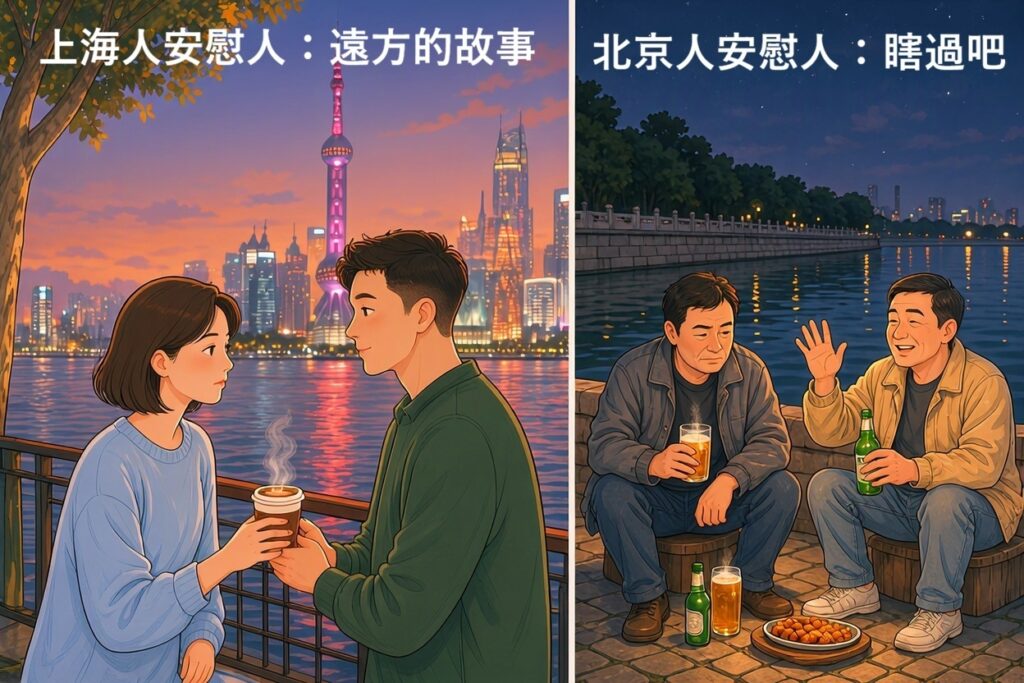
On November 20, the Weibo influencer ‘Weide Bu Da Qiu’ shared a post featuring a comparison image and text titled ‘Shanghai People Comforting vs. Beijing People Comforting’, which quickly went viral. Many netizens felt that this humorous take effectively illustrated the differing comforting styles of various cities.
If you mention to a Shanghainese that you’re feeling tired, they might kindly suggest that you need a little Moment for yourself. They may then share their experiences of daydreaming by the beach in New Zealand, feeding pigeons in London, and diving in Australia, using these distant travels and life experiences to help lift your spirits. This comforting approach is infused with a romantic touch and emphasizes the value of emotions. Here, the term Moment signifies more than just an English word; it embodies a lifestyle that prioritises life experiences and emotional significance, aiming to create beautiful moments amidst the everyday grind.
Shanghai-style comfort resembles a mental massage, reminding individuals that even in a hectic life, it’s important to carve out some time for oneself to find solace in distant places and daily experiences.
On the other hand, if you express your struggles to a Beijinger, you’re likely to hear a blunt response: “Ah, it’s all the same, just muddle through!” There are no elaborate phrases or refined life advice; instead, it’s a straightforward, relatable acknowledgement of life’s challenges. The Beijinger’s approach lacks coffee, lacks sophisticated life strategies, and doesn’t aim to help you rediscover life’s meaning; it simply tosses out three casual words: “Muddle through!”
Many netizens interpret this phrase as conveying the message: Who isn’t exhausted by life? Things rarely go smoothly. Since life is already tough, don’t burden yourself further. Beijing-style comfort doesn’t necessarily offer solutions or delve deeply into your worries; rather, it lightly brushes aside heavy emotions with a seemingly offhand comment.
Many internet users have indicated that they relate more to the Beijing-style comfort, which does not sugarcoat reality but instead offers direct empathy. Others, however, prefer the healing aspect of the Shanghai style, believing that the tougher life becomes, the more one needs to create beautiful moments for themselves.
Nonetheless, the prominent blogger “Lu Wan Bojue” argues that the Shanghai-style comfort depicted in these jokes does not accurately reflect the true style of Shanghai residents. A genuine Shanghainese might say: “Xia hun hun, da jia chai le ha hun hun,” a phrase rich in local dialect that actually resonates with the Beijing expression “Xia guo ba,” creating a north-south connection.
Why do people in mainland China constantly express their fatigue?
If the contrasting comfort styles of Shanghai and Beijing are merely the surface of this viral internet trend, the underlying factor driving its rapid spread is a widespread sense of exhaustion in everyday life.
For many ordinary individuals in mainland China, life is no longer simply about the notion that “hard work leads to rewards.” Work is becoming increasingly hectic, yet many are discovering that their incomes are declining, while they grapple with various real-life challenges such as mortgages, family responsibilities, children’s education, and interpersonal relationships. Even in the absence of particularly significant hardships, many experience an indescribable sense of fatigue.
This fatigue is sometimes not just physical tiredness that can be alleviated by a good night’s sleep, but rather a chronic state of stress that prevents the mind from truly relaxing.
For the past few decades, the core motivation that has kept people enduring and pushing through is an unspoken social contract: “If you are willing to endure hardship, work overtime, and follow the rules now, you will surely be able to exchange that for a better life in the future.”
However, people have now realised that this contract has been unilaterally breached. Regardless of how much they overextend themselves, the outcome is no longer social mobility or a sense of security; instead, they are merely struggling to maintain the status quo, and may even be sliding further down.
Consequently, lifestyles have changed dramatically, shifting from the previous focus on ‘relying on parents, working hard, and competing for property’ to the current trends of ‘lying flat’ and ‘competing for beds, meals, and memberships.’ This evolution of ‘competition’ represents a ‘battle for survival amid consumption downgrade.’
In other words, if hard work leads to some rewards, making the effort worthwhile, then those who are exhausted can still derive happiness from their efforts, and their fatigue can be alleviated. However, if one remains exhausted for an extended period without any rewards, with no improvement in life, and the situation potentially worsening, then when those who feel tired see no way to escape this state tomorrow, next month, next year, or even in the coming years, what arises in their hearts is not hope, but despair.
Especially as people’s expectations regarding income, job stability, and future life become more cautious, the pressures of life transform from specific issues into a culmination of multiple uncertainties. At this point, individuals carry the weight of mountains in their hearts.
Ordinary people expend all their vitality just to cope with various invisible resistances and anxieties in life, leaving them with no energy to create, to find joy, or to love.
This explains why a seemingly simple regional joke can resonate so widely. Many people experience a sense of exhaustion from feeling like there is no future ahead. When someone says ‘I’m tired,’ they may not be looking for solutions; sometimes, they just want someone to understand their situation.
The phrase ‘let it be’ does not offer profound insights or aim to evoke strong emotions; it simply humorously conveys the fatigue that many people feel.
What kind of comfort do you prefer?
As the discussion continues to grow, internet users have started creating various local versions, gradually forming an amusing ‘regional comfort map.’
The Tianjin version states: ‘Well, whether there’s money or not, just enjoy yourself.’ The Yunnan-Guizhou-Sichuan version goes: ‘Who cares about the troubles, let’s go eat hot pot.’ The Northeast version is even more straightforward: ‘Let it be, what else can we do?’
While these versions each reflect regional characteristics, the emotions they express are quite similar: life is tough, and no one has it easier than anyone else. Instead of making life difficult for ourselves, it’s better to find ways to feel a bit better.
From Shanghai’s Moment to Beijing’s ‘let it be,’ and then to various local versions from Tianjin, Northeast China, and Yunnan-Guizhou-Sichuan, netizens appear to be poking fun at regional culture, but in reality, they are using these jokes to relieve their life pressures.
The reason for its popularity is that this topic provides an emotional outlet that people from different regions can engage with.
‘Tired and hopeless’ has become the new normal.
As more individuals express their feelings of being ‘tired’, the real issue that deserves attention in this internet meme may not be whether people from Shanghai or Beijing are better at offering comfort, but rather the underlying reason why so many feel the need for consolation.
The despair that arises from this ‘worthless exhaustion’ is indeed a crucial indicator of a society’s psychological breaking point. Under high pressure, a person can endure as long as they see a glimmer of hope, much like a bow that is fully drawn; however, when the string remains tense for an extended period, only to discover that the arrows they shoot never reach the target—and that the target has even been removed—this kind of ‘despair over time’ can completely dismantle a person’s psychological defences.
When the era of ‘exhaustion with purpose’ comes to an end and ‘exhaustion without hope’ becomes the norm, society transforms from a well-functioning machine into a dormant volcano, with magma continuously bubbling beneath the surface while the land above grows increasingly desolate—seemingly calm on the outside, yet every step is precariously close to collapse.
In the end, the collective expression of exhaustion does not signify that ordinary people have become weaker; rather, it reflects an era that has exhausted everyone’s energy, leading to a collective depletion of vitality. When a society cannot even afford ordinary individuals the space to ‘take a breath’, this pervasive sense of fatigue becomes the most authentic and silent protest against the current state of affairs.
(First published by People News) △