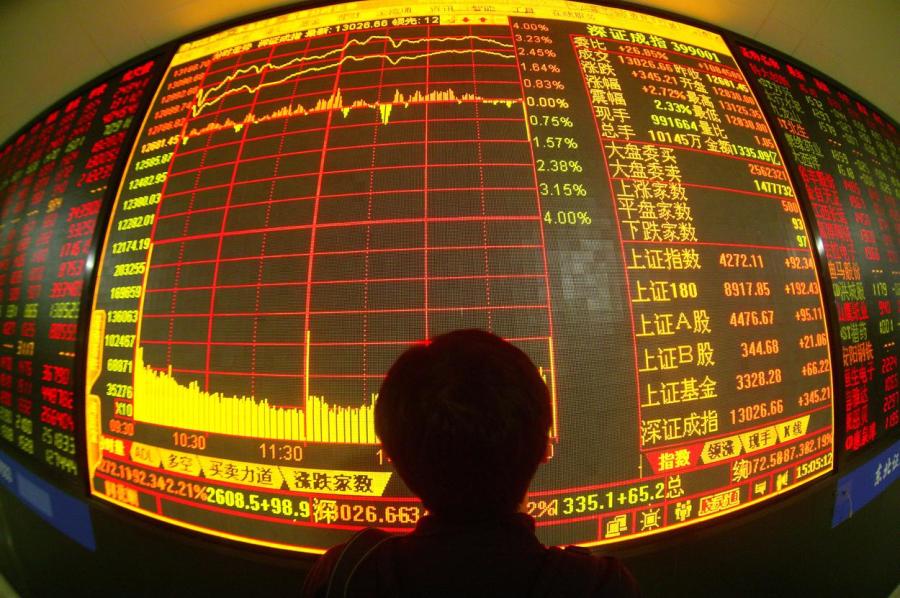

At the close, the Shanghai Composite Index had fallen 2.03% to 3,476.47 points; the Shenzhen Component Index dropped 3.24% to 10,086.36 points; and the ChiNext Index plunged 4.19% to 2,183.58 points. The CSI 300 Index fell 1.65% to 3,898.24 points, while the STAR 50 Index slumped 5.12% to 1,186.14 points.
Total trading volume on the Shanghai and Shenzhen stock exchanges reached approximately 1.38 trillion yuan (RMB), down about 272 billion yuan from the previous trading day. As the major indices suffered steep declines, trading volume also contracted significantly, indicating a decline in investors’ willingness to participate in the market.
In terms of individual stocks, the A-share market experienced a widespread sell-off. Closing figures showed that only 586 stocks rose, while 4,926 fell. A total of 58 stocks hit the daily upper limit, while 49 hit the lower limit. Declining stocks accounted for nearly 90% of the entire market, highlighting the intense selling pressure.
Even “Old Hu” Has Lost Enough to Cry Out in Pain
On November 25, several A-share-related topics trended on Weibo, including “Hu Xijin Says Today’s Losses Really Hurt.”
In his post, Hu Xijin wrote: “We all lost money today, and the losses really hurt. Actually, although stock investors may be cursing and swearing, as long as they haven’t completely liquidated their positions, they are still holding on to the hope of a rebound. So I want to say this: Retail investors are among the groups most optimistic about the future. They are using their own hard-earned money to support a stock market that keeps retreating.”
During the November 25 plunge, Hu’s tone changed dramatically. At the beginning of November, he was blaming the U.S. stock market for “causing trouble.” Now he has openly admitted how painful his losses are. This change in attitude over just a little more than 20 days vividly illustrates just how brutal the A-share market has become.
Netizens reacted to Hu’s remarks in two sharply divided camps. Some deeply trapped retail investors felt that, for once, Hu had finally said something sensible, expressing the sentiment they had long wanted to voice: “Please take the A-share market seriously and fix it. Don’t let it become an ulcer that festers endlessly.” Others continued to mock him, pointing out that just one day earlier, on November 24, he had been complaining about the market opening higher only to fall later in the day. By November 25, he was already openly lamenting his losses. To these critics, this once again confirmed the supposed “reverse indicator” rule: the more Hu calls for positive energy, the harder the market falls.
Video blogger “Dake Yatang” posted: “Old Hu must really be panicking. These past two days, he hasn’t even been writing his usual long-winded nonsense.”
Mainland Chinese director and screenwriter Hong Shui (real name: Qu Jihong) commented: “Old Hu has been badly burned by his losses too. Those who can’t bear to cut their losses have simply reached the point where they can’t bring themselves to sell anymore.”
Financial blogger “Ke Zong yyds” wrote: “If given another chance, Old Hu definitely wouldn’t enter the market again…”
Technology blogger “Guo Ren’er Technology” remarked: “The market took a dive today, and Old Hu immediately complained that his losses really hurt. Retail investors who haven’t liquidated their positions are all clinging to the hope of a rebound. That’s how this market works: as long as people are still holding on to their positions, their fantasies haven’t died. They curse and complain, but deep down, they are still hoping to recover their money. To put it bluntly, they’re not bullish on the market; they simply can’t bear to accept the losses on the hard-earned money they’ve already sunk into it.”
Financial blogger “Ye Aimao” challenged Hu’s statement: “Hu Xijin says that investors who haven’t liquidated their positions are still holding out hope for a rebound. Let me remind Old Hu: Don’t talk nonsense. Every afternoon, plenty of people simply can’t take it anymore and cut their losses. How can you say they still have hope? This kind of statement gives quantitative trading algorithms misleading input. It’s toxic! (Everyone has already lost hope. You people should understand that.)”
Financial blogger “Tou Yu Wen Dao” posted: “Hu Xijin says that investors who haven’t liquidated their positions are still hoping for a rebound. Old Hu has actually put this saying into practice: After the first day of entering the stock market, when investors want to make money, every day afterwards is about trying to get back to break-even. I just took a general look at the market, and the impression is that no matter when you try to buy the dip, you’ll end up losing quite a lot afterwards. Many stocks have basically been falling all the way down, declining slowly but continuously, without stopping. It’s as if they’ve been leaking away bit by bit.”
In the past, people often mocked Hu for his grandiose narratives and his fondness for positive-energy pep talks. But when even someone as skilled at finding ways to put a positive spin on things can only admit that his account has suffered “painful losses,” it suggests that pessimism in the market has reached a critical point.
Hu’s remark that investors who have not liquidated their positions are still holding on to hope reflects the predicament of countless retail investors. After suffering steep losses, they are unwilling to sell and accept their losses. Instead, they can only sit tight and pretend nothing is happening. In the process, they have effectively become passive “supporting capital” for the market. △