[People News] Hello everyone, and welcome to Hotspot Frontline. I’m Xiaokun.
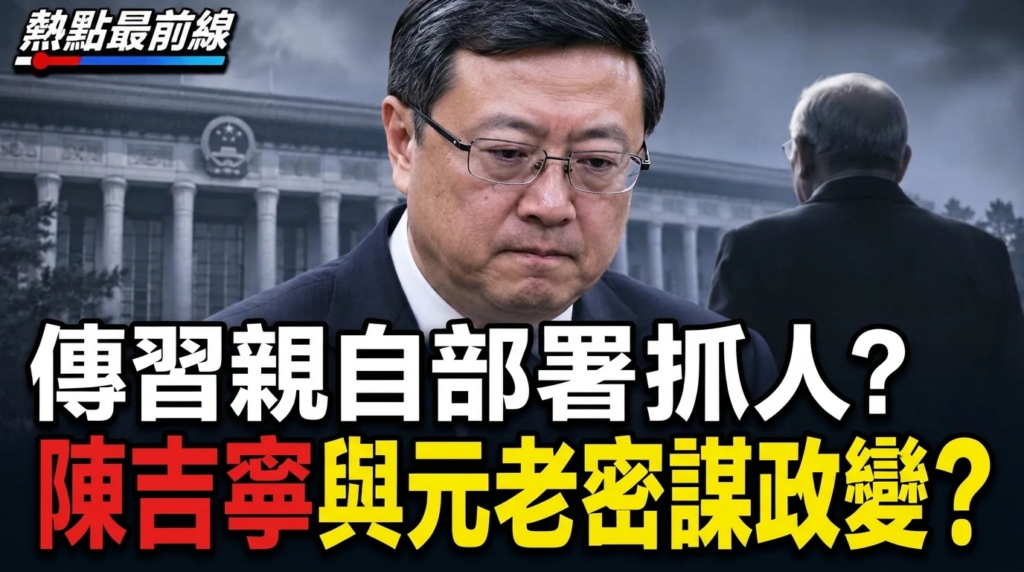
Another sensational political scandal has erupted within the Chinese Communist Party (CCP)! Chen Jining, a member of the CCP Politburo and Shanghai Party Secretary, who has long been viewed by outside observers as one of Xi Jinping’s potential successors, was suddenly reported to have fallen from power on the 24th.
According to revelations from overseas sources, even officials within the Shanghai Municipal Party Committee were completely unaware of what was happening beforehand. It was only after investigators sealed off the Party Committee building and forced open the door to Chen Jining’s office that they learned their own Party Secretary had been taken down.
On the surface, this appears to be another major anti-corruption case. However, newly disclosed inside information points to a major political affair that may involve a potential change in the CCP’s highest leadership.
If these reports are true, the shock could be no less than that caused by the Zhang Youxia case earlier this year. One case involves the military, while the other may involve retired Party elders and the civilian bureaucracy.
Did Xi Jinping Personally Order Chen Jining’s Arrest?
On the evening of November 24, the CCP authorities suddenly announced that Chen Jining, a member of the Central Politburo and Shanghai Party Secretary, was suspected of serious violations of discipline and law and was under investigation. The Shanghai Municipal Party Committee Standing Committee immediately convened an expanded meeting late that night to convey the central authorities’ decision.
Just one day earlier, the website of the Shanghai Municipal Commission for Discipline Inspection and Supervision had published news that Chen Jining had recently presided over a meeting on anti-corruption work. Unexpectedly, within the space of a day, he himself became the subject of an investigation.
Jiang Wangzheng, an Australian-based independent media commentator who frequently reveals inside information about the CCP’s upper echelons, disclosed that Chen Jining was summoned for questioning by the Sixth Supervision and Inspection Office of the Central Commission for Discipline Inspection (CCDI) in Beijing at around 9 to 10 a.m. on November 24. He was subsequently taken into custody. That same evening, the authorities officially announced that he was under investigation.
As for Shanghai, Du Wen, a former Inner Mongolian official, revealed that a large number of investigators suddenly sealed off the Shanghai Municipal Party Committee building. Carrying body cameras, they directly forced open the door to Chen Jining’s office and conducted a search. Shanghai officials did not learn that their Party Secretary had been taken down until that moment.
Jiang Wangzheng also claimed that Chen Jining had already been formally placed under investigation as early as June this year.
On October 29, following the conclusion of the CCP’s Fifth Plenum, The Epoch Times reported that Chen Jining had been summoned for a talk by the CCP Central General Office. At the time, outside observers speculated that he might be about to receive a major promotion. No one expected that less than a month later, news would emerge that he had fallen from power.
Even more astonishingly, Du Wen claimed that the operation had been personally arranged by Xi Jinping, with the participation of state security agencies. It was reportedly carried out on an “act first, report later” basis. The Politburo had not even held a meeting beforehand, and even Li Xi, secretary of the CCDI, was allegedly unaware that Chen Jining was about to be taken down.
What exactly happened that required such a sudden operation?
Du Wen disclosed four pieces of inside information. One of the leads involves Xia Linmao, Beijing’s former executive vice mayor, who reportedly fell from power in October. According to the allegations, during his investigation, Xia disclosed information implicating Chen Jining. The two had worked together in Beijing for many years.
Another lead points to current Chinese Premier Li Qiang. According to Du Wen’s sources, after Chen Jining succeeded Li Qiang as Shanghai Party Secretary, he may have used his official position to help Li Qiang’s family obtain economic benefits in Shanghai.
In addition, reports indicate that Chen Jining’s wife, Hu Qing, has held positions at environmental consulting firms, state-owned enterprises, and university research institutions. Overseas media have previously questioned whether the couple engaged in improper transfers of benefits during Chen Jining’s tenure as environmental protection minister and in other official positions. These allegations have yet to be verified. Whether Hu Qing will also be summoned for questioning in the coming days is another matter worth watching.
However, within the CCP’s officialdom, having corruption problems and being brought down because of corruption are not necessarily the same thing.
Did Chen Jining Conspire with Party Elders to Seize Power?
Looking back at the disciplinary announcements concerning senior CCP officials since Xi Jinping took power, in addition to economic issues, one recurring theme has been political loyalty. These include accusations of disloyalty to the Party, paying lip service to the leadership while acting against it, forming factions and cliques, and behaving as political two-faced individuals.
The other two pieces of inside information disclosed by Du Wen happen to involve precisely these issues: political loyalty and the struggle for the highest political power.
According to Du Wen, following the CCP’s Fifth Plenum, a group of retired Party elders became deeply uneasy about Xi Jinping’s continued political purges. They believed that if things continued this way, the political blade would sooner or later fall on them as well. Rather than sit back and wait for their fate, they decided to fight back in a desperate gamble.
This group of elders therefore began secretly discussing a plan to nominate Chen Jining at the CCP’s 21st National Congress in 2027 to replace Xi Jinping as CCP general secretary.
Why did they choose Chen Jining?
Du Wen analysed that Chen Jining will be only 63 next year. He has a Western educational background and an international outlook, as well as experience governing China’s two major centrally administered municipalities, Beijing and Shanghai. More importantly, he is himself an official who rose through the ranks under Xi Jinping’s administration. Having him succeed Xi might therefore make it easier for various factions within the Party to accept the arrangement.
Sources revealed that these elders had already held secret communications with Chen Jining. They reportedly told him that he possessed the best education, political credentials, and resources, and that he should not limit himself to being merely a “pillar of the country.” Instead, at a moment when the Party and the nation faced “life-or-death survival,” he should step forward to save the Party and the country. Although Chen Jining did not explicitly say, “I am willing to take over as general secretary,” he reportedly responded quite positively, saying that he was willing to act in the interests of the Party and the country as a whole, step forward when necessary, and shoulder major responsibilities.
However, another source revealed that CCP state security agencies had previously been secretly investigating Chen Jining because of his overseas experience. During the investigation, they unexpectedly intercepted secret communications between him and retired Party elders concerning the succession to the country’s top leadership position.
According to Du Wen, after state security agencies directly reported the situation to the highest authorities, Xi Jinping immediately personally arranged the arrest operation. However, Du Wen also emphasised that these two central revelations have not yet been independently verified by a third party.
If the reports are true, the Chen Jining case would no longer be an ordinary major corruption investigation. Instead, it could be a major political case involving a potential transfer of the highest level of power.
Du Wen did not disclose which specific Party elders were involved in the alleged conspiracy, but he claimed that these elders might also be arrested in the coming days.
Therefore, the most important development to watch next is whether any heavyweight figures among the CCP’s retired senior leadership will suddenly fall from power. If the investigation leads back to Chen Jining, the inside story of this struggle for the highest political power may gradually come to light.
Could an Even Greater Political Storm Be Brewing in Zhongnanhai?
With Chen Jining’s sudden downfall, who will take over as Shanghai Party Secretary?
One of the candidates currently attracting outside attention is Zhu Zhongming, the 54-year-old mayor of Shanghai and deputy Party secretary.
However, since Zhu Zhongming only officially took office as Shanghai mayor at the end of September this year, his chances of being directly promoted to Party Secretary are relatively low. Nevertheless, given the sudden nature of the incident, it would not be surprising if Zhu temporarily took charge of the Shanghai Municipal Party Committee.
According to Du Wen, the CCP Politburo may convene a meeting this Friday, November 27, at which personnel arrangements for Shanghai could potentially be discussed.
On the other hand, if Du Wen’s claim that Xi Jinping acted first and reported later is true, then, following the Zhang Youxia case, has Xi once again bypassed the Politburo’s collective decision-making procedures? Could this trigger new doubts and resentment within the Party?
Chen Jining is only 62 years old this year. He holds a PhD from Imperial College London in the United Kingdom and has experience governing both Beijing and Shanghai, China’s two major centrally administered municipalities. Within the CCP Politburo, he is an official with a particularly strong technical and professional background and an international outlook.
If Du Wen’s revelations about the alleged conspiracy among retired Party elders to arrange a succession are true, the implications of the Chen Jining case could extend far beyond personnel arrangements for the 21st National Congress. The number of officials implicated, and the seniority of those who could be affected, may be far greater than outside observers imagine.
Earlier this year, Zhang Youxia fell from power in the military. Now, if Du Wen’s revelations are true, the civilian bureaucracy has produced another figure comparable to “Zhang Youxia.” So how many other senior CCP officials are secretly discussing arrangements for the distribution of power after Xi Jinping?
Following these two incidents, will Xi Jinping become even more reluctant to designate a successor at the 21st National Congress? After all, once a successor emerges, another centre of power could potentially take shape within the Party.
Last month, the CCP’s Fifth Plenum had just called for persistent efforts to advance comprehensive and strict Party governance. Now the Chen Jining case has suddenly emerged. Will the political purges become even more severe in the coming period? Could even retired senior officials who were once regarded as untouchable “iron-hat princes” be swept up in the investigations?
With less than a year remaining before the CCP’s 21st National Congress, the political storm in Zhongnanhai may well become increasingly fierce.
All right, that concludes today’s edition of Hotspot Frontline. Thank you for watching. We will see you again in our next program. △