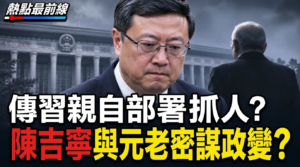
[People News] Chen Jining, a member of the Chinese Communist Party (CCP) Politburo and Shanghai Party Secretary, was officially announced to have fallen from power on November 24. Observers believe that Chen’s downfall at this particular moment is connected to an important political context that cannot be overlooked. Looking back at developments within the CCP’s officialdom over the past two-plus years, the network of personal connections known as the “Tsinghua Faction,” which radiates outward from former Organisation Department Minister Chen Xi and was largely built through his long-standing patronage and promotions, has been experiencing continuous upheaval, with numerous key members successively losing power or coming under investigation.
The so-called “Tsinghua Faction,” as referred to by outside observers, mainly refers to a group of former subordinates whose careers were cultivated and promoted by Chen Xi over many years. As a classmate of Xi Jinping when the latter studied at Tsinghua University in the late 1970s, Chen Xi was appointed a member of the CCP Central Politburo and Minister of the Organisation Department during Xi’s second term. He controlled the key powers governing the evaluation and promotion of centrally managed officials nationwide. However, as Chen Xi gradually retreated from the political front line, several members of this extensive network began encountering trouble one after another.
The first to fall were several of Chen Xi’s former subordinates from his time at the Organisation Department.
In June 2024, Zhang Jianchun, who had served as a deputy minister of the Organisation Department under Chen Xi before later transferring to become a deputy minister of the Publicity Department, was placed under investigation while still in office. In December of the same year, he was expelled from the Party and dismissed from public office (the so-called “shuangkai”). Three months later, in September 2024, another official, Cao Xingxin, who had worked in the Organisation Department for more than two decades and had served as deputy director of its Third Bureau of Civil Servants and Party secretary of the National Academy of Governance for Organisational Cadres, was also announced to have fallen from power. When the authorities announced his expulsion from the Party and dismissal from public office in February 2025, they unusually and explicitly accused him of having “violated organisational principles and used his position to benefit others” in the selection and appointment of officials. He was eventually sentenced to 12 years in prison for accepting bribes totalling more than 26.75 million yuan.
The anti-corruption storm subsequently spread further to individuals connected with the Tsinghua academic network and the Beijing political establishment. In October 2025, Zhang Yaoxue, a retired member of the Chinese Academy of Engineering and former president of Central South University, who had been retired for several years, was announced to be under investigation. Not only had he worked with Chen Xi when both were teaching at Tsinghua in the 1990s, but later, when Chen Xi served as a vice minister of education, Zhang also held a director-level position in the Ministry of Education. The two had therefore crossed paths on two separate occasions. By 2026, the storm had spread to Beijing’s officialdom. In June, Wei Xiaodong, chairman of the Beijing Municipal Committee of the Chinese People’s Political Consultative Conference (CPPCC), who had served as head of the Beijing Municipal Party Committee Organisation Department while Chen Xi was in charge of the central Organisation Department and had also served alongside Chen Jining on the Beijing Municipal Party Committee Standing Committee, was investigated while still in office. On October 22 of the same year, Xia Linmao, another official with a doctorate in engineering from Tsinghua University who had served for many years on the Beijing Municipal Party Committee Standing Committee during Chen Jining’s tenure as Beijing Party Secretary, likewise fell from power while still holding office.
In addition to direct anti-corruption investigations, unusual personnel reshuffles involving key senior-level positions have also sent strong signals.
For example, Li Ganjie, a current Politburo member who also graduated from Tsinghua University, had only taken over the position of Organisation Department Minister from Chen Xi in April 2023. Yet, just two years later, in April 2025, he was unusually involved in a position swap with Shi Taifeng, transferring to become head of the United Front Work Department of the CCP Central Committee. This unconventional lateral transfer was widely interpreted within political circles at the time as a sign that Li Ganjie’s political prospects were cooling and that a clear process of “de-Chen Xi-ification” was underway within the Organisation Department.
In addition, Wang Xiqin, former president of Tsinghua University, also disappeared from public view in an unusual manner in October 2025. First, his biographical profile was quietly removed from the official website of the National Natural Science Foundation of China. At the end of that month, the Standing Committee of the National People’s Congress (NPC) announced that it had accepted his resignation as an NPC deputy. His positions as a member of the NPC Standing Committee and deputy chairman of its Education, Science, Culture and Public Health Committee were also terminated. At just 57 years old, he subsequently disappeared from public view. To this day, the authorities have not announced any investigation or explanation for his removal.
Ultimately, all these developments point to the very top of the network. In June 2026, Chen Xi successively relinquished his positions as president of the Central Party School and president of the National Academy of Governance. These two important institutional positions were subsequently taken over concurrently by Cai Qi, one of Xi Jinping’s current key political aides. Then, five months later, on November 24, Chen Jining, who had worked with Chen Xi at Tsinghua for many years, served as Tsinghua University president from 2012 to 2015, and was widely regarded as having been promoted throughout his career with Chen Xi’s backing, was officially announced to be under investigation while serving as a Politburo member and Shanghai Party Secretary. He became the highest-ranking official to fall in the entire “Tsinghua Faction” upheaval.
Chen Xi controlled the Organisation Department for many years, holding considerable authority over the evaluation, appointment, and removal of officials. Over time, an intricate network of personnel connections gradually took shape around the Tsinghua system, universities, central government ministries, and Beijing’s officialdom. Under a highly centralised political system, even former subordinates and personal connections once regarded as loyal insiders can become potential risks once relatively entrenched networks of interests and promotion emerge. Such networks may become too powerful for their original patrons to control, or develop into competing political factions. Through a series of investigations and personnel adjustments, Xi Jinping may well be seeking to dismantle the existing structure of the “Tsinghua Faction,” ensuring that all power and political loyalty are directed straight toward the central leadership itself rather than being tied to any intermediary network of personal connections.
Overall, outside observers generally believe that the core purpose of this wave of reshuffling within the “Tsinghua Faction” is to prevent personal networks from becoming entrenched, restructure key personnel appointment mechanisms and local governance arrangements, and further consolidate control over political power ahead of the CCP’s 21st National Congress. As for how much of this involves investigations into specific disciplinary violations, and how much is driven by considerations of factional balance and positioning in personnel arrangements, that remains to be seen through subsequent official announcements and personnel changes.
(First published by People News) △