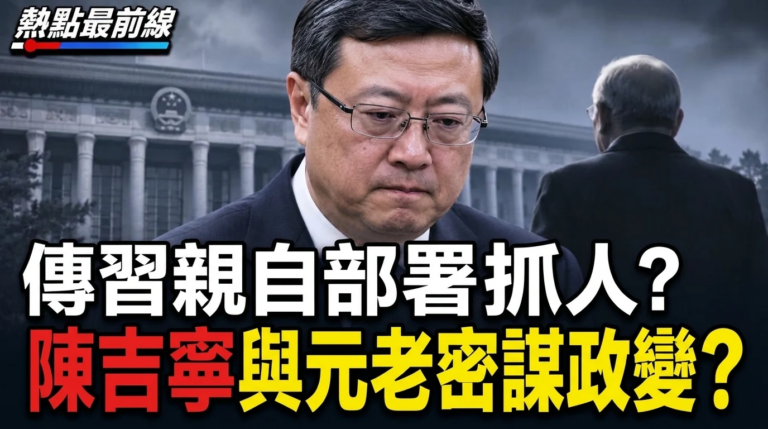
[People News] When that Xinhua announcement from the Chinese Communist Party’s official media came out on the evening of November 24, I believe the vast majority of people had not yet grasped what was happening. Chen Jining, a member of the CCP Politburo and Secretary of the Shanghai Municipal Party Committee, was suspected of serious violations of discipline and law and was under investigation. Perhaps the quickest person to understand the situation was Chen Jining himself. He had become the fourth member of the 20th Politburo to fall. When the first three—He Weidong, Zhang Youxia, and Ma Xingrui—went down, Chen Jining must also have voiced his firm support for the decisions of the Party Central Committee.
Chen Jining’s downfall came almost without warning. Just six days earlier, he had been conducting public inspections and research. Ten months earlier, he had accompanied the supreme leader on an inspection tour of Shanghai’s old residential neighbourhoods and their renovation projects. Born in 1964, Chen holds a PhD from Imperial College London. His career included serving as president of Tsinghua University, Minister of Environmental Protection, Mayor of Beijing, and eventually Party Secretary of Shanghai. His résumé was impressive, his professional credentials solid, and his age made him a promising political figure. In the eyes of many observers, he was among the most promising members of the post-1960 generation, with all the attributes of a rising political star and public representative. Some analysts had quietly placed his name on their lists of potential members of the Politburo Standing Committee at the 21st Party Congress. Little did they realise that this was effectively putting him in the line of fire.
Under Xi Jinping’s prisoner’s-dilemma mentality, driven by his ambition to rule indefinitely, and amid Beijing’s current political climate, the more highly regarded a person is by outside observers, and the more prominently he stands out, the more weight is effectively subtracted from his political prospects. The greater his perceived potential, the greater his risk of running into trouble. Chen Jining’s transformation from a professional expert into a technocrat, then a political star, and finally a casualty of a lightning-fast purge can be described as the “Chen Jining Law.” Behind it lies the brutal yet very real succession paradox of the Xi Jinping era: the more power becomes concentrated, the less stable the regime becomes. The greater the vacuum surrounding the highest office, the more objectively urgent the need for a successor becomes. Yet once anyone acquires the label of a potential successor, that person has effectively taken hold of a death warrant that cannot be shaken off, rather than the coveted supreme power.
Being Favoured Is, in Essence, the Riskiest Investment of All
Chen Jining is not a conventional political “tiger.” He does not enjoy the aura of a red aristocratic family, nor did he rise through the ranks of a powerful local faction. He followed the technocratic path: an outstanding academic background and a stint as president of Tsinghua University, widely regarded as a breeding ground for the Zhongnanhai leadership. He then assumed the post of Party Secretary of Shanghai, a major political springboard. Xi Jinping, Jiang Zemin, Li Qiang, and Han Zheng all had their political paths intersect with Shanghai before moving into positions of power in Beijing. Chen Liangyu did as well. Chen Jining’s fate seems far more reminiscent of Chen Liangyu’s than of the paths taken by Xi, Jiang, or Li.
Speculation circulating in the public sphere has focused on the hidden circumstances surrounding the incident. Some say that Chen Jining’s overseas experience made the top leadership uneasy. He spent ten years in Britain, speaks fluent English, and naturally interacts with executives from multinational corporations. In diplomatic settings, he could even outshine Xi Jinping by several Mount Everests. Others say that, during a recent conversation with a visitor, he mentioned the possibility of entering the highest levels of power. Such remarks, interpreted as flaunting his talents and promoting himself, could easily be reported upward as evidence of political ambition. Still others claim that he openly discussed the possibility of succeeding Xi with retired members of the Politburo Standing Committee. That would be tantamount to putting a noose around his own neck.
Political commentator Cai Shenkun has said that Chen Jining had poor social skills and behaved arrogantly when attending meetings with the sidelined former heir apparent Hu Chunhua. Others have turned their attention to Shanghai’s industrial projects, many of which involve investments worth hundreds of billions of yuan. Some say Chen was caught in the fallout from Chen Xi’s political troubles, and that Chen Xi’s loss of favour led to his own downfall. The speculation is varied and endless. But one thing is clear: under the current rules of the game, ability, credentials, reputation, and even a history of loyalty no longer guarantee safety. Once outsiders begin interpreting someone as a person with significant political potential, that alone can become the greatest risk and an inescapable political deadlock.
Of the 24 members elected to the Politburo at the 20th Party Congress, four have now fallen. The remaining members are probably racking their brains trying to figure out how to keep a low profile—so low that they disappear into the dust.
Xi Jinping’s Prisoner’s Dilemma: The Dictator’s Paradox and Political Paranoia
What kind of mentality lies behind such large-scale, sustained, and targeted purges? What political symptoms and circumstances are driving them? Political psychology has a concept known as the “dictator’s paradox.” More frightening than incompetent teammates is an incompetent leader—and dictators are precisely that kind of leader. The more powerful an authoritarian ruler appears on the surface, the more fragile he may be internally. The more sweeping and ruthless his political purges become, the more they expose his deep-seated insecurity. History offers numerous examples. Stalin and Mao Zedong in his later years both followed similar paths. Purges create fear, and fear, in turn, breeds new purges. Xi Jinping’s actions in recent years increasingly resemble a repetition of this cycle. The more power is concentrated, the greater the demand for absolute loyalty; the greater that demand, the deeper the suspicion; and the deeper the suspicion, the more ruthless the arrests become.
Xi Jinping now seems to see Lin Biao and Nikita Khrushchev in everyone. After all, during the Mao and Stalin eras, intelligence gathering relied on human informants and confidential denunciations. Xi Jinping, however, has built a grid-based surveillance system and AI-driven data analysis models. Applying these tools to assess the loyalty of senior Party officials is something that can be done in a matter of minutes.
Eric V., a former CCP intelligence operative, pointed out on the X platform: “To prevent internal genetic mutations from causing the Party and the country to perish, the CCP has established a complex and rigorous system of surveillance and assessment targeting senior officials. Multiple departments—including discipline inspection, organisation, state security, and propaganda—operate overlapping mechanisms to monitor and archive senior Party officials’ public statements, private associations, and past political declarations. These records are used to construct a visible trajectory of their ‘ideological changes,’ with any suspicious ideological tendencies flagged. Chen Jining had been flagged more than once long ago. The so-called inappropriate text message praising Chai Jing was by no means an isolated incident for Chen. As for his previous remarks, including those made publicly, people can look them up for themselves. Had an ordinary person made the same statements in today’s Xi era, they would have been summoned for questioning, silenced, or even removed from their position long ago.”
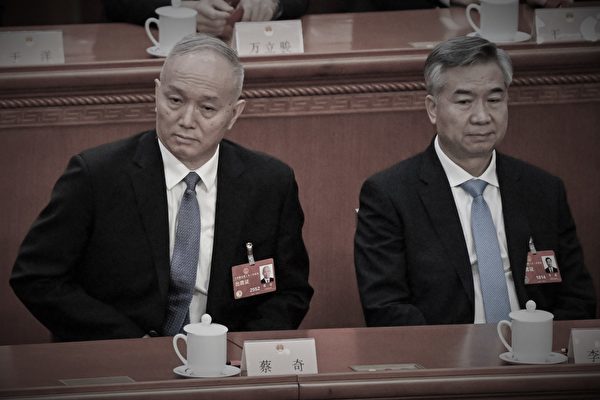
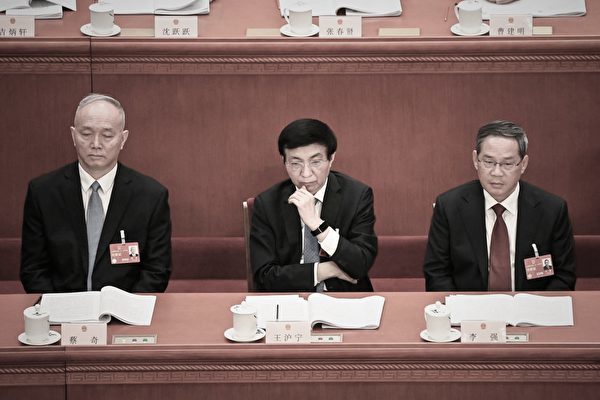
On November 25, Cai Qi conveyed Xi Jinping’s important instructions at a national meeting on Party regulations: “We must improve the mechanisms for implementing major decisions and deployments of the Party Central Committee, uphold and improve the system of the Party’s comprehensive leadership, and promote the development of a comprehensive system for exercising strict Party governance.” The Dajiyuan received information from an insider alleging that Chen Jining was arrested directly by Cai Qi, who deployed forces from the Central Guard Bureau. Li Qiang was also involved. Rather than saying that Cai Qi and Li Qiang set up a trap to arrest Chen Jining, it would be more accurate to say that the two were presenting Xi Jinping with a political offering of loyalty. Recently, overseas media commentator Qiang Shuo had claimed that Cai Qi and Li Qiang were positioning themselves to succeed Xi. Such reports may have frightened the two men out of their wits. This time, by helping bring down a major figure, they could offer their leader a substantial show of loyalty and ease some of the pressure on themselves.
Following Chen Jining’s downfall, some analysts believe this may indicate that the top leadership not only intends to extend Xi’s tenure beyond the 21st Party Congress, but may even be looking much further ahead. If the leadership skips over the post-1960 generation and turns its attention to the post-1970 generation, provincial- and ministerial-level officials born in the 1970s will have even more reason to tremble. As for whether a member of the Politburo Standing Committee might fall before the 21st Party Congress, that will depend on whether Xi Jinping’s internal system for regulating his lust for power remains stable.
The Practical Impact on Personnel Politics and the Economy
For the 21st Party Congress, Chen Jining’s removal has directly disrupted what may have been the original succession arrangements. Shanghai’s role as a political springboard has failed, the Tsinghua network has come under pressure, and the technocratic route to advancement has effectively been put on hold. From now on, those who make it into the inner circle will probably be judged more on their absolute reliability and their willingness to behave like obedient subordinates. Officials will be increasingly inclined to demonstrate loyalty at every turn and avoid taking initiative in everything. As for the list of potential members of the Politburo Standing Committee at the 21st Party Congress, regardless of how political tides rise and fall, no one will dare make a move.
Chen Jining’s downfall will also have a considerable impact on China’s economy. Shanghai is a gateway for foreign investment and financial activity. The sudden fall of its top official could leave local decision-making in a vacuum. Some observers have expressed confidence in Zhu Zhongming as a possible successor, but even Zhu himself probably no longer dares to be confident. Foreign investors’ confidence will inevitably be shaken. If Chen Jining is ultimately implicated in a major economic scandal, Shanghai—which is already in decline—may enter the final and most dismal chapter of its history.
The scale of Xi Jinping’s political purges has already approached the peak levels seen since the end of the Cultural Revolution, but there is no indication that the current wave has reached its highest point. The more these purges reinforce personal authority, the more they expose the fragility of the system. Chen Jining’s downfall is not merely a warning bell for others; it is another prolonged tolling of the death knell for the CCP system itself. The political bloodbath ahead of the 21st Party Congress has become an irreversible new normal. Perhaps the answer is already written in the ever-growing numbers of detention centres and prisons.
(First published by The People News.) △