[People News] Expectations that China’s economy would “recover next year” have repeatedly failed to materialise. The chill has now thoroughly shattered the luxury goods industry’s long-held myth that it is “recession-proof.” China, once regarded as the world’s biggest growth engine for luxury brands, is now becoming a major source of weakness in the financial results of leading luxury companies.
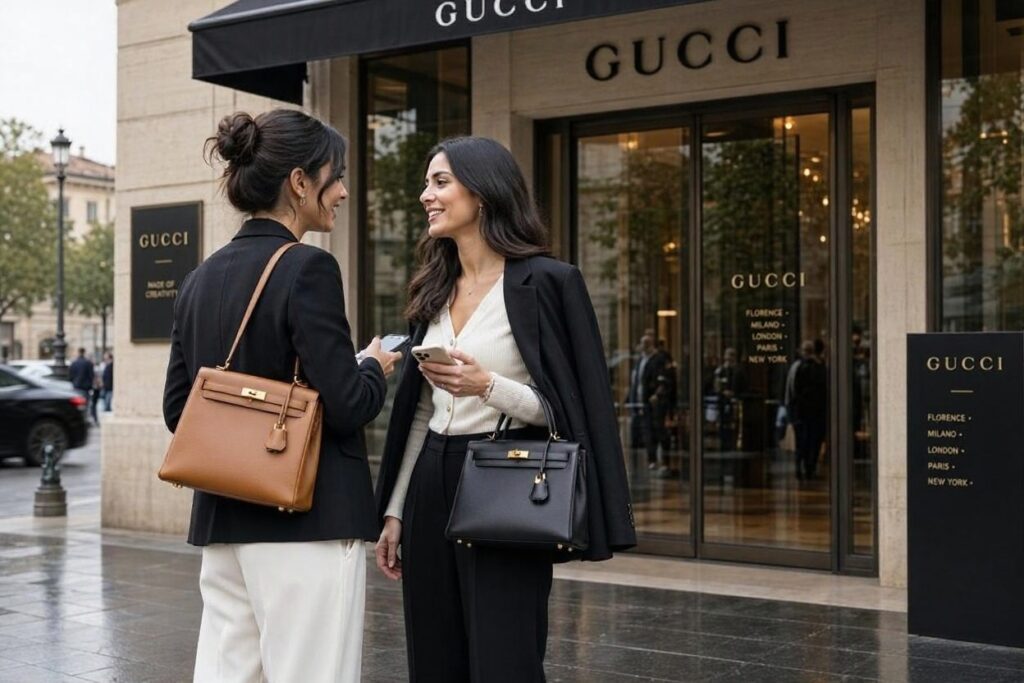
In previous economic downturns, luxury brands were often able to maintain growth against the trend by raising prices for their wealthiest customers. But this strategy has stopped working amid the prolonged slump in the Chinese market. Since the beginning of this year, the share prices of Hermès, LVMH—the parent company of Louis Vuitton—and Kering, the parent company of Gucci, have all fallen by approximately 40 per cent.
Amid economic uncertainty, high-net-worth individuals who still have substantial purchasing power are placing greater emphasis on preserving the value of their assets. As a result, categories with hard-asset characteristics, such as gold and high-end jewellery, have proved relatively resilient. Fashion apparel and leather goods, which primarily serve as status symbols and depreciate rapidly, have borne the brunt of the downturn.
According to The Dajiyuan, the collapse of China’s real estate bubble and weakening consumer confidence have continued to weigh on the luxury goods market. One banking analyst bluntly stated that China’s economy is no longer a story of “recovery next year,” and believes demand in China’s luxury market will remain under pressure.
The Nikkei reported on November 26 that the three French luxury goods companies were performing relatively steadily in the United States, Europe, and Japan, but were facing sales pressure in Asia, where China is a major market. After Kering announced its third-quarter results in October, its share price plunged 16 per cent in a single day, marking its largest single-day decline on record. Hermès and LVMH have also seen their share prices fall by nearly 40 per cent since the beginning of this year.
Corporate earnings reflect the weakness of the Chinese market. LVMH’s organic sales in its Fashion and Leather Goods division fell 5 per cent year on year in the third quarter. Sales in Asia, excluding Japan, also declined by 5 per cent. The group said that market conditions in China were less active than before, while the United States, Europe, and Japan continued to record growth. Kering’s third-quarter revenue was flat year on year, while comparable sales at its Gucci brand fell 6 per cent. Reduced customer traffic in mainland China was one of the factors weighing on its performance.
Chinese Consumers Are No Longer in a Hurry to Buy Luxury Brands
An October report by The Business of Fashion pointed out that economic uncertainty in China was suppressing demand for luxury goods.
The report cited the example of Sean Sun, a 24-year-old financial industry professional in Shanghai. In the past, he spent more than US$200,000 (approximately 1.42 million yuan) annually on clothing and leather accessories. Now, however, he has cut back on purchasing new-season products and instead searches for styles on second-hand platforms, comparing prices with those in the broader market.
Sun said: “I feel the products aren’t really any different.” He believes consumers are becoming increasingly concerned about whether the quality of a product justifies its price.
The report also cited feedback from HSBC analyst Anne-Laure Bismuth following visits to Hong Kong, Xiamen, and Shanghai. She told clients: “China’s economy is no longer a ‘recovery next year’ story. During our week-long research trip to Hong Kong, Xiamen, and Shanghai, we saw no signs of recovery.”
A report released by global management consultancy Bain & Company in January this year showed that China’s mainland personal luxury goods market contracted by 3 to 5 per cent year on year in 2025. Although this decline was smaller than the 17 to 19 per cent contraction in 2024, consumer confidence remained cautious for most of 2025.
Falling Property Prices Are Undermining Household Spending Power
The weakness in the luxury goods market is closely linked to the prolonged downturn in China’s property market and the erosion of household wealth. A study released by Stanford University in July 2026 found that real estate accounts for nearly 70 per cent of Chinese household wealth. For every 10 per cent decline in property prices, household consumption expenditure may fall by 1.5 to 2.3 per cent. The study concluded that falling property prices make households feel poorer, prompting them to reduce spending even when their incomes remain unchanged.
Figures released by the CCP’s National Bureau of Statistics show that from January to October 2026, total retail sales of consumer goods increased by just 1 per cent year on year. Among these figures, retail sales at brand-exclusive stores operated by enterprises above the designated size fell by 11 per cent, while sales of gold, silver, and jewellery products declined by 5.4 per cent. In October alone, total retail sales grew by just 0.4 per cent. These figures are not direct statistics on luxury goods sales, but they reflect the difficult consumer environment facing expensive non-essential products.
Consumer spending pressures are also spreading to some wealthy groups. A Reuters report dated October 9 stated that Chinese consumers account for approximately one-fifth of global luxury goods purchases, but the downturn in the property market has already affected consumption among the middle class. Tax recovery demands by the CCP authorities targeting offshore trust assets held by certain wealthy individuals may further weigh on high-end consumption.
Alexis Bonhomme, head of Trinity Asia, a Shanghai-based luxury goods consultancy, said that the additional tax payment demands could create liquidity pressures for some wealthy individuals. He said: “This doesn’t mean they won’t start buying again in the future, but right now, the appetite for spending simply isn’t there.”
Faced with the reality that a recovery in the Chinese market is nowhere in sight, international research institutions, including Bernstein, have been lowering their forecasts for global luxury goods growth. Major brands are currently adopting two key survival strategies. The first is “de-risking from China” by diversifying their markets. They are shifting the focus of growth back toward the United States, which is benefiting from wealth effects generated by the stock market and artificial intelligence, and Japan, where favourable exchange rates are attracting tourists. The second strategy is to “focus on the biggest customers and abandon the smaller ones” in China. Brands are halting indiscriminate expansion into second- and third-tier cities and instead concentrating their resources in prime commercial districts in first-tier cities. Through more intensive VIP services, they hope to retain the small number of customers at the very top of the wealth pyramid. △