

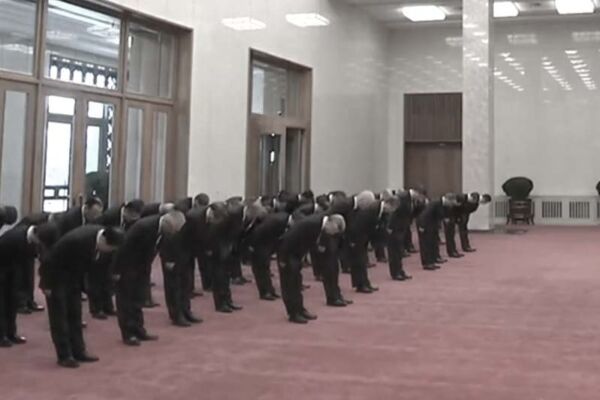
March 11, 2023: Senior members of the CCP’s Central Military Commission line up to take the oath at the National People’s Congress. From right to left: Zhang Youxia, He Weidong, Li Shangfu, Liu Zhenli, Miao Hua, Zhang Shengmin. (Lintao Zhang/Getty Images)
[People News]Hello everyone, welcome to *Tang Qing Looks at Current Affairs*.
The power struggle inside the Chinese Communist Party has heated up once again. A string of incidents involving the military and local high-ranking officials has occurred, and Xi Jinping’s loyalists keep running into trouble. Even more shocking is that one sentence from Trump revealed the most authentic scene inside Zhongnanhai — a live display of terror from a group of “puppet aides.” Today we’re going to talk about this astonishing series of power upheavals.
By the way, if you haven’t subscribed to the channel yet, please remember to subscribe, give a like, and hit the little bell so you’ll be notified the moment a new episode drops.
Abnormalities at the Fujian Carrier Commissioning Ceremony
On November 5, Xi Jinping attended the commissioning and flag-giving ceremony for the CCP’s third aircraft carrier, the *Fujian*, in Sanya, Hainan.
According to Xinhua News Agency, the ceremony was presided over by the newly appointed CMC Vice Chairman Zhang Shengmin. The only central-level officials in attendance were Cai Qi and Zhang Guoqing, with just over 2,000 representatives from naval units and the carrier construction team.
From CCTV footage, the outside world noticed that three key figures were conspicuously absent:
- Navy Commander Admiral Hu Zhongming
- Southern Theater Command Commander Admiral Wu Yanan
- Southern Theater Political Commissar Admiral Wang Wenquan
It is widely speculated that they have been taken down.
Rumors had already circulated before the Fourth Plenary Session that Hu Zhongming had been removed. Wu Yanan’s absence from the plenary session also led to suspicions that he had fallen, and Wang Wenquan’s absence this time looks like yet another general personally promoted by Xi has been toppled. At this point, nearly the entire active roster of admirals has been wiped out.
Even stranger, the scale of this ceremony was visibly downgraded compared to previous ones.
Zhou Xiaohui pointed out in an Epoch Times analysis:
- In 2012, when Hu Jintao attended the *Liaoning* carrier commissioning, he was surrounded by top officials like Wen Jiabao, Guo Boxiong, and Xu Caihou.
- In 2019, when Xi attended the *Shandong* carrier commissioning, Ding Xuexiang, Liu He, He Lifeng, and other central leaders accompanied him, with 5,000 troops neatly lined up on the pier.
This time, only Cai Qi and Zhang Guoqing showed up, and the number of participants was cut to 2,000 — a visible “shrinking” of pomp and circumstance.
Several other details are even more telling:
- In previous ceremonies, Xi would always review the naval honor guard; this time he did not.
- In the past, representatives from the shipbuilding unit and the Navy commander would give speeches; this time both were canceled. With even the highest naval officer absent, where does that leave Xi’s face? Who is slapping Xi in the face? This has become a hot topic of discussion outside China.
Another noteworthy detail: in 2019, official media released a photo of Xi with 5,000 officers and men; this time, there was only a photo of him with 20 carrier-based pilots and aviation support personnel — the “momentum” is clearly not what it used to be.
Moreover, the camera composition was subtle: although Xi stood in the center, the angle did not highlight his position; it seemed deliberately low-key.
Six years apart, the same type of carrier commissioning ceremony gives a completely different feeling. Is this telling the world that Xi’s power is shrinking?
Military Storm — Zhang Youxia and Zhang Shengmin’s “Loyalty Displays” and Unusual Movements
Behind the cold reception at the *Fujian* carrier ceremony, a series of intriguing developments have emerged among the military top brass.
On November 3, the PLA held a report session in Beijing to convey the spirit of the Fourth Plenary Session. The two main speakers on stage were heavyweight military figures: CMC Vice Chairman Zhang Youxia and the newly promoted Vice Chairman Zhang Shengmin.
Official CCP media reported that Zhang Youxia called on officers and soldiers to “deeply understand Chairman Xi’s important speech” and consciously support the so-called “Two Establishes.” Zhang Shengmin also mentioned the “Two Establishes,” “Four Consciousnesses,” “Four Self-confidences,” and “Two Safeguards,” stressing the need to implement the CMC Chairman Responsibility System.
However, such “loyalty displays” are not necessarily signs of stable power; more often than not, they signal turmoil.
For example, the now-purged former CMC Vice Chairman He Weidong, in the months before he was investigated, repeatedly swore allegiance to Xi Jinping at various meetings, loudly emphasizing the “Two Establishes” and “Two Safeguards.” Not long after, he was taken down.
Observers note that after the Fourth Plenary Session, Zhang Shengmin replaced He Weidong as CMC Vice Chairman and concurrently serves as Secretary of the CMC Discipline Inspection Commission and Director of the CMC Supervision Commission. Strangely, however, he was not added as a Politburo member.
This is quite unusual in CCP precedent. There have been many instances in past Fourth Plenums where Politburo members were added. This means that although Zhang Shengmin has been promoted, his position is not yet secure, and the military top brass is still engaged in behind-the-scenes power struggles.
Even subtler details follow.
Commentator Li Yanming pointed out in an Epoch Times analysis that Zhang Youxia’s presentation that day at the CMC organs contained two abnormalities.
First abnormality: the tone changed.
The entire report was about 440 words long, and Zhang Youxia mentioned Xi Jinping only twice — once as “Chairman Xi’s important speech” and once as “Xi Jinping Thought on Strengthening the Military.” He no longer mentioned slogans like “Xi’s core,” instead emphasizing the need to “strengthen Party committee leadership.”
Compared to July last year, when he conveyed the Third Plenary Session, he also mentioned Xi’s “important speech” and “Thought on Strengthening the Military” twice, but at that time he still demanded “more resolute and conscious support for the ‘Two Establishes.’” The tone is clearly different within just one year.
Second abnormality: almost all senior generals were collectively absent.
CCTV footage showed that apart from Zhang Youxia, Zhang Shengmin, Liu Zhenli, and Dong Jun, virtually no other admirals appeared.
At a similar meeting last year, He Weidong and Miao Hua sat in the front row, and generals such as CMC Political and Legal Affairs Commission Secretary Wang Renhua, Equipment Development Minister Xu Xueqiang, and Deputy Chief of the Joint Staff Xu Qiling were all present. Now they have all vanished.
This shows that dark currents are surging in the military; many generals may have already been investigated or sidelined. The military is undergoing a new round of purges.
Collapsing Corruption in the CMC — From the Admiral Group to Structural Anomalies
Let’s look deeper at the problem — the “collapsing-style corruption” inside the Central Military Commission. This is not an exaggeration; it is the most accurate description of the current state of the CCP military.
Commentator Wang Youqun wrote in Epoch Times that twelve abnormalities have appeared inside the CCP, several of which concern the military.
He pointed out that the degree of upheaval in the military is unprecedented. Since Xi Jinping came to power, he has promoted 79 admirals; at least half of them have either been taken down or are rumored to have problems. These are just the surface figures — meaning that the “own people” Xi personally promoted are now collapsing on a large scale.
Even more bizarre is that the current structure of the Central Military Commission has become almost an empty shell. Wang Youqun noted that the CMC now has only “one chairman, two vice-chairmen, and one member”: Chairman Xi Jinping, Vice Chairmen Zhang Youxia and Zhang Shengmin, plus the only remaining member Liu Zhenli. This is the weakest configuration in the CCP’s 70-plus years of rule.
He also pointed out that the CMC has seen three consecutive directors of its General Office and three consecutive defense ministers fall. This layer-by-layer fracture is not just a personnel issue — it is the system disintegrating. The “Two Establishes” have been shouted for so long, yet vice chairmen are being investigated one after another, and admirals are disappearing one after another. The so-called “loyal and reliable Xi family army” can no longer even be called “reliable.”
Even more bizarre is that recent military announcements nearly always “say only half the story.” Who was investigated, why, and for what — none of it is revealed. Just one sentence: “serious violations of discipline and law,” vague and evasive. This way of handling things actually exposes a deeper crisis — the real scandals are probably so huge that Zhongnanhai dares not make them public.
Local Chain Reactions — Xi’an Party Secretary Fang Hongwei Falls
The instability in the military is only the tip of the iceberg. Local officialdom is equally jittery. Next, something happened in Xi’an.
On the evening of November 7, the CCDI website announced that Fang Hongwei, member of the Shaanxi Provincial Party Committee Standing Committee and Xi’an Municipal Party Secretary, is under investigation for suspected “serious violations of discipline and law.”
In fact, rumors had already spread a day before the official announcement. Several major Weibo influencers posted on November 6 that Fang Hongwei had been continuously absent from important events, implying he was “in trouble.”
Hong Kong’s Ming Pao, citing sources in Xi’an, revealed that Fang Hongwei was on his way to inspect religious affairs on the 5th when he was intercepted and taken away by CCDI personnel.
Local entrepreneurs told Ming Pao that Fang Hongwei was personally involved in corruption and allowed relatives to use his influence for personal gain. “His wife and sister have huge appetites; everyone in the local business community knows.”
Even earlier, during the Fourth Plenary Session, Fang Hongwei had already been singled out. When the center filled 11 alternate Central Committee member slots, his name was “skipped.”
Being skipped in the CCP system means “not trusted.” Such people may still be in their posts, but they are essentially under surveillance and can be taken down at any time.
Why did Fang Hongwei attract so much attention? Because he is no ordinary official. A native of Fuping, Shaanxi, he is Xi Jinping’s fellow townsman and a Tsinghua alumnus. His career went smoothly from the state-owned enterprise system to local leadership, and he was once regarded as a reserve cadre of the “Xi faction.”
Independent commentator Cai Shenkun analyzed on X that Fang Hongwei’s career is closely tied to the Tsinghua clique. When he rose to Shaanxi Provincial Party Committee Secretary-General and later Xi’an Party Secretary, it was during Hu Heping’s tenure in Shaanxi. Hu Heping, former Tsinghua Party Secretary, was promoted by Chen Xi and is considered part of the “Shandong gang.”
Cai believes that it was precisely with the support of Hu Heping and Chen Xi that Fang Hongwei rose to the Provincial Standing Committee. However, he became too bold in office and meddled in major projects for profit. When Hu Heping left, he specially recommended Fang to Liu Guozhong. Now this entire chain of relationships has almost completely collapsed.
Fang Hongwei’s investigation means another earthquake in Shaanxi officialdom.
Unrest in Xinjiang — Discipline Inspection Secretary’s Sudden Death and Ma Xingrui Removed
While local high officials are falling one after another, shocking news has also come from the sensitive region of Xinjiang.
On November 5, the CCP’s *Corps Daily* reported that Jiang Xinjun, Discipline Inspection Commission Secretary of the Xinjiang Production and Construction Corps, “suddenly fell ill during work” and died at 2:24 pm on November 3 despite emergency treatment, aged only 56.
Normally, an official dying of illness wouldn’t be news, but strangely, the announcement of this “death due to illness” was delayed by a full two days. In CCP officialdom, such delays are rarely coincidental.
The official obituary used the usual boilerplate: “an outstanding Party member loyal and reliable to the Party,” praising his “remarkable achievements” while serving in the regional Discipline Inspection Commission and Supervision Commission.
Announcements of “sudden illness” or “died despite emergency treatment” are often a fig leaf for power struggles. At the end of last year, Customs Director Yu Jianhua was also said to have “died of sudden illness,” but later it was revealed he committed suicide in his office.
Jiang Xinjun’s case is particularly sensitive. He was a member of the CCDI and in charge of anti-corruption work in the Corps — in other words, he wielded the “anti-corruption sword” and naturally offended many people. It’s hard not to associate this sudden death with foul play.
Records show Jiang Xinjun was born in August 1969 and had worked in Xinjiang for a long time. He was a cadre promoted by Xinjiang Party Secretary Ma Xingrui. But Ma Xingrui himself was removed in July this year; the official line was “another appointment,” and his whereabouts remain unknown. Rumors say he may be implicated in corruption cases in Xinjiang.
Moreover, high-ranking officials in the Xinjiang Corps have been falling one after another recently:
- In May, Song Quanwei, deputy director of the Corps’ Caohu Project Area
- Wang Shengping, former secretary of the 10th Division
- Zhang Xuejun, political commissar of the 4th Regiment of the 1st Division
All were taken down. The fifth and sixth rounds of central inspections both listed Xinjiang and the Corps as key targets.
On November 1 alone, Xinjiang CPPCC Vice Chairman Jin Zhizhen was also investigated. In just a few months, Xinjiang has seen sudden deaths, dismissals, and multiple investigations — the frequency is so high that one cannot help but suspect Xinjiang has become a new focal point in the CCP’s internal power struggle.
Hu Chunhua’s Signed Article Has an Unusual Tone
Another subtle signal comes from Hu Chunhua.
On November 5, the *People’s Daily* published a signed article by CPPCC Vice Chairman Hu Chunhua, which attracted attention. On the surface it was a routine political statement, but after careful reading, many people felt something was off.
*People’s Report* commented that the tone of this article was “unusual” — more like a declaration from someone in a superior position.
Why? Hu Chunhua wrote in the opening:
“During the plenary session, I personally listened on site to the important speech delivered by General Secretary Xi Jinping, was deeply educated, deeply inspired, and greatly invigorated. We must conscientiously study and implement the spirit of the plenary session.”
It looks respectful, but it’s redundant. Everyone was listening on site — why emphasize “I” in particular?
Commentators believe this may imply that “someone was not present,” or it could be deliberately highlighting “my” presence.
Even more striking is that Hu Chunhua used the tone of “we must do this and that.” As CPPCC Vice Chairman, he can only represent the CPPCC system, yet the “we” he used seems to refer to the entire central collective leadership — which is a bit overstepping.
Looking back, the change in his tone over the past few years is even more obvious:
- In 2023, he still called himself a “new soldier in the CPPCC,” very humble.
- In 2024, he began saying he “profoundly comprehended Xi Thought.”
- By October 2025, he had switched to using “I” and “we” to refer to the decision-making level and even gave a comprehensive summary of the significance of the Fourth Plenary Session.
*People’s Report* believes this “I-lead-the-way” tone is sending a signal: Hu Chunhua is not just a “CPPCC Vice Chairman”; he may be showing the outside world that he still has political influence.
At the same time, the other CPPCC Vice Chairmen who published articles on the same day — Shi Taifeng, Shen Yueyue, Wang Yong, Zhou Qiang, and Bater — all wrote only formulaic platitudes. Not one of them spoke on behalf of the whole party and the big picture like Hu Chunhua did.
Therefore, some analysts believe this may foreshadow a new shift in power inside Zhongnanhai. It could be Hu Chunhua testing the waters, or someone deliberately putting out feelers.
The Terror of Power — The Real Scene of “Puppet Aides”
Just as the CCP high-level infighting continues to ferment, one remark from Trump allowed the outside world to see the truest face of Zhongnanhai.
On November 5, at a Republican breakfast at the White House, Trump recounted his meeting with Xi Jinping in South Korea. He said that at that meeting, Xi had twelve senior CCP officials seated around him — six on the left, six on the right, lined up perfectly straight, each one frozen like a statue.
Trump said he tried to speak to one of them, but the man didn’t move or respond at all. He asked again, “Are you going to answer me?” Still not a peep. In the end, Xi himself answered for him, saying, “I will answer all questions.”
Trump laughed as he imitated their posture — sitting ramrod straight, not moving an inch, expressionless. He said it was “a level of fear I had never seen before.” Even Foreign Minister Wang Yi and Politburo Standing Committee member Cai Qi remained silent throughout.
Commentator Yuan Bin said this scene is actually the most authentic portrayal of Zhongnanhai. In front of Xi Jinping, all high officials are like puppets — they dare not speak, dare not move, and must even control their facial expressions. This is not a scene from the novel *1984*; this is real-life terror politics.
He said this atmosphere of fear is deliberately maintained by Xi Jinping to strengthen “absolute obedience.” In other words, even high-ranking officials like Cai Qi and Wang Yi have become “puppets ruled by fear.” One can only imagine the situation of ordinary officials and the common people.
Dear viewers, what do you think? Where do you think the CCP’s power struggle will go next? Feel free to leave your thoughts in the comments, and don’t forget to like and subscribe. See you next episode!
Subscribe to the YouTube channel: https://www.youtube.com/@tangqingnews
Subscribe to the GJW channel: https://www.ganjingworld.com/channel/1eiqjdnq7go2ebXA2yTPUSg631de0c
— Produced by *Tang Qing Looks at Current Affairs* team





News magazine bootstrap themes!
I like this themes, fast loading and look profesional
Thank you Carlos!
You're welcome!
Please support me with give positive rating!
Yes Sure!