
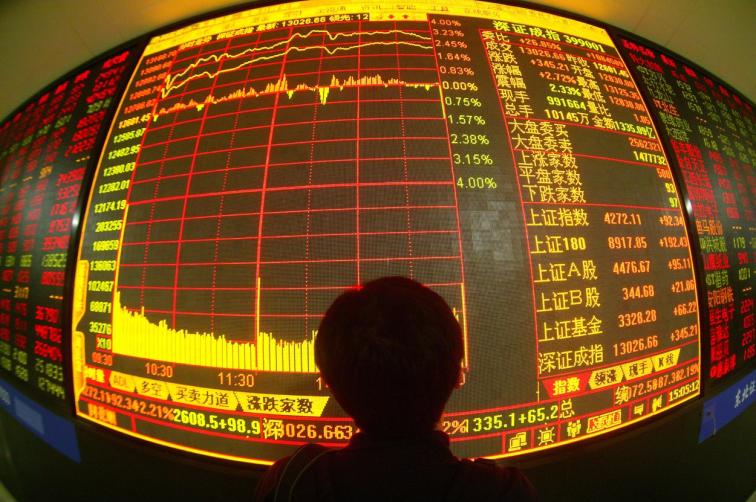
Recently released May financial data once again confirms the grim state of China's economy. (Photo by China Photos/Getty Images)
[People News] The hotel industry, as a crucial component of the modern service sector, is directly tied to a country’s economic growth, employment market, and level of social consumption. It is like a mirror reflecting macroeconomic changes — both an economic “thermometer” and a “blood pressure gauge.” The hotel industry’s upstream and downstream chains cover real estate, construction, food and beverage, tourism, conventions and exhibitions, catering, and transportation. A change in any one link can trigger a chain reaction, affecting the survival of the entire industry.
In past years, as China’s economy expanded rapidly, the hotel industry entered an unprecedented golden age. The development of chain operations and large-scale expansion propelled consumption upgrades, business conventions, and tourism growth, making the hotel sector a “main force” in advancing China’s urbanization. At that time, hotels were not only part of urban economies; they were also a major pillar of employment and infrastructure construction, and even served as an economic barometer for many local governments.
However, as China’s overall economy has declined — especially with the collapse of the real estate market — the hotel industry’s golden era has come to an end. By 2025, whether luxury hotels in first-tier cities, mid-range hotels in second-tier cities, or the individual leisure travel market, persistent weakness has become the norm. Housing prices continue to fall, occupancy rates remain dismal, food and beverage revenues are weak, and business travel and conference demand has sunk into a trough. The industry’s downturn is increasingly evident.
According to the 2025 Q3 China Hotel Market Prosperity Survey Report released by Horwath HTL, the national hotel market prosperity index fell to -35 in the third quarter of 2025, down 11 points from the second quarter. Regionally, South China saw a slight rebound, with an index of -24, making it relatively better off, while most other regions remain under heavy pressure. The occupancy rate index stood at -15, with about 46 percent of respondents expecting occupancy rates to decline year-on-year; only 30 percent anticipated an increase. Meanwhile, the average room rate index and total revenue index fell to -46 and -44, respectively, with nearly 70 percent of respondents believing hotels will face declining revenues.
Among first-tier cities, Sanya stands out as an exception. Its prosperity index rebounded to 0, making it the most optimistic city, with a quarter-on-quarter increase of 19 points, signaling relatively strong recovery potential. By contrast, Shenzhen, Shanghai, and Guangzhou remain mired in the doldrums, with indices of -21, -31, and -34, respectively. The most severe situation is in Beijing, where the prosperity index plunged to -44, a 21-point drop from the previous quarter and the lowest level in recent years. In Beijing, weak domestic demand and intensifying competition have put high-end accommodation and catering under severe pressure. In the first half of 2025, the average profit of accommodation enterprises above the designated size in Beijing was only 37,000 yuan, even lower than the half-year salary of a single employee. A 92.9 percent decline in industry profits reveals the hotel sector’s stark struggle for survival.
At the same time, China’s broader economic downturn has become increasingly pronounced. Of the three major growth engines — investment, consumption, and exports — the first two have nearly stalled. Exports alone have maintained a façade of prosperity through government subsidies and exchange-rate controls, but they too face mounting pressure from overcapacity and international trade barriers. The overall economic malaise has pushed most industries into contraction, and the hotel industry is no exception.
The primary driver of the hotel industry’s accelerated decline is the collapse of the real estate market. Excessive development has left large numbers of office buildings and commercial complexes vacant, many of which have been forcibly converted into hotels, sharply increasing supply. By 2024, the total number of hotels nationwide exceeded 348,700, a record high, intensifying competition and placing enormous pressure on the supply side. Meanwhile, weak demand has made survival even more difficult. Waves of business closures, soaring unemployment, and shrinking household incomes have suppressed consumer spending. Young people, in particular, increasingly favor ultra-low-cost travel. During the 2025 May Day and National Day holidays, many travelers opted for camping or sleeping outdoors instead of traditional accommodations, further accelerating the hotel industry’s contraction.
In addition, fiscal stress on local governments has compounded the industry’s difficulties. Heavy debt burdens, “austerity” policies for civil servants, and administrative measures such as alcohol bans have directly constrained hotel operations. Conference venues often sit idle, and survival pressure on owners and operators continues to mount.
As an economic barometer, China’s hotel industry is magnifying the inherent contradictions of the CCP system. Behind surface-level “stability maintenance” policies, public dissatisfaction continues to grow, and the accumulation of social tensions may erupt in the future, further intensifying instability. The prolonged slump in the hotel sector is not only a manifestation of economic decline, but also a warning sign of a systemic crisis. The CCP’s governing foundation is facing an unprecedented challenge.
(First published by People News) △








News magazine bootstrap themes!
I like this themes, fast loading and look profesional
Thank you Carlos!
You're welcome!
Please support me with give positive rating!
Yes Sure!