

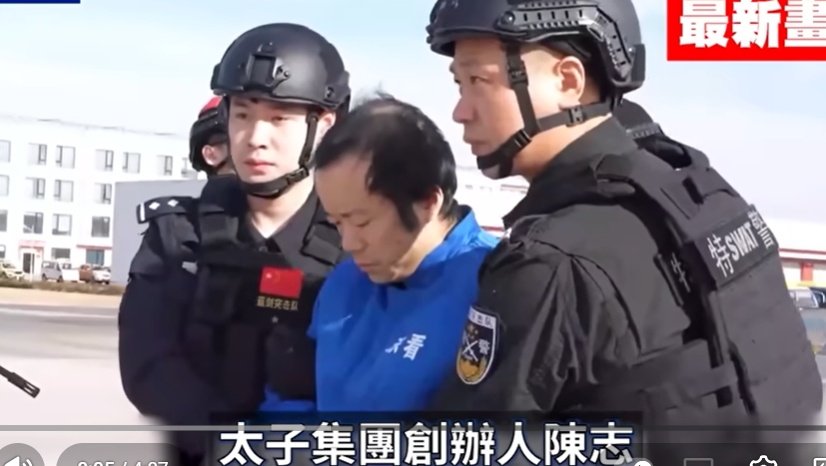
Chen Zhi, founder and chairman of the Prince Group, being deported back to China. (Video screenshot)
[People News] On January 6, 2026—a seemingly ordinary day—Cambodian law enforcement authorities suddenly arrested Chen Zhi, founder of the Prince Group, and quickly deported him back to China. This incident swiftly sparked heated discussion in international public opinion. On the surface, it appeared to be a case of cross-border law enforcement cooperation, with the Chinese side requesting Chen Zhi’s repatriation on charges including telecommunications fraud, money laundering, and human trafficking. However, on a deeper level, some observers have interpreted this action as a form of “rescue”—with the Chinese government, under international pressure, bringing back this businessman (who held Cambodian nationality, though it had already been revoked) to prevent him from falling into the judicial systems of the United States or other Western countries. Why would China under Xi Jinping choose this course of action? What secrets does Chen Zhi’s Prince Group actually conceal? This article explores the issue from the perspectives of geopolitics, economic interests, and even more sensitive allegations.
I. Chen Zhi’s “Dual Identity” and Cambodia’s Dilemma
Chen Zhi (陈志), formerly known as Chen Zhi (陈智), is a native of Fujian. At only 37 years old, he built a massive business empire in Cambodia. The Prince Group is involved in real estate, entertainment, and cryptocurrency, but its core operations have been internationally accused of constituting a transnational criminal network. In October 2025, the U.S. Department of Justice indicted Chen Zhi, freezing and confiscating approximately USD 15 billion worth of his Bitcoin assets, accusing his group of operating “pig-butchering” scam compounds, forcing victims to engage in telecom fraud, and being involved in human trafficking and forced labor. The United Kingdom, Singapore, Thailand, and other countries subsequently froze his assets as well.
Interestingly, Chen Zhi held Cambodian nationality and maintained close ties with former Cambodian Prime Minister Hun Sen, even being granted the title of “Duke.” This afforded him political protection in Cambodia, where most of his alleged criminal activities took place. According to international norms, such cases should be handled by Cambodia or prosecuting countries such as the United States. Yet China proactively intervened and demanded his repatriation. In December 2025, the Cambodian king officially revoked Chen Zhi’s nationality, paving the way for his deportation. This step, though seemingly logical, raised doubts: why did China not allow Chen Zhi to be tried in Cambodia or by an international court, but instead rushed to bring him back home?
From a geopolitical perspective, the close relationship between China and Cambodia is key. The two countries cooperate closely under the Belt and Road Initiative, and the Prince Group had participated in multiple Chinese-funded projects. If Chen Zhi were tried abroad, more “gray areas” of Sino-Cambodian cooperation might be exposed, potentially affecting China’s influence in Southeast Asia. The deportation can be seen as an effort to protect national interests, but it also placed China under international public pressure—countries such as the United States accused the move of potentially undermining global anti-fraud efforts.
II. The Prince Group as the CCP Elite’s “Black Glove”
Deeper allegations point to economic entanglements between Chen Zhi and senior CCP officials. Some overseas media claim that the Prince Group is not merely a scam empire, but also serves as a money-laundering tool for CCP officials. Through cryptocurrency and cross-border trade, Chen Zhi’s group allegedly transferred massive sums of money overseas, managing wealth for the Fujian faction or other elite families. For example, there have been reports—unverified—that Chen Zhi is connected to Xi Jinping’s family. Although unproven, such rumors circulate widely in anti-CCP circles. The sheer scale of the Prince Group’s Bitcoin holdings (over 140,000 bitcoins) far exceeds what an ordinary scam operation could accumulate, which some view as evidence suggesting backing by more powerful forces.
If these allegations are true, then repatriating Chen Zhi would not be a simple law enforcement action, but a “rescue” or protection. Tried domestically in China, he could avoid revealing sensitive information to international courts, such as fund flows or details of political protection. This aligns with Xi Jinping’s anti-corruption narrative—ostensibly cracking down on corruption while actually controlling the flow of information. In recent years, Xi has repatriated many overseas suspects through “Operation Fox Hunt,” many of whom were involved in money laundering or economic crimes. But Chen Zhi’s case is unusual: his group was designated by the United States as a “transnational criminal organization,” and repatriation effectively means “sharing” the suspect with China, potentially severing key evidentiary chains.
III. Chen Zhi’s Alleged Involvement in Overseas Organ Harvesting Bases
According to accusations from multiple Chinese victims, the Prince Group is suspected of involvement in CCP-backed “overseas live organ harvesting bases.” It is alleged that Chen Zhi’s scam compounds not only forced victims to commit fraud, but also used them as sources of organs for China’s domestic transplant industry. This echoes longstanding allegations of “CCP live organ harvesting,” often associated with Falun Gong practitioners or Uyghurs. Some reports indicate that the Prince Group’s compounds in northern Myanmar and Cambodia kidnapped Chinese youths, with some used as an “organ bank,” and that these operations were linked to Zhongnanhai proxies. If even part of these allegations is true, then repatriating Chen Zhi would indeed constitute a form of “protection.”
Conclusion
In sum, Xi Jinping’s decision to “rescue” Chen Zhi under international public pressure appears on the surface to be law enforcement cooperation, but in reality may reflect multiple considerations: protecting elite interests, controlling economic secrets, and preventing international judicial intervention. Against the backdrop of intensifying Sino–U.S. rivalry, this action highlights China’s reluctance to let key figures fall into Western hands. But it also comes at a cost—reinforcing China’s international image as “harboring criminals” and fueling further speculation about money laundering and human rights abuses.
(Author’s X account)
△





News magazine bootstrap themes!
I like this themes, fast loading and look profesional
Thank you Carlos!
You're welcome!
Please support me with give positive rating!
Yes Sure!