
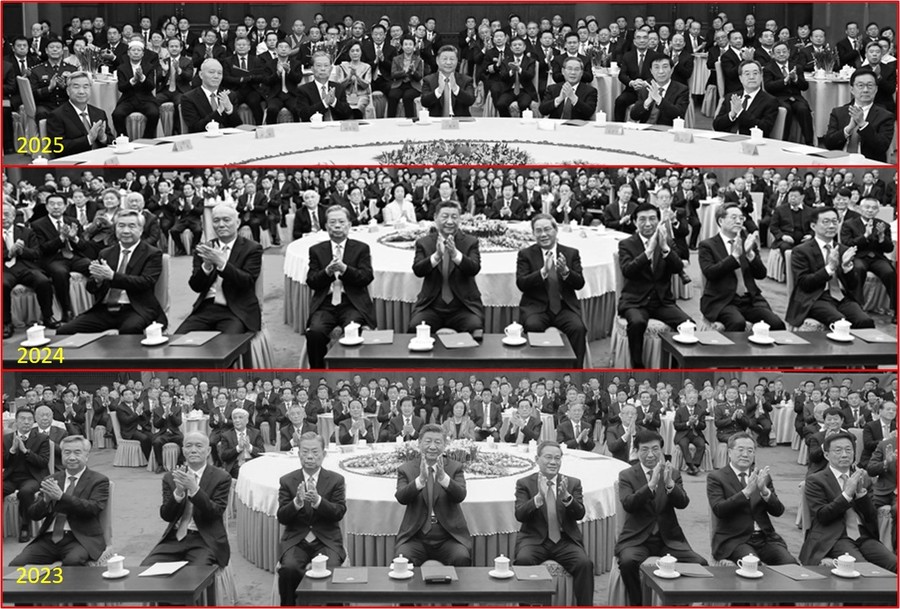
Group photo of CCP party chief Xi Jinping with the other Standing Committee members
[People News] This year’s Chinese New Year may be the quietest in history. Cities across the country appear deserted. From ordinary citizens to the top leadership in Zhongnanhai, from the political sphere to the military, there seems to be little enthusiasm or interest in celebrating. Streets and markets in Beijing, Shanghai, Guangdong, Wuhan, Hangzhou, and other cities are unusually deserted, and consumption has clearly cooled. Many bloggers, netizens, and ordinary citizens have posted online asking: Where has everyone gone?
This New Year, not only have many ordinary people stayed home, but top Party, government, and military officials—including the bigwigs in Zhongnanhai—have also “disappeared” since the first day of the Lunar New Year. Apart from some pre-holiday “televised New Year greetings” and symposiums reported by official media such as People’s Daily, Xinhua, and the Ministry of National Defense—where those appearing on camera sat upright with stern expressions—there have been no reports on where Xi Jinping, Li Qiang, or other Politburo Standing Committee members are, what they are doing, or how they are spending the holiday. Xi has had no new publicly disclosed itinerary for about 10 days.
On February 20, the headline of People’s Daily was about new trends in rural Spring Festival couplets; Xinhua’s headline focused on tourism; and the Ministry of Foreign Affairs’ headline still featured a four-day-old story about “replying to friends in Iowa, USA.” Netizens exclaimed: Where have the Zhongnanhai leaders gone?
The CCP treats the activities of its leaders and their family members as state secrets. Under this opaque system, it is impossible to know exactly how Xi and his family spent the holiday. However, Mr. Liu, a Beijing resident living in an armored corps compound, told The EDajiyuan: “I heard that the leaders of the Central Military Commission are all in Beijing and haven’t left.” He said there were no publicly reported trips by Xi or Vice Chairman Zhang Shengmin during the New Year.
According to several informed sources, many generals at various levels in the military gave up returning home for the New Year. Those in Beijing largely stayed indoors to avoid being accused of “forming factions.” This suggests that after the arrests of Zhang and Liu, rumors about power shifts within the top ranks of the Central Military Commission are still fermenting.
Mr. Xu, who is close to military sources, said many senior officers chose to remain at their posts, celebrating the New Year with rank-and-file soldiers, minimizing public activities and reducing private travel.
Xu revealed that many military officers are adopting a wait-and-see attitude. Morale is unsettled, and there is fear of becoming targets of purges. Officers are keeping a low profile, avoiding long-distance travel, including family visits. Even shopping trips are often handled by their wives.
Xu also mentioned that this year the military adopted a “collective New Year” approach. At various theater command bases, regimental and battalion commanders organized in-house activities such as making dumplings and putting up Spring Festival couplets. However, the festive atmosphere was much weaker, and funding allocations were reduced. Everyone acted cautiously and deliberately kept a low profile.
Xu emphasized that such arrangements are rare in normal years and typically occur only when tensions within the military are high.
A Chinese military scholar, Chen Guoming (pseudonym), told The EDajiyuan: “Right now, no one can say for sure where the command authority lies in the Eastern Theater Command (responsible for Taiwan) and the Central Theater Command (responsible for defending Beijing).”
Xi Jinping once delivered holiday greetings via video from the Bayi Building to all officers and soldiers, directly demanding loyalty from grassroots troops and urging them to firmly follow Party command, faithfully fulfill their duties, and remain completely reliable. He appeared to be signaling that he, not Zhang Youxia, is the supreme leader of the Central Military Commission.
At the time, many political observers analyzed that cracks had emerged within the CCP regime. At minimum, Xi was aware that many within the armed forces were not fully obeying his command. By publicly emphasizing loyalty, he effectively revealed deep mistrust and heightened vigilance toward the top brass of the PLA, including various departments of the Central Military Commission and the commanders and political commissars of the five theater commands.
It is likely that Xi’s mood during this year’s New Year was not cheerful. Fewer people may have come to pay their respects. Now increasingly isolated, surrounded by people who fear him, he appears trapped in political isolation. Wherever he goes, applause would likely come only from arranged performers. He may have little interest or enthusiasm to make public appearances.
Japanese veteran journalist Katsuji Nakazawa analyzed that another reason the CCP leader did not visit military units during the New Year for the usual “personal inspection and command” display is that many senior officers have been purged, leaving theater command headquarters in disarray. A personal inspection under such circumstances might not proceed smoothly and could even pose security risks.






News magazine bootstrap themes!
I like this themes, fast loading and look profesional
Thank you Carlos!
You're welcome!
Please support me with give positive rating!
Yes Sure!