
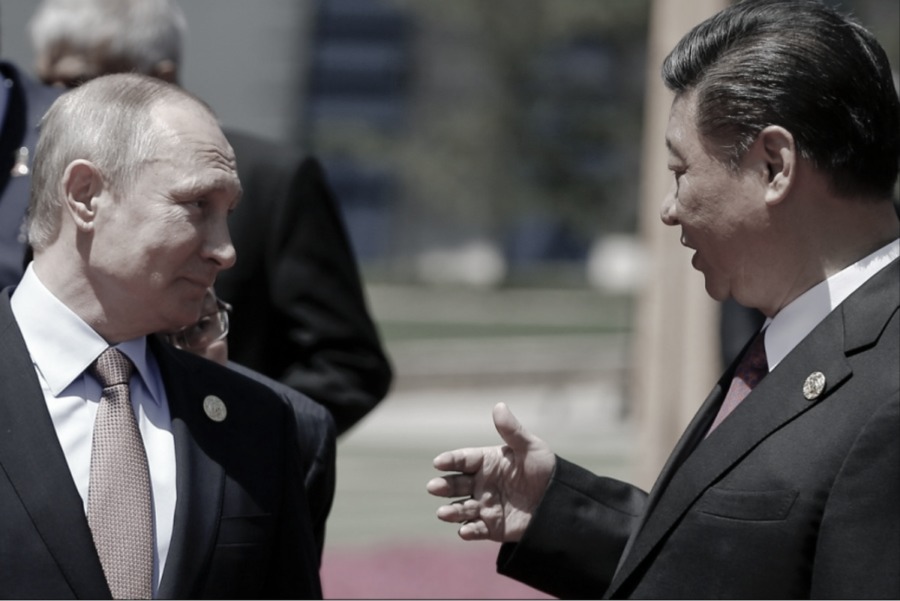
File Photo: Putin and Xi Jinping Posing for a Photograph
[People News] The day after Iran’s Supreme Leader Ayatollah Ali Khamenei was killed in a joint U.S.–Israeli decapitation strike, on March 1, 2026, Chinese Foreign Minister Wang Yi urgently held a phone call with Russian Foreign Minister Sergey Lavrov at Russia’s request. The conversation directly condemned the U.S.–Israeli action as the “open killing of a sovereign nation’s leader” and declared that “inciting regime change is unacceptable.” They repeatedly emphasized that military action must be authorized by the United Nations Security Council, that hostilities must cease immediately, and that negotiations should resume.
On the surface, this appeared to be China and Russia defending international law and the principle of sovereignty. But strip away the diplomatic language, and the core motivation is simple: when the rabbit dies, the fox grieves.
Khamenei’s death dealt a heavy blow to the loose “anti-Western axis” of China, Russia, Iran, and North Korea. As the most aggressive member of this bloc in confronting the United States, Iran’s supreme leader being precisely eliminated effectively announced that decapitation strikes have become an operational option in major power competition. Russia has already experienced sustained Western military aid and sanctions in the Ukraine war. China continues to test red lines in the South China Sea and across the Taiwan Strait. Who can guarantee that the next “targeted elimination” would not be a close associate of Putin—or a key decision-maker in Beijing?
This sense of fear is the real driving force behind the language of “serious concern” and “strong opposition.”
Even more ironic is that China and Russia are now waving the banner of “U.N. authorization” and condemning unilateralism, conveniently forgetting their own records. When Russia invaded Ukraine in 2022, did it seek authorization from the Security Council? It proceeded under the label of a “special military operation,” disregarding international condemnation. China, in its large-scale island-building in the South China Sea and routine military flights around Taiwan, has never sought U.N. or regional approval. Instead, it has unilaterally altered the status quo and created faits accomplis.
Now that Iran has been struck, they suddenly present themselves as the most faithful defenders of international law. Such selective indignation is difficult to take seriously.
The China–Russia–Iran–North Korea alignment is not built on shared values, but on shared hostility toward the U.S.-led order. Iran’s collapse means the bloc has lost a key piece—and the remaining members now see more clearly that when the West decides to act, slogans like “sovereignty” and “multilateralism” do not provide real protection.
When the rabbit dies, the fox naturally grieves. But when the fox itself has repeatedly ignored the rules of the jungle, and now cries out against “jungle law,” the grief appears especially hypocritical.
The international order is indeed fragile. But restoring it requires all major powers to abide by the same set of rules—not to act alone when it suits them, and only call for restraint when an ally is attacked.
This China–Russia statement reads less like a principled defense and more like a warning bell: when “decapitation” becomes normalized, anyone could be next.
(Excerpted from X platform) △






News magazine bootstrap themes!
I like this themes, fast loading and look profesional
Thank you Carlos!
You're welcome!
Please support me with give positive rating!
Yes Sure!