
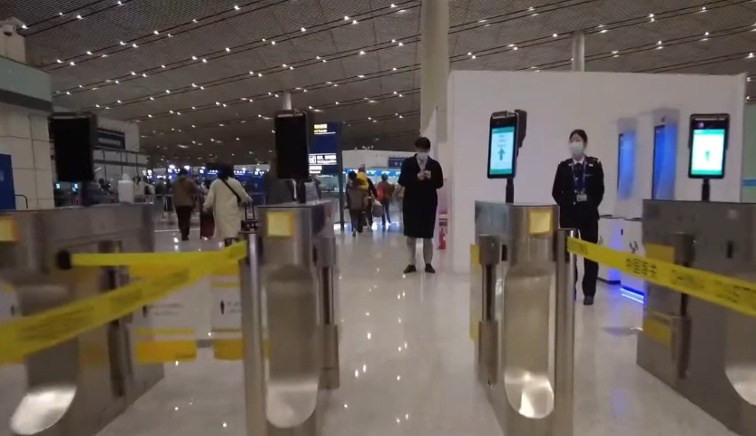
Many foreign businessmen preparing to depart from Beijing Airport discover that they have been placed on a list of individuals restricted from leaving the country by the CCP authorities. (Video Screenshot)
[People News] In recent years, the CCP has increasingly reinforced its 'security-oriented' governance, integrating data, supply chains, and capital flows into a national security framework, which makes it easier to associate the daily operations of businesses with security risks. Within this context, foreign companies that shift their supply chains or withdraw investments may be perceived as engaging in 'critical resource outflow' or 'supply chain risks,' resulting in stricter reviews, penalties, and restrictions. Even as foreign capital continues to exit China, the State Council of the CCP issued two new economic regulations last month, mandating penalties such as fines, asset freezes, and criminal liability for foreign companies attempting to relocate their business out of China, including withdrawing from joint ventures and seeking suppliers outside of China. This situation exposes foreign businessmen in China to risks of property loss and restrictions on personal freedom, raising concerns among foreign enterprises operating in China, and contradicting Beijing's urgent efforts to attract foreign investment to stimulate the economy.
Linking Business Activities to National Security
The non-profit human rights organisation 'Safeguard Defenders,' based in Spain and focused on promoting human rights and the rule of law in China and Asia, noted in its latest article that the CCP's actions are a response to attempts by some countries to decouple from Communist China, as well as the increasing risks associated with external economic sanctions and economic measures. The CCP's strategy clearly connects business activities with national security issues.
The article highlights a significant concern: the two new regulations from the Chinese Communist Party (CCP) explicitly permit the imposition of exit bans on foreigners suspected of violating these new rules.
With the implementation of these new regulations, foreigners conducting business in China will find it increasingly difficult to transfer their funds abroad after investing in the country. They also face the risk of losing their personal freedom, creating a situation where both their money and their ability to leave are at risk. This kind of investment climate is unlikely to attract foreign investors.
On November 27, 2013, the Southern Metropolis Daily published an interview with Hong Kong billionaire Li Ka-shing (Li Jiacheng). In the interview, Li expressed that under conditions of unfair policies, a poor business environment, and the selective exercise of governmental power, a businessman’s willingness to invest is bound to decrease.
The CCP continues to introduce new border control regulations.
Over the past decade, the CCP has consistently developed various regulations that enhance its border control powers over both foreigners and citizens.
A report titled "Dilemma: The Continuous Expansion of China's Exit Bans," published by "Protectors" in 2023, reveals that between 2018 and 2022, the CCP introduced four new exit ban laws within just four years, raising the total number of related laws to 14. Notably, the "Supervision Law" permits the CCP to impose border control on any individuals involved in investigations, even if they are not suspects.
The article highlights that these two new regulations further heighten the risk of business professionals in China facing CCP border control. The report also indicates that many foreign businesspeople only discover they are subject to CCP border control when they arrive at the airport ready to depart. The duration of these exit bans can range from a few days to several years. For instance, Irish businessman Richard O’Halloran was prohibited from leaving China for nearly three years (from 2019 to 2022) due to a civil business dispute.
Significant Increase in the Number of Exit Bans
The data presented in the article shows that since "Protectors" first published the CCP exit ban report in 2023, the trend of increasing exit bans has become more pronounced.
Although the CCP has never publicly disclosed the total number of exit bans, an analysis of the frequency of mentions of "exit restrictions" in the Supreme Court of the CCP's database (China Online Judgments, abbreviated as CJO) reveals that the number of mentions has nearly doubled each year from 2021 to 2024.
The article notes that the data for 2025 is likely underestimated due to the time required for uploading information to the system, suggesting that the actual number of exit bans may be higher. The significant increase in CJO data, which has roughly doubled each year, strongly indicates that the number of exit bans issued by the Chinese Communist Party (CCP) is on the rise.
In conclusion, the article highlights that since Xi Jinping (Xi Jinping) assumed power in 2012, the CCP has broadened the legal framework for exit bans, increasingly employing them even in cases lacking legal justification. This has led to border control, transnational repression, and other forms of coercion affecting various groups, including activists and foreign journalists. The recent implementation of these two new regulations by the CCP has heightened concerns about the party's increasingly harsh measures.
Funds are trapped, Taiwanese Businessmen Abandon the Chinese Market
As the Chinese Communist Party continues to escalate its nationwide campaign to 'catch spies', interest from foreign investors in China is rapidly waning. Once seen as the 'world's factory', China attracted countless Taiwanese businessmen looking to strike it rich, but the landscape has changed dramatically. For example, Taiwanese investors who were once 'enthusiastic' about investing in China are now exhibiting a notable shift towards a 'rational retreat'.
According to a statement from Taiwan's Ministry of Economic Affairs in April this year, Taiwan's investment in China (including Hong Kong) has plummeted from $14.62 billion in 2010 to just $1.873 billion projected for 2025. The share of Taiwan's investment in China (including Hong Kong) relative to its total foreign investment has dropped from a previous high to approximately 4.69% by 2025. Additional data suggests that the proportion of investment in China will fall to 3.8% by 2025, marking a historic low.
The share of Taiwanese exports to China has decreased from 40.1% in 2016 to only 26.6% by 2025, indicating that Taiwanese businessmen's interest in investing and trading with China has steadily declined to a historical low.
Analysts indicate that the 'difficulty of freely repatriating funds' faced by Taiwanese businessmen investing in mainland China, often referred to as the 'only in, not out' or 'trapped funds' dilemma, is one of the primary reasons driving them to abandon the Chinese market.
Despite the provisions of the Chinese Communist Party's (CCP) "Foreign Investment Law," which allows Taiwanese businesses to freely remit their legitimate earnings, the reality is that various levels of the CCP government often act inconsistently. Taiwanese companies frequently encounter administrative hurdles such as tax audits and bank compliance checks, resulting in delays or blockages in currency exchange. Without complete tax documentation or investment review committee papers, it becomes challenging for Taiwanese businesses to transfer funds.
At present, the CCP has broadened its financial regulatory authority and may even impose "exit restrictions" (border control) on Taiwanese businesses, effectively trapping both personnel and capital within China. When a company seeks to cease operations and withdraw its funds, it often faces local government tax inspections, labour disputes, or challenges in disposing of factory assets, leading to unmet expectations of being able to "pack up and leave."
In recent years, Taiwan's economy has gradually carved out its own path, strengthening economic and trade ties with major economies such as the United States, Japan, South Korea, and Australia, and aligning closely with the global market without needing to revert to dependence on China.
Thus, the CCP's hope of attracting more foreign investment to pull China's economy out of its slump is destined to be a "futile endeavour."
(First published in People News)△





News magazine bootstrap themes!
I like this themes, fast loading and look profesional
Thank you Carlos!
You're welcome!
Please support me with give positive rating!
Yes Sure!