

On March 5, 2025, PLA delegates arrived at the Great Hall of the People in Beijing to attend the opening of the National People&9;s Congress. (Photo by Kevin Frayer/Getty Images)
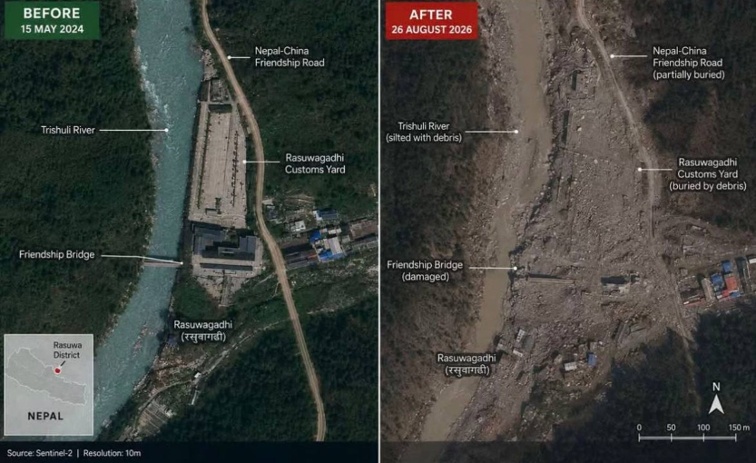
[People News] On August 26, a severe landslide struck the Jilong Port on the China-Nepal border, completely engulfing the port building in an instant. By August 29, CCP media reported that 554 individuals were still unaccounted for. On the Nepalese side, there were also numerous disaster victims, and the limited helicopters available to the Nepalese army were nearly all deployed to rescue people to the best of their ability. In contrast, the CCP military only made a symbolic deployment of helicopters, with no significant rescue operations observed. This stark difference in rescue efforts underscores the many internal problems facing the CCP military.
The Nepalese army can truly be regarded as the people's army.
With a total personnel count of less than 100,000, the Nepalese army has limited helicopter resources, likely consisting of three helicopters purchased from the United States, two each from France and Italy, as well as three light helicopters from India and six Mi-171 helicopters from Russia, though their operational status remains uncertain. The Global Firepower website indicates that the Nepalese army has a total of 10 helicopters and 7 fixed-wing transport aircraft, with an operational readiness rate of approximately 50% for helicopters.
Following the disaster, the available helicopters of the Nepalese army promptly flew to the frontline disaster areas to conduct search and rescue operations for trapped civilians, which included not only the injured, the elderly, the sick, and students, but also the transportation of deceased individuals' bodies back to the rear military camp.
In response to the sudden disaster, the limited helicopters of the Nepalese army were effectively utilized, participating in the rescue of civilians in the affected areas at the earliest opportunity, exemplifying the essence of a people's army. As the saying goes, 'It takes a thousand days to train troops, but only a moment to use them.' This is a standard that any normal national army should strive to meet during peacetime.
In comparison, how does the performance of the CCP military stand up?
Where Have 1,500 Helicopters Gone?
In recent years, the Chinese Communist Party (CCP) military has significantly increased its fleet of helicopters, including models such as Zhi-8, Zhi-9, Zhi-10, Zhi-11, Zhi-18, Zhi-19, and Zhi-20, along with Mi-8, Mi-17, and Mi-171 helicopters purchased from the Soviet Union/Russia, as well as some from France and the United States. The CCP claims to have established 15 aviation brigades, boasting a total of 1,500 helicopters, making it second only to the U.S. military.
Given this substantial number of helicopters, one would expect the CCP military to be well-equipped to mobilize a large number of them for search and rescue operations in disaster-stricken areas, and even to offer assistance to Nepal in such efforts. However, the reality is quite astonishing.
On August 26, the Chinese military newspaper published an article titled 'The City of Shigatse in Tibet's Jilong County Suffers from Mudslide Disaster; PLA and Armed Police Forces Conduct Emergency Rescue.'
The article notes that after the disaster occurred, Xi Jinping placed great importance on the situation and issued significant directives... The Party Committee of the Western Theater Command took decisive action to implement these directives... The joint command center of the theater activated its emergency response mechanism immediately... The Tibet Military District dispatched a forward command group to the site... Troops from the Shigatse Military Sub-district... rushed to the front lines to initiate rescue operations... The air force of the Western Theater Command... sent a drone to the Jilong port area to assess the disaster situation... The troops of the Tibet Armed Police Corps Shigatse Detachment... arrived in Jilong Town and Sale Township in Jilong County, working closely with local authorities to conduct personnel search and rescue operations, as well as to clear roads.
The People's Liberation Army (PLA) Western Theater Command received a rescue order, but the Western Theater Air Force only sent a single drone to assess the disaster area in the Jilong Port region, which had been overwhelmed by a mudslide, and no helicopters were deployed. The Tibet Military District merely dispatched a so-called forward command group. The Shigatse Military Sub-district sent a team, claiming they were heading to the front lines. However, the Tibet Armed Police Corps Shigatse Detachment only reached Jilong Town and Sale Township in Jilong County, effectively serving as rear support for the rescue efforts.
The Western Theater Command, Tibet Military District, and Tibet Armed Police Corps appear to be conducting a lackluster or performative disaster response; nonetheless, the PLA Daily asserts that the troops are resolutely following directives and making every effort to search for missing persons. Although the Shigatse Military Sub-district claims to have sent personnel to the front lines, their lack of helicopters makes it challenging to reach the site of the disaster.
On August 29, Xinhua News Agency published an article titled "72 Hours After the Disaster in Jilong, Tibet: A Direct Look at the Rescue Scene," which reported that around 1 PM on August 29, ongoing road clearance operations by various engineering rescue teams had opened up 2.6 kilometers of road, leaving 1.7 kilometers to reach Jilong Port.
Three days after the disaster, the PLA's rescue team had still not cleared the road to Jilong Port, and ground rescue efforts were limited to difficult foot travel, resulting in very low efficiency.
The article noted that as of 1 AM on the 29th, two villagers from Resuo Village had been rescued, while the Jilong mudslide disaster had claimed seven lives and left 554 people missing.
In the high-altitude mountainous region, the critical 72 hours for rescue urgently require helicopters, yet there has been no significant deployment of PLA helicopters to assist in the rescue efforts.
Where is the PLA during these crucial 72 hours?
On August 28, the People's Liberation Army Daily published an article titled 'PLA and Armed Police Forces Engage in Rescue Efforts in Jilong, Tibet,' which reported that on August 27, a certain aviation brigade from the Tibet Military District deployed helicopters to assess the disaster situation.
The day after the disaster struck, the Tibet Military District of the Communist Party of China sent helicopters into action, but they did not conduct any rescue operations on-site; they only performed reconnaissance. The assessment of the disaster could have been entirely carried out using drones, while helicopters should primarily be utilized for rescue missions.
According to the article, by noon on the 27th, the PLA had mobilized over 500 personnel, conducted 4 helicopter sorties, and deployed several drones. Notably, the article did not mention that the troops were firmly implementing directives or making every effort to locate missing individuals.
On August 29, the PLA Daily shared a Xinhua News Agency article titled 'PLA and Armed Police Forces Continue Disaster Relief and Rescue in Jilong, Tibet,' indicating that the mudslide disaster rescue in Jilong County, Shigatse City, Tibet, had entered its fourth day. A unit from the Shigatse Military Sub-district and the Shigatse Detachment of the Armed Police Tibet Corps organized officers and soldiers to continue advancing into the affected areas, working to establish rescue routes to facilitate the search for personnel and the transport of the injured.
The critical 72-hour rescue window has elapsed, yet the ground rescue teams of the PLA have still not reached the disaster zone.
The article further noted that on the afternoon of August 29, a certain aviation brigade from the Tibet Military District urgently dispatched two helicopters to the Jilong port to deliver rescue supplies.
Seventy-two hours after the disaster, the PLA finally deployed two helicopters again, but they only airdropped a small quantity of supplies without landing to conduct rescues.
The prospects for rescuing the missing individuals appear grim.
On August 29, Xinhua News Agency published an article titled "In the Face of Disaster, We Should Charge Forward - Exclusive Interview with Rescue Team Members in the Core Area of the Jilong Debris Flow Disaster." The article quoted Yin Wei, the political instructor at the Xinfeng Road Fire Rescue Station in Jilong County, who stated, "We were the first firefighting and rescue team to arrive approximately 5 kilometers from the national gate (Jilong Port). Initially, we only saw the road covered with mud and sand, which was very soft and made it impossible for personnel to advance. All the buildings along the road, including utility poles and the road surface, were completely destroyed."
He further explained, "The accumulation of mud and sand on the road is quite deep, making it difficult for personnel to walk steadily. Moreover, the section of the road at the front has already been washed away, and the water flow is very turbulent, making it hard for personnel to reach the scene."
This once again confirms that the ground forces of the Chinese Communist Party (CCP) did not arrive at the frontline disaster area in a timely manner.
On August 29, CCTV News reported that approximately 70 firefighting and rescue personnel were conducting a thorough search and rescue operation in the core disaster area of Jilong Port to locate missing persons.
Seventy-two hours after the disaster, about 70 firefighting and rescue personnel arrived at the core disaster area of Jilong Port, claiming to conduct a thorough search and rescue for missing persons; however, how large of an area can 70 firefighters effectively cover, and how many people can they rescue?
According to CCP state media, as of 1 a.m. on the 29th, 554 people were still reported missing. At this time, the ground disaster relief troops dispatched by the CCP military had not yet reached the core disaster area of Jilong Port. Additionally, many helicopters from the CCP had still not been deployed for rescue operations.
What exactly is going wrong with the CCP military, which is often referred to as the "People's Army"?
Is the Chairman of the Military Commission and the "Party Central" merely putting on a show?
On August 28, Xinhua News Agency reported that the "Political Bureau of the Central Committee of the Communist Party of China convened a meeting to discuss and deploy rescue efforts for the mudslide disaster in Jilong County, Shigatse City, Tibet." The article noted that following the disaster, the Party Central Committee placed significant emphasis on the situation, with Xi Jinping promptly issuing rescue directives. Premier Li Qiang traveled to the disaster area to oversee the rescue operations, and various departments acted quickly, with the military responding immediately and arriving on site.
According to the CCP's media reports, the Chairman of the Military Commission and the "Party Central Committee" issued timely rescue orders, and the CCP military also arrived promptly. However, the reality is that 72 hours after the disaster, the road clearance operation was still 1.7 kilometers from Jilong port, with only about 70 firefighters and rescue personnel reaching the core disaster area. The CCP military was still en route, and the helicopters that were most urgently needed only made symbolic reconnaissance flights and airdropped a small quantity of supplies, without directly engaging in the search and rescue of missing persons.
It appears that the CCP military did not effectively carry out the Chairman of the Military Commission's orders to exhaust all efforts in searching for missing individuals. If this is indeed the case, it suggests that either the Chairman of the Military Commission and the "Party Central Committee" were unable to command the military, or the military did not "follow the Party's command."
On August 28, the Standing Committee of the National People's Congress of the CCP issued a notice relieving Zhang Youxia from his position as Vice Chairman of the Military Commission and Liu Zhenli from his role as a Military Commission member; Zhang Youxia, Liu Zhenli, Ju Qiansheng, and Zhong Shaojun were all dismissed from their positions as national representatives.
The ongoing turmoil within the Chinese Communist Party (CCP) military raises questions about command and control, making it difficult to ascertain who should follow whom. If the CCP military is not resisting the orders from the Chairman of the Central Military Commission and the 'Party Central,' it may be because both the Chairman and the 'Party Central' are merely putting on a façade. Their directives and commands might be intended for external observation only, lacking genuine intent to mobilize the military for comprehensive rescue operations, instead merely requesting a superficial display of action.
In light of the public handling of Zhang Youxia and Liu Zhenli, the CCP leader likely fears a military uprising, which may explain the reluctance to authorize large troop movements, including a ban on the mass deployment and takeoff of helicopters and drones. There are also concerns regarding the reliability of domestically manufactured helicopters. Since these helicopters have never been tested in actual combat and lack experience in battlefield search and rescue, any large-scale deployment that results in accidents or embarrassing incidents would further tarnish their image.
According to a report from Xinhua News Agency regarding the Politburo meeting, there are still numerous glacial lakes and geological disaster risks in the surrounding areas, making rescue efforts extremely challenging. It is crucial to ensure the safety of the entire rescue process... and to maintain extreme and bottom-line thinking.
The mindset of the CCP's senior leadership can be characterized as unconventional; their primary concern does not revolve around the potential rescue of missing individuals, but rather on preventing the rescue efforts from triggering a new political crisis.
In mainland China, various disasters have been occurring continuously in 2026. The Standing Committee of the Communist Party's Political Bureau has never visited the sites of these incidents, nor has the Political Bureau ever convened a special meeting for any accident or disaster. The party's media often downplays these events and frequently ignores them. Recently, a disaster struck at the Gyirong Port on the border between China and Nepal, prompting extensive coverage from international media on the Nepal side. Unable to cover it up, high-ranking officials of the Communist Party had to make a public appearance; however, the performance of the Communist military in the rescue efforts was significantly inferior to that of the Nepalese army, quickly exposing the facade.
In 2016, Xi Jinping aggressively implemented military reforms, dismantling various military regions and restructuring them into five major battle zones, which disrupted personnel arrangements within the military. He swiftly eliminated dissenters and promoted those loyal to him. A decade later, the personnel situation in the Communist military is chaotic, with only 2 out of 7 members of the Central Military Commission remaining, and nearly all generals promoted by Xi Jinping have been removed. Following the recent disaster at the Gyirong Port in Tibet, while the Communist military claimed to be involved in rescue efforts, the command system is already in disarray, and the command structure in the western region is once again showing signs of confusion.
The Tibet Military District of the Communist Party is not under the jurisdiction of the Western Theater Command but is directly commanded by the Army Headquarters of the Military Commission. During peacetime, the command center of the Western Theater has no authority to mobilize troops from the Tibet Military District, and in this so-called disaster relief effort, the Western Theater has no troops available to deploy in Tibet. The Shigatse Military Sub-district, part of the Tibet Military District, dispatched ground troops, but they failed to reach the disaster relief front in time; helicopters were deployed in a symbolic manner, which hardly qualifies as a show of force.
The Tibet Corps of the Armed Police does not respond to the Western Theater's orders but instead takes commands from the Armed Police Headquarters in Beijing. Consequently, the Shigatse Detachment under its command does not accept mobilization from the Western Theater.
The Chinese Communist Party's military and the Nepalese military were both involved in disaster relief efforts at the same time. However, a rescue operation related to the disaster at Gyirong Port has once again revealed numerous problems within the Chinese Communist Party's military to the global community.
(Excerpt from Dajiyuan)
△







News magazine bootstrap themes!
I like this themes, fast loading and look profesional
Thank you Carlos!
You're welcome!
Please support me with give positive rating!
Yes Sure!