
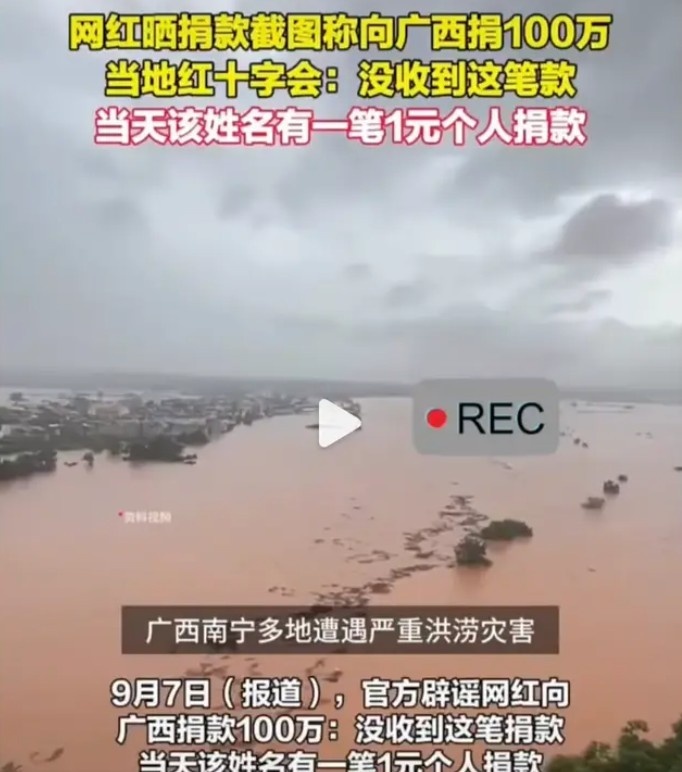
This year, multiple typhoons have caused heavy rainfall, flooding, and geological disasters in various regions, including Fujian and Guangxi. While many netizens have donated money and goods to support the affected areas, some have taken advantage of the situation to fabricate false charitable acts for the sake of gaining attention. (Video screenshot)
[People News] Recently, due to the impact of several typhoons, strong rainfall and severe flooding have struck areas like Fujian and Guangxi in China. The general public is suffering greatly, yet the events unfolding online are both disheartening and infuriating.
"Staged disaster relief" and "AI-generated fake charity"
According to recent news reports, numerous internet celebrities and influencers have been actively posting screenshots of their donations on social media platforms in mainland China.
For instance, the Douyin account "Qiu Ye Bai" shared a certificate indicating a donation of 100,000 yuan to the "Putian Red Cross Foundation," presenting himself as a generous philanthropist and commenting, "A small effort, not worth mentioning." However, upon verification, it was found that the organization name, logo, and punctuation of the donation amount in the screenshot he posted did not match the actual details, raising suspicions of fraudulent donations.
This video from "Qiu Ye Bai" received over 7,000 likes and thousands of comments, with many netizens from Fujian expressing their thanks in the comments.
Another account on Xiaohongshu, "An Lan," which has over ten thousand followers, posted a screenshot showing a donation of 1 million yuan to the Guangxi Zhuang Autonomous Region Red Cross, quickly gaining tens of thousands of new followers. The screenshot indicated that the donation was made on July 17, and this account also published content such as "Post-disaster reconstruction, doing my small part," which garnered thousands of likes and rapidly increased its follower count to 31,000.
However, staff from the Guangxi Zhuang Autonomous Region Red Cross Society reported that they did not receive a personal donation of 1 million yuan on July 17. Upon checking the names provided by netizens, they found a donation of only 1 yuan on that day, and the last digits of the account number did not match the screenshot shared by 'Anlan'. Attempts to reach out to that account went unanswered. Following this, Xiaohongshu announced that the relevant posts had been addressed and that the account had been muted.
This phenomenon of 'fake donations, real follower attraction' is not new. It dates back to earlier incidents, such as a singer who photoshopped a donation slip from 100 yuan to 18,000 yuan during the heavy rains in Henan, and now we see internet celebrities in Gansu using AI to generate entire sets of disaster relief certificates, fabricating a 'public welfare good person' image. The display of 'public welfare donations' during disasters is increasingly being exploited by some for traffic.
The fraudulent ecology is fostered by the notion of 'great, glorious, and correct'
Why can even natural disasters that threaten lives and cause widespread suffering be used as tools for gaining traffic?
Many believe this reflects the moral decline of modern self-media and the unscrupulous behavior of internet celebrities chasing traffic. However, if we reflect more deeply, is the underlying issue really just that some individuals possess 'low quality'?
This situation is, in fact, an inevitable outcome of the long-term brainwashing by the Chinese Communist Party and the erosion of traditional moral values, resulting in a 'collective poisoning' of society.
In mainland China, the central leadership frequently adopts the role of the 'omnipotent leader', directing affairs from above, while local officials create false achievements, inflate economic data, and manipulate statistics to meet targets and win the favor of their superiors, ultimately securing personal promotions. This evaluation system, which prioritizes pleasing those above rather than those below, has normalized concealment and deception within the ranks of officials.
From academic plagiarism to financial fraud, and extending to the most alarming issues of food and drug safety—such as gutter oil, counterfeit vaccines, and toxic milk powder—these fabrications have significantly undermined the fundamental trust between individuals.
Even more disheartening is that investigative journalists, professional fraud fighters, or rights-protecting parents who dare to speak the truth may face suppression or 'stability maintenance' when confronted with local protectionism, resulting in a reverse elimination of those who challenge the status quo.
This social phenomenon is rooted in deep cultural and institutional factors. The central government is engaged in a grand performance, proclaiming its 'leadership' and status as a 'responsible major power', while officials at various levels flatter one another and compete in their displays, and numerous unscrupulous merchants at the grassroots level engage in fraud for profit. Consequently, society is sinking into this 'theater of deception'.
When the cost of telling the truth is prohibitively high, and lying can bring benefits or protection, society becomes saturated with 'toxic falsehoods', and those living within it inevitably become tainted by this toxicity. As a result, people tend to go with the flow, while those who resist become a minority or even targets of suppression. It has become a common occurrence to lie publicly and to deceive in front of the camera, no longer raising eyebrows.
When even 'kindness' must be artificially created through photo editing and AI, the harm this system does to social morality and human nature is far more frightening than typhoons and floods.
(Originally published by People News)
△





News magazine bootstrap themes!
I like this themes, fast loading and look profesional
Thank you Carlos!
You're welcome!
Please support me with give positive rating!
Yes Sure!