
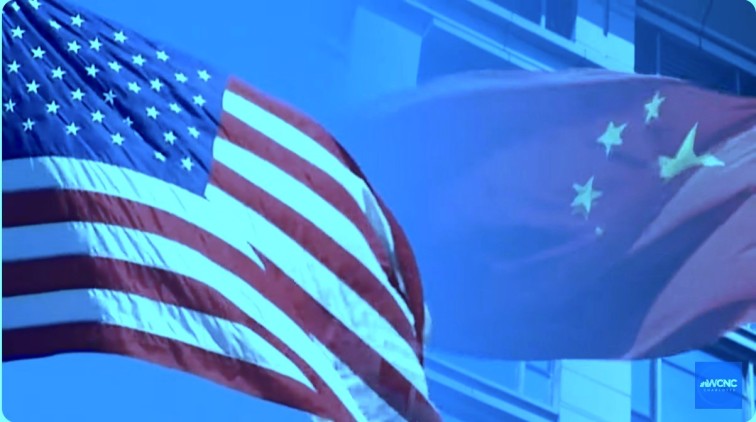
U.S.-China Confrontation. (Video screenshot)
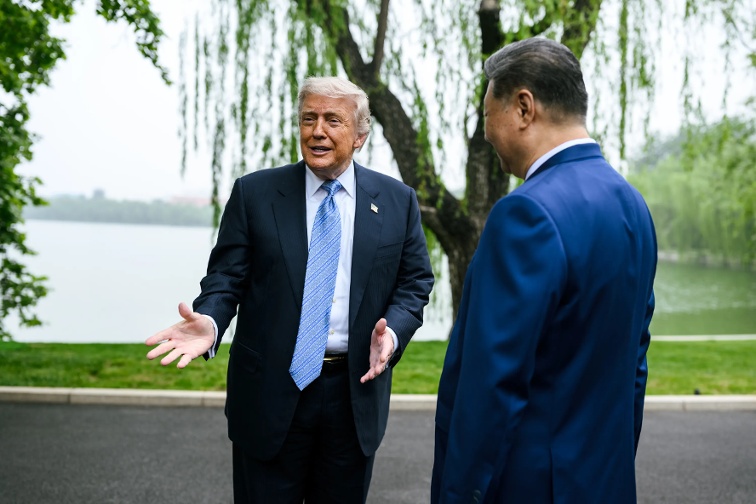
[People News] Chinese Communist Party leader Xi Jinping is expected to arrive in the United States on the afternoon of September 23, Eastern Time, to commence his visit and hold another summit meeting with President Trump. Various scholars and commentators suggest that the discussions between the two leaders may encompass a wide array of topics, including the trade war, arms sales to Taiwan, restrictions on artificial intelligence technology, and the 'US-China strategic relationship.'
Highlight 1: Will the Trade Truce Be Extended?
Bonnie S. Glaser, a prominent scholar on US-China-Taiwan relations and director of the German Marshall Fund, stated in an interview with RFA that both Trump and Xi are keen to maintain a relatively stable US-China relationship and effectively manage the issues that arise between them. A breakdown in relations could have adverse effects on both nations. However, there are still specific economic issues that require resolution, with the most pressing concern being the trade truce.
Glaser pointed out that the 'truce period' for US-China trade is set to expire in November, and it remains uncertain whether the two sides will officially announce an extension of the 'truce period' during the upcoming summit. Reports indicate that the US is seeking to extend the truce for six months, while the Chinese Communist Party aims to prolong it until the end of Trump's term. Despite the differing timelines proposed by both parties, Glaser believes that the trade truce is likely to continue, stating, 'The only question now is how long it will be extended.'
Highlight 2: How to Articulate the US-China Strategic Relationship
Wu Guoguang, a senior researcher at the China Economic and Institutional Research Center at Stanford University, recently delivered a public lecture in Taipei, where he discussed the agreement reached between Xi Jinping and Trump during the May summit to establish a 'constructive strategic stable relationship between China and the United States.' Wu interpreted this relationship as having two main components: first, the Chinese Communist Party (CCP) is seeking to leverage the current opportunity for renewed engagement between China and the U.S. to enhance bilateral exchanges in trade, technology, culture, and other areas, effectively reverting to the conditions that existed before Trump's first term. He believes that the CCP is using these exchanges to gain technological and economic advantages from the U.S., while simultaneously infiltrating and utilizing American companies to influence U.S. politics.
From the U.S. perspective, there is a strong desire to secure short-term economic benefits from China. China has already pledged to purchase U.S. agricultural products, Boeing aircraft, and more. The U.S. is keen for China to fulfill these commitments to bolster support for the ruling party ahead of the midterm elections. Furthermore, the U.S. hopes for Chinese cooperation on international issues, such as the U.S.-Iran conflict, but the CCP appears unwilling to make any commitments in this regard.
Point of Interest Three: The Taiwan Issue
Wu Guoguang believes that during the May summit, Xi Jinping's reference to a 'constructive strategic stable relationship' also entails a request for the U.S. to refrain from intervening in the Taiwan Strait conflict. The CCP perceives Trump's term as a 'window of opportunity.'
Wu analyzed that Xi Jinping has three objectives: first, for the U.S. to at least subtly and indirectly signal that it will not intervene in military conflicts in the Taiwan Strait. Second, to exert pressure on the U.S. to minimize or even cancel arms sales to Taiwan. Third, to 'educate' Americans that 'the status quo in the Taiwan Strait cannot be maintained indefinitely.'
Huang Jiezheng, the Chairman of the Taiwan Chinese Strategic and Wargaming Research Association, noted in a newspaper commentary that during the summit between the two heads of state, Taiwan should focus not on dramatic 'big deals' but rather on the seemingly reasonable 'small adjustments' that occur repeatedly. It is not about the United States changing its Taiwan Strait policy overnight; instead, it is about gradually defining what Taiwan can do, when it can do it, and to what extent, all under the pretext of 'strategic stability relations.'
Huang Jiezheng also believes that Xi Jinping's visit to Washington cannot solely revolve around Taiwan without addressing Japan. This is because Taiwan, Japan, the U.S.-Japan alliance, the First Island Chain, and the post-war order are increasingly interconnected. Thus, what Beijing truly hopes Trump will restrain may extend beyond Taipei to include Tokyo and the growing security ties between Japan and Taiwan.
Point of Interest Four: Artificial Intelligence Technology
Li Houcheng, a commentator living in Japan, argues that when it comes to AI issues, there are both 'surface' and 'actual' layers in the discussions between the two countries. On the surface, the talks will likely cover topics such as 'joint defense against AI risks' and 'dominance in AI security.' However, Trump has previously stated quite candidly that the development of AI must not fall behind China, and discussing issues like 'threats to humanity' only aids China in catching up. Of course, on the other hand, China's policies must also keep pace with those of the United States.
Regarding the actual restrictions on technology procurement and transfer, Li Houcheng noted that the Chinese Communist Party (CCP) is certainly hoping that the United States will not only lift the current restrictions on H200 chips but will also go further to ease the embargo on advanced B200 and even B300 chips. NVIDIA's CEO Huang Renxun likely shares this perspective, stating, 'This is what China aims to achieve at the Xi-Trump meeting.' Both the CCP government and Huang Renxun have strong incentives to remove all sales restrictions and embargoes on chips to China.
Consequently, Li Houcheng believes that the main point of interest at the US-China summit is how effectively Huang Renxun can lobby and influence policy decisions during the discussions. (Adapted from Radio Free Asia)
△




News magazine bootstrap themes!
I like this themes, fast loading and look profesional
Thank you Carlos!
You're welcome!
Please support me with give positive rating!
Yes Sure!