
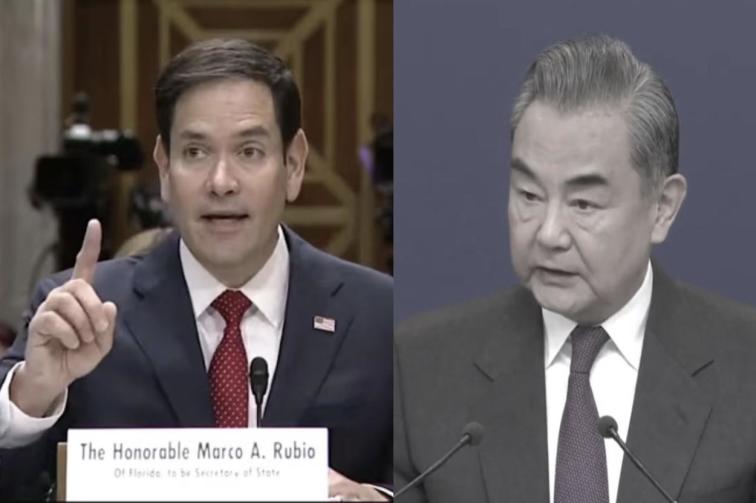
Rubio (left) and Wang Yi (right). (Composite image by People News)
[People News] The European Subcommittee of the U.S. House Foreign Affairs Committee recently held a hearing titled 'Hybrid Warfare Against U.S. Interests in Europe: Strategies of Moscow and Beijing.' In his opening remarks, subcommittee chairman Keith Self warned that the 'hybrid warfare' initiated by Russia and China (the Communist Party) in Europe against the interests of the United States and its allies has already begun in earnest. Experts suggest that the aim of the China-Russia 'hybrid warfare' is to fracture Western unity and create strategic paralysis within the free world, with the Communist Party identified as the instigator and primary source of global issues.
According to NATO's definition, 'hybrid warfare' combines military and non-military means, as well as covert and overt methods. This includes spreading false information, conducting cyberattacks, applying economic pressure, deploying irregular armed forces, and utilising regular troops. The 'hybrid warfare' model seeks to obscure the distinction between war and peace, aiming to instil doubt among target populations, with the ultimate objective of destabilising and undermining entire societies.
The Communist Party Continues Its Hybrid Warfare Efforts in Europe.
From the 12th to the 16th of this month, Wang Yi, the Foreign Minister of the Communist Party of China, visited the Middle Eastern nations of the United Arab Emirates, Saudi Arabia, and Jordan. Throughout his trip, Wang Yi criticised Japanese Prime Minister Kishi Matsumoto, relaying the Communist Party's stance that 'Japan must change the status quo in Taiwan.' He warned that 'tolerating 'Taiwan independence' will allow various separatist forces to create chaos on the international stage.' Just days prior, Wang Yi was actively engaging with European leaders in France, the United Kingdom, and Germany, pressuring and enticing these nations to align their statements regarding Japan and Taiwan with the Communist Party's position, thereby broadening their support. Analysts believe this may be an effort to create confusion ahead of a potential attack on Taiwan by the Communist Party in 2027, effectively waging a cognitive war.
Regarding economic pressure, the Chinese Communist Party (CCP) is leveraging rare earths as a tool to threaten both Europe and the United States. It seeks to unite the European Union against the U.S. tariff hikes while simultaneously attempting to create divisions within the EU to tackle each member state individually. The situation is inconsistent; for example, there was a recent announcement about halting rare earth exports, but today (the 18th), during a routine press conference by the Ministry of Commerce of the People's Republic of China, spokesperson He Yadong revealed that some applications for general export licenses for rare earths from Chinese exporters have been approved. Brandishing a large sack of 'people's currency' to 'dance with swords' globally, the CCP alternates between sanctioning certain companies and raising taxes on specific products. Concurrently, Chinese companies are strategically embedding themselves in ports, logistics hubs, telecommunications networks, data centres, and renewable energy supply chains to create artificial dependencies. When European nations cross Beijing's political red lines, the CCP applies pressure through informal trade blockades, counter-sanctions, and threats to limit market access. For instance, on December 16, the Ministry of Commerce of the People's Republic of China announced that starting December 17, tariffs ranging from 4.9% to 19.8% would be imposed on pork imports from the EU.
In the realm of cyber attacks, France, Germany, and the Netherlands have all accused Beijing of launching cyber assaults against them. Last week, the UK imposed sanctions on Sichuan Anxun Information Technology Co., Ltd. and Chengxin Technology Group, citing cyber attacks as the reason. The Chinese Communist Party (CCP) responded with strong criticism of the UK and the US, claiming to be the largest victims of their cyber operations and accusing them of collusion. Following this, Norway also expressed serious concerns regarding the malicious cyber activities carried out by certain Chinese information security companies. Many European nations suspect that the CCP's cyber attack objectives include stealing technology and information, conducting espionage, and disrupting the social operations of other countries. For example, the construction of a super-large embassy in the UK is suspected to facilitate the CCP's espionage activities.
Furthermore, Chinese vessels have been implicated in the cable-cutting incident in the Baltic Sea, with EU government officials and NATO member states accusing the CCP of engaging in hybrid warfare and sabotage. A bulk carrier named 'Yipeng 3', owned by 'Ningbo Yipeng Shipping Co., Ltd.', was reported to have deliberately dragged anchor and sailed 100 miles near the island of Öland in Sweden, severing two Baltic Sea data cables. This incident resulted in the 'BCS East-West Interconnection' submarine cable, which connects Lithuania and Sweden, being cut. Simultaneously, the C-Lion1 submarine cable, which connects Finland and Germany, also experienced a break in the same area of the Baltic Sea, leading to a disruption of telecommunications services in both countries.
Awakening of Western and American Experts
William R. Keating, a senior member of the Democratic Party's European Subcommittee, remarked, "We are currently in a state of war. As the world transitions into a new era of fifth-generation warfare, malicious entities, including the Russian Federation and the People's Republic of China, are employing all means necessary to undermine the interests of the United States and its allies. Both Russia and China are leveraging diplomatic, informational, military, and economic tactics to intimidate, harass, and disrupt NATO member states, as well as other nations, institutions, and societies. Since Russia's full-scale invasion of Ukraine in 2022, the 'complexity and persistence' of these new strategies from Russia and China have only intensified."
Keating further stated, "Russia and China (the Communist Party of China) are swiftly forming an alliance, continuously enhancing their action plans to exploit vulnerabilities, manipulate political discourse, and weaken our shared transatlantic values."
"Beijing is trying to undermine the European Union through bilateral economic cooperation with countries such as Hungary and Serbia, pressuring allies and partners to recognise Taiwan, eroding Europe's capacity to defend against cyberattacks, and instilling doubt within our democratic institutions," Keating added.
Experts indicate that the hybrid warfare tactics employed by the Chinese Communist Party against Europe far exceed those of Russia. They share an increasingly close symbiotic relationship in the realm of disinformation propaganda; however, the methods used by the Chinese Communist Party are more diverse, more forceful, and carry more severe consequences.
Craig Singleton, a senior fellow at the Foundation for Defence of Democracies (FDD), stated that China (the Chinese Communist Party) is attempting to create a "more divided and distracted" Europe through a strategy of "divide and conquer." This approach aims to establish a strategic advantage for the future by undermining the resolve of countries on both sides of the Atlantic, thereby evading responses led by the United States. He explained that the Chinese Communist Party is infiltrating Europe’s networks, politics, and information space using normative shaping tools such as the united front and inter-party relations, as well as Confucius Institutes and loosely regulated research collaborations. For example, they have been supplying microelectronics and other dual-use materials to Russia in its war against Ukraine. "The two countries are implementing a complementary hybrid strategy."
Christopher Walker, vice president of the European Policy Analysis Centre, highlighted at the same hearing that Beijing plays a crucial role in Russia's unconventional military "shadow war" against Europe.
"China (the Chinese Communist Party) is a key driver of Russia's and Moscow's 'shadow war.' These two authoritarian states share common interests in dividing Western unity and creating strategic paralysis within the free world—as long as they can achieve it," he remarked.
Zelensky: Russia aims to make 2026 another 'year of war'
Ukrainian President Volodymyr Zelensky warned on December 17 that Russia is preparing to continue its war in 2026, intending to make 2026 another "year of war." Previously, Russian President Vladimir Putin asserted that Moscow's objectives in Ukraine "will undoubtedly be achieved."
△





News magazine bootstrap themes!
I like this themes, fast loading and look profesional
Thank you Carlos!
You're welcome!
Please support me with give positive rating!
Yes Sure!