

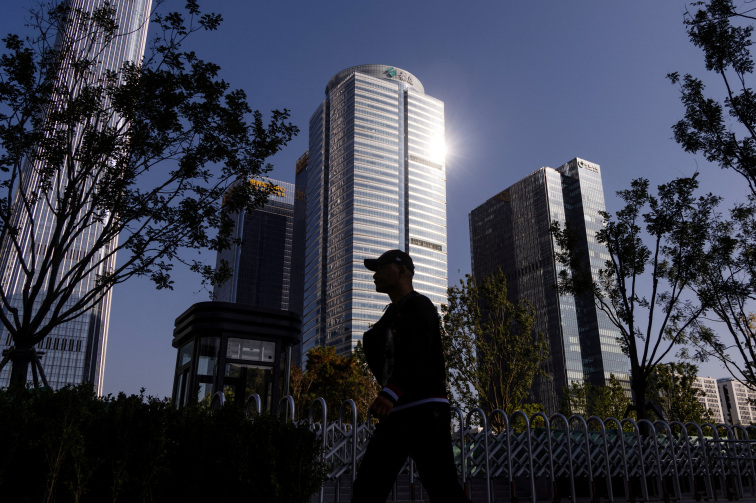
China’s economy is declining, the real estate market remains persistently weak, and unfinished housing projects are spread across the country. (People’s Daily Report)
[People News] The CCP’s top leadership concluded its two-day annual “Central Economic Work Conference” on December 11, for the first time explicitly pledging to reverse the decline in investment—an apparent sign that the leadership has become alert to the fact that many of China’s economic indicators are showing negative values.
A report by Deutsche Welle pointed out that if the CCP increases investment in export-oriented manufacturing while trying to expand domestic demand, the contradiction between the two is likely to persist.
For decades, China’s economic growth has been highly dependent on investment—not only in infrastructure and real estate, but also in recent years in high-end manufacturing such as electric vehicles and semiconductors. A sharp drop in investment indicates that Xi Jinping’s campaign to curb “involution” and excessive capacity competition has hindered local governments from approving new investments, which may already have impacted China’s economic performance.
According to official data released in November, China’s fixed-asset investment from January to October this year fell by 1.7 percent year-on-year, following a 0.5 percent decline from January to September. The CCP has not released month-by-month comparisons of fixed-asset investment, but based on the cumulative decline so far this year, October’s fixed investment is estimated to have fallen by about 11 percent compared with last year.
According to a Reuters report, the U.S. think tank Rhodium Group released a report on December 22 stating that China’s economic growth rate in 2025 is expected to be between 2.5 percent and 3 percent—less than half of what the CCP government projects. However, it is reported that the CCP government plans to announce at its meeting next March that it has achieved an official economic growth target of “around 5 percent.”
The report pointed out that the gap between the CCP’s officially promoted 5 percent economic growth and the actual growth of about 2 percent is equivalent to a shortfall of roughly $500 billion in domestic economic demand.
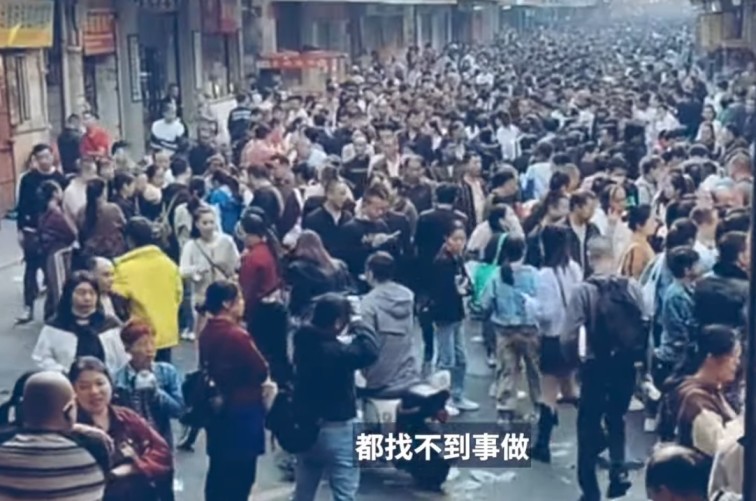
In fact, ordinary Chinese people do not believe the officially published figures. In the public’s eyes, apart from the dates, everything else in the state media is fake. According to official claims, if China’s economy truly grew by as much as 5 percent, why have housing prices nationwide fallen sharply? Why have so many large shopping malls closed down? Why does the army of unemployed keep growing? Why is it becoming increasingly difficult for college graduates to find jobs? Why are most storefronts on city streets closed and not operating? And why are the malls that do remain open mostly empty with no customers? Moreover, how can it be explained that more than 600 million Chinese people earn less than US$2,000 a year?
The huge discrepancy between the CCP’s official figures and reality has also been noticed by the U.S. think tank Rhodium Group that issued the report. The authors pointed out that the CCP’s official data themselves contain contradictions: on the one hand, the data show a decline in fixed-asset investment; on the other hand, official statistics still show capital formation making a positive contribution to gross domestic product (GDP). The report wrote: “Interpretations of China’s 2025 economic growth hinge on whether investment merely softened in the second half of the year, or whether it has already collapsed.”
Meanwhile, a Chinese stock analyst, Bu Qingsong, recently wrote that, based on his particular sensitivity to economic conditions, he feels that China’s economy is step by step moving toward the bottom.
Bu Qingsong, a former Shanghai stock analyst who entered the securities industry immediately after graduating from university, is a veteran analyst with a special sensitivity to economic trends, and he senses that China’s economy is gradually heading toward the bottom.
Through exchanges with clients who run businesses, Bu Qingsong found that their businesses were still doing well in the second half of 2023; in 2024 business became difficult but was still manageable; but from the end of 2024 to early 2025, business suddenly became extremely hard—clients could not be found and money could not be found. “I also noticed myself that in the past, old clients were very active in paying fees, but since June this year, it seems everyone has started tightening up more and more. Before, a few thousand yuan was nothing, even twenty or thirty thousand didn’t matter. Now everyone is desperately cutting back.”
Bu Qingsong observed that after 2020, China’s overall environment deteriorated; after 2022, local governments were already extremely short of money, and so-called ‘deep-sea fishing’ and cross-provincial arrests began to become common domestically. Now everyone is full of grievances: the ‘workhorses’ at the bottom have no money, and those at the top also have no money. “I know some people in the courts in Shanghai and Hangzhou—their year-end bonuses for 2023 and 2024 all had to be handed back.”
Bu Qingsong believes that under such economic distress, it is easy to understand why the CCP’s top leadership pushed the stock market on September 24 last year. He said this was “the first time the top leadership made such a statement” and that it was “extremely rare.”
He analyzed that in the ten years since Xi Jinping came to power, China’s GDP growth has declined all the way from double digits to single digits. Previously, the real estate market still provided support, so public resentment was not as strong. In 2022, housing prices began to fall, and the stock market also declined. At that time, finding a job became extremely difficult, industries became increasingly ‘involuted,’ and wage incomes were shrinking.
“If this is not resolved, it feels like everyone is full of resentment. Although people don’t dare to riot, one thing is clear: social hostility is extremely severe, and indiscriminate attack incidents occurred frequently in 2023 and 2024.”
Because of the economic downturn, the CCP government—from the central level to local levels—is now severely short of money. “Deep-sea fishing” law enforcement and illegal fines have become important sources of fiscal revenue for grassroots governments, but they have also triggered enormous public anger. A few days ago, merchants in Baoding City, Hebei Province, shut down almost all their shops in a citywide strike to resist the authorities’ illegal fines imposed under the pretext of inspections. During the incident, merchants across the city could be described as “united as one,” displaying a level of unity that can be called “rare in history.” Especially under CCP tyranny, this kind of “unity of the masses” is even more significant—and it has shocked and frightened the CCP. △



News magazine bootstrap themes!
I like this themes, fast loading and look profesional
Thank you Carlos!
You're welcome!
Please support me with give positive rating!
Yes Sure!