
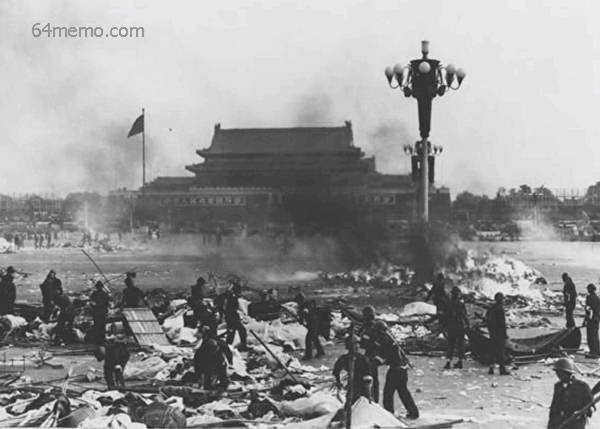
Many out-of-town students living in tents on Tiananmen Square died inside them. (Photo: DaJiYuan ImageLib / Dajiyuan)
[People News] As of January 12, the anti-government protests in Iran have entered their 16th day. Despite the Iranian government's violent crackdown, which has resulted in significant casualties among the people, the wave of protests continues unabated. What is unfolding in Iran is no longer merely a public protest; it has escalated into a significant Iranian revolution. The slogans have shifted from 'against rising prices' to 'Khamenei must step down.' Interestingly, Iran's Supreme Leader Khamenei rose to power in 1989, the same year as China's June Fourth incident. The Tiananmen Square democracy movement in China was ultimately suppressed by the military of the Chinese Communist Party. Similarly, the anti-government protests in Iran are now at a critical juncture reminiscent of the events of June Fourth. So, how will the current anti-government protests in Iran progress?
What started as a protest in Tehran's bazaar, where businesses ceased operations, has quickly transformed from a small spark into a raging inferno within just two weeks. Over 1.5 to 1.85 million Iranians have taken to the streets, with protests occurring in 585 locations across 186 cities and 31 provinces nationwide. In Mashhad, Iran's second-largest city, some neighbourhoods have even been seized by protesters.
The Human Rights Activists News Agency (HRANA) reported on January 11 that the latest figures indicate 544 people have been confirmed dead in the protests over the past 15 days. Furthermore, over 10,681 individuals have been arrested. However, according to statistics cited by Time magazine on the 12th from various hospitals in Tehran and scholars abroad, the death toll could be as high as 6,000 as of the 10th.
On January 12, the protests in Iran marked their 16th day, with Iranian Crown Prince Reza Pahlavi making a third appeal: to occupy and secure city centres and streets, to take over government institutions, and for officials and military police to make a choice. Diplomatic missions outside Iran are urged to replace the current flag with the 'Lion and Sun' flag of Iran.
In the UK, videos shared on social media showed protesters removing the Iranian national flag from the balcony of the Iranian embassy in London on both Saturday and Sunday of last week.
Videos from Australia on platform X indicated that an Iranian embassy in Australia has heeded the call of the Iranian Crown Prince by raising the 'Lion and Sun' flag of Iran.
On this day, the protests by the Iranian people reached a peak. Demonstrators occupied significant locations in the city centre and government buildings, urging the public to join in a larger-scale protest movement.
In the western and southern areas of Tehran, authorities have deployed the Islamic Revolutionary Guard Corps, all equipped with AK47 rifles. However, fearless protesters continue to charge forward, engaging in fierce resistance. Some protesters have picked up plastic trash cans to throw at the military and police, while also using their primary weapon—Molotov cocktails—to counter the modern equipment of the military and police. Many protesters have begun systematically destroying surveillance cameras or using cars to build barricades to block the advance of the suppression forces.
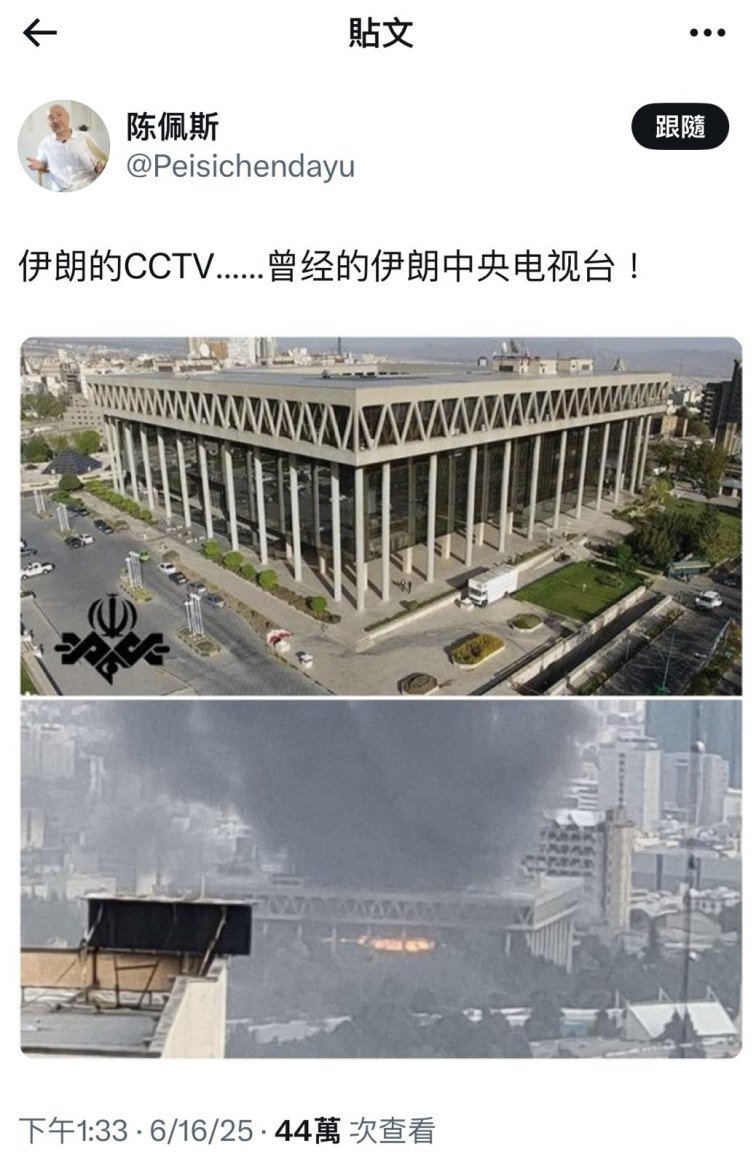
In the Rasht area of northwestern Iran, reports transmitted via Starlink indicate that the local situation has completely spiralled out of control, with nearly the entire population of the city taking to the streets, reportedly including pregnant women. Some have even set up tents directly on the streets. They declare that they will not return home until their struggle is victorious and comes to an end. The angry crowds have attacked all local mosques and have directly set fire to the state-owned broadcasting building, the telecommunications building, and government power institutions.
At 6 PM on the 12th, Tehran implemented a curfew. Simultaneously, Iranian President Ebrahim Raisi acknowledged, "If the problems cannot be resolved, the government will find it difficult to maintain its rule." This statement has been interpreted as a sign that the regime is on the brink of collapse.
The political news website Axios reported that U.S. President Donald Trump stated on January 11, Eastern Time, that Iranian leaders had called him, expressing a desire to negotiate. However, he added that the U.S. "may take action before the meeting."
Trump mentioned that he receives updates on the situation in Iran every hour and hinted that the Tehran regime has crossed the red lines he established.
Trump is scheduled to meet with senior U.S. national security officials on January 13 to receive briefings and discuss various strategies for addressing Iran, including sanctions, cyber warfare, or airstrikes, as well as providing Starlink assistance to help locals overcome internet disruptions.
Israel has emerged as a crucial player in escalating the situation. Prime Minister Netanyahu has publicly stated that "we are prepared for war." U.S. Secretary of State Rubio remarked after a conversation with Netanyahu, "The United States has a duty to prevent the Iranian regime from carrying out 'massacres' against its people."
Moreover, some officials from the Iranian regime are reportedly fleeing, with some spotted in Moscow. A report from The Wall Street Journal indicates that in the past week, their reporters have reached out to three mid-level Iranian government officials. The report reveals that these officials privately express a desire for the return of the Pahlavi dynasty.
At present, the key question is whether Trump will take action, and if so, in what form? Will the Iranian clerical regime fall? How can this be achieved without repeating the mistakes of China's failed Tiananmen Square democracy movement?
First, can the protesting Iranian populace endure the government's violent repression? If the protests continue, the crackdown will persist. This will require the Iranian people to pay a steep price; we are still in a stalemate phase, which is the most painful and bloody. However, if they remain steadfast, the international community will not remain passive, and the Iranian people will receive greater support from abroad.
Second, will there be a division within the Iranian government? Several experts emphasise that Iran's future hinges not on ideology, but on whether the Revolutionary Guard, Basij militia, and other coercive institutions will splinter.
The Revolutionary Guard and the Basij militia play crucial roles in Iran's political and security framework. The Basij militia is instrumental in protests and suppression efforts, while the Revolutionary Guard serves as Iran's military force. Should the Basij and the Revolutionary Guard choose to defect, it would significantly impact the stability of the Iranian regime.
Analysts suggest that the possibility of a military coup cannot be dismissed. If some members of the Basij split or opt to remain passive, and the Revolutionary Guard hesitates to fully engage, Iran's internal control could quickly unravel.
Most importantly, it is reported that Israel's Mossad intelligence agency has been focused on a critical task within Iran: identifying the exact location of Ali Khamenei. If a successful decapitation occurs, capturing Khamenei, along with a military coup and the courageous resistance of the Iranian people, could lead to the eventual downfall of the clerical regime.
(First published by People News)
△





News magazine bootstrap themes!
I like this themes, fast loading and look profesional
Thank you Carlos!
You're welcome!
Please support me with give positive rating!
Yes Sure!