
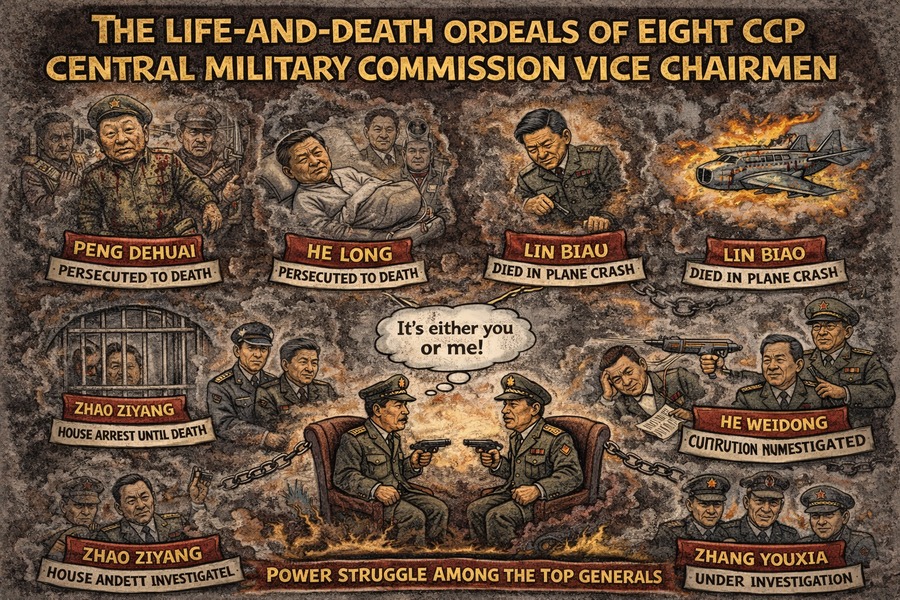
The Life-and-Death Ordeals of Eight CCP Central Military Commission Vice Chairmen
[People News] On January 24, Politburo member and Vice Chairman of the CCP Central Military Commission Zhang Youxia was suddenly officially announced to have fallen from power, becoming one of the most explosive pieces of news in Chinese politics at the start of 2026.
Looking back at the history of the CCP since it took power, at least eight vice chairmen of the Central Military Commission have faced life-and-death ordeals amid deadly internal struggles. Here is a brief review.
1. Peng Dehuai – Persecuted to Death
Peng Dehuai was a capable battlefield commander who made major contributions to the CCP’s seizure of power. Mao Zedong once praised him in a poem: “High mountains, long roads, deep pits—our great army gallops across. Who dares mount a horse with a blade in hand? Only our great General Peng!”
In 1950, Mao appointed Peng commander of the “People’s Volunteers” to fight in Korea, praising him as someone who could fight tough battles. After returning from Korea, Peng became Mao’s most capable assistant in military command. In 1955, he was awarded the rank of marshal.
Peng had long served in senior military roles: vice chairman of the Chinese Soviet Republic’s Military Commission in 1931, vice chairman of the CCP Central Military Commission in 1945, vice chairman of the Central Government Military Commission after 1949, and effectively vice chairman of the reestablished Central Military Commission in 1954.
In 1958, Mao enlisted Peng to lead a campaign against “anti-dogmatism,” targeting Marshal Liu Bocheng and others. But in 1959, Mao turned on Peng at the Lushan Conference after Peng wrote a candid letter criticizing problems with the Great Leap Forward. Backed by Lin Biao and others, Mao labeled Peng the head of an “anti-Party clique,” and Peng fell from favor.
During the Cultural Revolution, Peng was brutally persecuted. He was beaten by Red Guards and suffered broken ribs. From July 1967 onward, he endured more than 100 struggle sessions. Accused of anti-Party and anti-socialist crimes, Peng died on November 29, 1974, after years of imprisonment and abuse.
2. He Long – Persecuted to Death
After Peng’s fall in 1959, Mao reorganized the Central Military Commission, making Lin Biao first vice chairman and He Long second. Because Lin was often ill, He handled daily military affairs.
In 1964, during a visit to the Soviet Union with Zhou Enlai, Soviet Defense Minister Rodion Malinovsky told He Long that just as they had removed Khrushchev, the Chinese might remove Mao. He Long reported this to Zhou and Mao, but Mao remained deeply suspicious of marshals staging coups.
After the Cultural Revolution began, He Long was accused—based on rumors amplified by Kang Sheng—of plotting a “February mutiny.” In 1967, Mao ordered He placed under investigation and detention. Suffering from diabetes and denied proper care, He Long died on June 9, 1969. His wife later suggested he had been given fatal glucose injections.
3. Lin Biao – Died in a Plane Crash
Lin Biao was also a renowned commander who led major campaigns during the civil war. After 1949, he strongly supported Mao at key moments and was named Mao’s successor in 1969.
Later, Lin and Mao diverged over the Cultural Revolution. Mao wanted it prolonged; Lin favored stability and an end to turmoil. Their split became public at the 1970 Lushan Conference. In 1971, as Mao moved against him, Lin reportedly attempted to flee. On September 13, 1971, Lin died in a plane crash in Mongolia. He was later denounced as a traitor and plotter.
4. Zhao Ziyang – House Arrest Until Death
Zhao Ziyang became CCP General Secretary and first vice chairman of the Central Military Commission in 1987. During the 1989 pro-democracy movement, Zhao opposed the use of military force, clashing with Deng Xiaoping. Deng prevailed, leading to the June 4 crackdown.
Zhao was removed from office and placed under house arrest for 16 years, dying in 2005.
5. Guo Boxiong and Xu Caihou – Investigated for Corruption
Both were promoted under Jiang Zemin to serve as his proxies in the military after his retirement. Their tenure was marked by massive corruption, including selling military ranks. Xu died of illness in 2015 during prosecution; Guo was sentenced to life imprisonment in 2016.
6. He Weidong – Investigated, Reportedly Suicide
He Weidong rose rapidly under Xi Jinping and was seen as a key ally for potential Taiwan operations. In 2025, he was detained for investigation over serious violations and corruption. Reports later claimed he had committed suicide.
7. Zhang Youxia – Under Investigation
A long-time associate of Xi Jinping, Zhang had extensive combat experience and played a role in Xi’s third term. Yet in January 2026, he was abruptly removed and accused of multiple serious political and corruption crimes. The full story remains unclear.
Conclusion
Why have so many vice chairmen of the Central Military Commission met tragic fates?
The CCP has long believed that “political power grows out of the barrel of a gun.” Whoever controls the military holds real power. The person closest to the CMC chairman is the vice chairman. The chairman fears coups most—and the most likely challenger is the one closest to him. Better to eliminate a potential rival first than be eliminated. This logic has repeatedly led to the downfall of CMC vice chairmen.
As long as military power does not come from legitimate public authorization, both the CMC chairman and vice chairmen will remain permanently insecure.
— Dajiyuan






News magazine bootstrap themes!
I like this themes, fast loading and look profesional
Thank you Carlos!
You're welcome!
Please support me with give positive rating!
Yes Sure!