
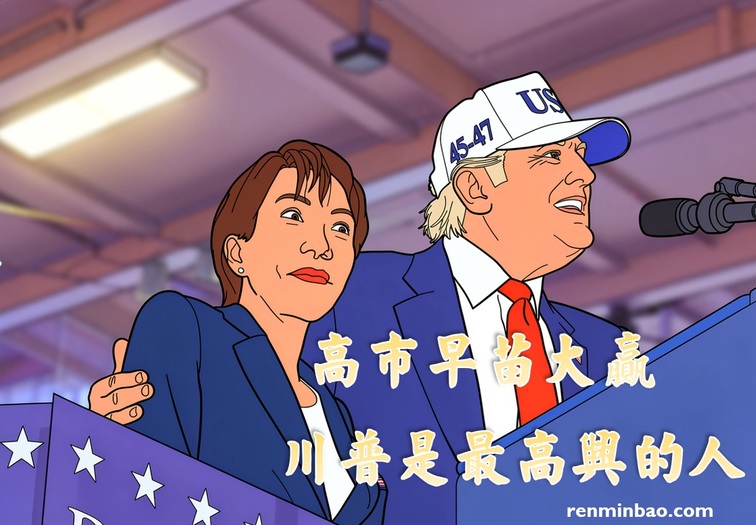
“With Sanae Takaichi’s big win, the happiest person is Donald Trump.”
[People News] In the recent House of Representatives election, Japanese Prime Minister Kishi Sanae led the Liberal Democratic Party to a decisive victory, which not only solidified her government's foundation but also successfully surpassed the 'two-thirds' threshold for constitutional amendments. This early election, seen as a 'political gamble', has reshaped Japan's political landscape and stirred geopolitical sensitivities among the U.S., China, and Japan.
Notably, U.S. President Trump took the unusual step of publicly endorsing Kishi Sanae before the election. He described her on social media as 'strong, powerful, and wise', announcing 'full and complete support' for Kishi and her ruling coalition. Trump also confirmed that Kishi would visit the White House on March 19, signalling to the world that the U.S.-Japan alliance is set to strengthen during the 'Kishi era'.
On one hand, the U.S. hopes Kishi will use her constitutional amendment advantage to reclassify the Self-Defence Forces as a 'National Defence Army' and effectively enhance 'enemy base attack capabilities'.
On the other hand, as a reciprocal gesture, Trump expressed strong concerns about Japan's $550 billion investment and financing progress in the U.S. Following Kishi's victory, these projects are expected to be expedited to ensure the stability of the U.S.-Japan alliance.
In contrast to the U.S. enthusiasm, Beijing's response to Kishi's victory has been tepid. Chinese Foreign Ministry spokesperson Lin Jian stated at a press conference on February 10 that Sino-Japanese relations would not change due to the election results, criticising Kishi for 'calling for dialogue while engaging in confrontation'.
Following the Liberal Democratic Party's victory, on the evening of February 9, platforms like Baidu Tieba in mainland China began to disseminate anti-Japanese sentiments, alleging that Japan would push for "militaristic constitutional amendments." Online rumours claimed that Japan's new constitution would "permit proactive military action against foreign nations" and require that "individual rights must absolutely submit to the government."
So, what is the reality?
Data indicates that these rumours are a malicious distortion of the constitutional amendment proposal introduced by the Liberal Democratic Party in 2012. The proposal explicitly states that Japan will continue to renounce the use of war as a means of exercising national sovereignty while maintaining its right to self-defence.
Regarding the so-called "submission to the state" clause, it is actually a temporary measure intended for "emergency situations" such as earthquakes and large-scale natural disasters, and the clause clearly stipulates that the government must still respect basic human rights.
This type of misinformation has sparked radical rhetoric on Chinese internet platforms, with some netizens even calling for the "de-industrialisation" of Japan. This tactic is consistent with the Chinese Communist Party's approach of spreading false information and exploiting nationalist sentiments to mislead the public.
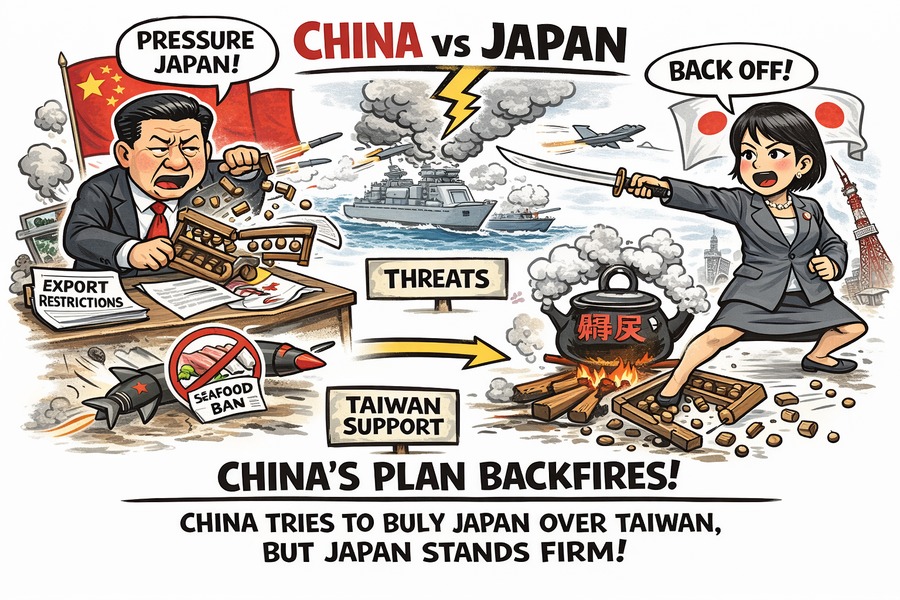
In light of the potential for Sōma Takamatsu to establish a long-term administration, the Xi Jinping government finds itself in a dilemma. On one hand, China continues to demand that Japan retract statements concerning Taiwan's core interests; on the other hand, Beijing is compelled to seek dialogue opportunities, with rumours suggesting a possible meeting between Chinese and Japanese leaders at the APEC summit this November.
△







News magazine bootstrap themes!
I like this themes, fast loading and look profesional
Thank you Carlos!
You're welcome!
Please support me with give positive rating!
Yes Sure!