

Over the past two days, the CCP’s discipline inspection system has unusually issued dense announcements. Officials from the financial regulatory system, central SOE energy sector, public security system, and multiple local party and government departments have successively been investigated or expelled from the Party and public office. (Web screenshot)
[People News] Over the past two days, the Chinese Communist Party’s discipline inspection system has unusually issued a concentrated wave of announcements. Officials from the financial regulatory system, central state-owned enterprise energy sector, public security system, and multiple local party and government departments have successively been investigated or subjected to “double expulsion” (expelled from the Party and removed from public office).
The notices cover central financial regulatory authorities, the National Energy Group, deputy mayors at the prefectural level, county-level organization department heads, and former deputy directors of autonomous region public security departments. Multiple lines of power have been shaken simultaneously.
Insider: “I’ve Never Seen Arrests at This Frequency”
According to a report by The Epoch Times, Mr. Ye, an insider familiar with the CCP’s discipline inspection system, told reporters:
“In January and February this year alone, seven ministerial-level officials have already been investigated, about 30 vice-ministerial and lower-level officials have been investigated, and another nine military generals have fallen. I’ve never seen arrests at this frequency. Now that most high-ranking officials have been taken down, they’ve begun retroactive investigations going back 20 years, extending down to county- and section-level officials, executives of state-owned enterprises and public institutions—even hospital directors and chief physicians are being investigated.”
Mr. Ye believes this round of rectification is clearly different from previous “point-based anti-corruption” campaigns and has entered a stage of systemic retroactive investigation. From ministerial-level officials down to grassroots section chiefs, and further into public institutions and professional systems, the scope of investigation shows a pattern of downward pressure layer by layer.
On February 26, Jiangsu Economic Daily disclosed case details of Liu Zhangjun, former director of the Office for Handling Illegal Fundraising under the former China Banking Regulatory Commission. The notice stated that between 1998 and 2021, Liu committed 50 illegal and criminal acts involving 190 million yuan (RMB). He allegedly used regulatory resources to facilitate job placements in the banking system for multiple individuals, charging from hundreds of thousands to millions of yuan per person. Authorities also disclosed that after retirement, he continued helping companies secure loans and job placements, accepting bribes totaling 37.03 million yuan.
Ms. Fang, a source familiar with Nanjing’s financial regulatory system, revealed that Jiangsu authorities are currently conducting concentrated asset investigations targeting key individuals. She said:
“The Jiangsu Provincial Commission for Discipline Inspection and Supervision has set up a special task force, led by the Party secretary, with the discipline inspection secretary directly responsible for the investigation. Officials’ assets—including bank deposits, real estate, and companies, stocks, and securities they directly or indirectly hold—are all under review. Even retirees who have already undergone departure audits are being investigated a second and third time. Financial systems across provinces must cooperate.”
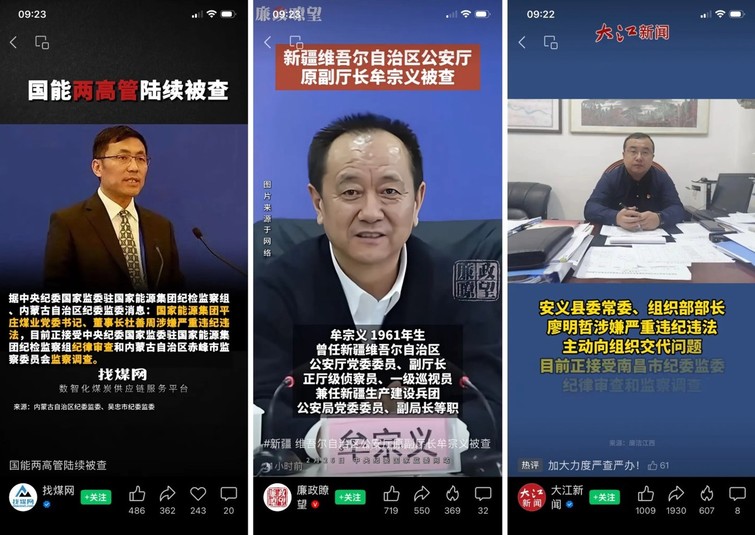
Over the past two days, the CCP’s discipline inspection system has unusually issued dense announcements. Officials from the financial regulatory system, central SOE energy sector, public security system, and multiple local party and government departments have successively been investigated or expelled. (Web screenshot))
“The Party Is Short of Money and Wants to Refill the Treasury”
On the same day, the discipline inspection and supervision group stationed at the National Energy Group under the Central Commission for Discipline Inspection announced that Du Shanzhou, Party secretary and chairman of Pingzhuang Coal Industry under the National Energy Group, is suspected of serious violations of discipline and law and is under investigation. The National Energy Group is a central state-owned energy enterprise with massive coal assets.
Zhao Youlin (pseudonym), a former researcher at a nonferrous metals institute, told reporters that corruption in the energy sector has long existed and is severe.
“This industry is highly specialized, making it difficult for outsiders to intervene. In the energy sector, projects are highly centralized. Procurement, resource allocation, and project approvals all circulate within the internal system. Once one link is investigated, the entire network of relationships gets uprooted. Right now, the Party is short of money and wants to retrieve funds to refill the state treasury.”
Rectification Extends to the Grassroots, Targeting the Sale of Official Positions
Currently, as the CCP leadership seeks to consolidate its power, the scope of official rectification has extended to prefectural and county-level party and government systems, with corruption cases at the grassroots level emerging intensively.
On February 25, “Clean Jiangxi” reported that Liao Mingzhe, member of the Standing Committee of Anyi County and head of its Organization Department, is suspected of serious violations of discipline and law. He has voluntarily confessed issues to authorities and is under investigation by the Nanchang Municipal Commission for Discipline Inspection and Supervision.
Mr. Chen, familiar with Jiangxi’s party and government structure, told reporters:
“When an organization department head falls, it often implicates a large number of local officials. The organization department controls promotions. Their way of making money is selling official positions. Party secretaries of state-owned enterprises, hospitals, schools, town governments, and subdistrict offices are all connected to the organization department head. Once a local Party secretary is investigated, corruption cases among grassroots party and government officials follow.”
In Shandong, the provincial discipline inspection commission reported on February 25 that Jiao Weixing, former member of the Jinan Municipal Government Party Group, vice mayor, and former Party secretary of Laiwu District, was expelled from the Party and public office for actions including buying and selling official positions and engaging in power-money transactions.
In Heilongjiang, Li Qing, former deputy Party secretary and vice chairman of the Harbin Municipal CPPCC, was also “double expelled.” In Xinjiang, Mou Zongyi, former deputy director of the Xinjiang Uyghur Autonomous Region Public Security Department, was placed under investigation.
Mr. Chen said:
“This time, the systems targeted—finance, energy, public security, organization—are all key nodes of power and networks. The Central Commission for Discipline Inspection knows very clearly how these networks operate and how benefits are transferred. Investigating grassroots officials is not difficult. The concentrated announcements across regions send a deterrent signal. This is a psychological war.”
In addition, according to official announcements, Yang Haitao, former chairman of Huacheng Financing Guarantee Co., Ltd. in Fengtai County, Anhui, was expelled from the Party and public office, and his suspected duty-related crimes have been transferred to procuratorial authorities. △






News magazine bootstrap themes!
I like this themes, fast loading and look profesional
Thank you Carlos!
You're welcome!
Please support me with give positive rating!
Yes Sure!