
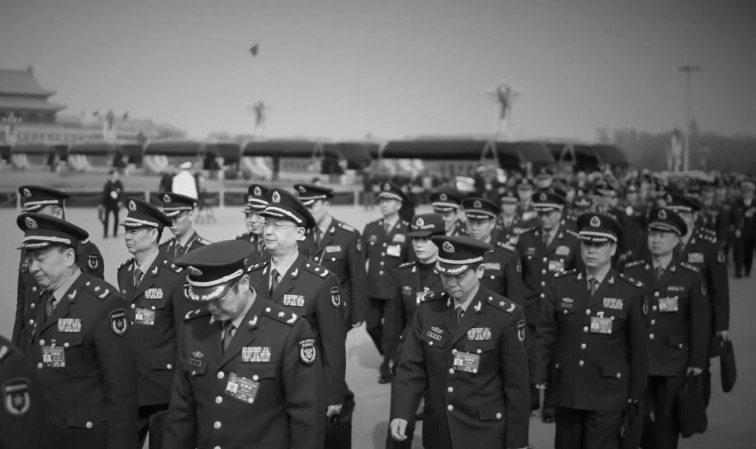
The new prophecy mentions that Xi will face a rebellion from the military and local warlords. The image shows the representatives of the Chinese military attending the Two Sessions in Beijing. (Video screenshot)
[People News] According to insiders within the Chinese Communist Party (CCP) system who disclosed information to The Dajiyuan, the latest internal briefing shows that in 2025, the CCP internally confirmed that the total amount of embezzlement, bribery, buying and selling of official positions, illegal income, and unrecovered illicit funds reached as high as 1.1 trillion yuan (RMB). Calculated across a population of one billion people, this averages about 1,100 yuan per person. Since last year, the CCP’s “second-round exit review” of retired officials has exposed astonishing hidden wealth accumulated over many years, including large amounts of undisclosed real estate and vast offshore deposits. Waves of interconnected corruption cases have implicated more than 60% additional individuals beyond those officials directly investigated.
Xinhua News Agency, citing the website of the Central Commission for Discipline Inspection and the National Supervisory Commission on January 17 this year, reported that in 2025, a total of 1.012 million cases were filed, including 115 officials at the provincial and ministerial level or above; 983,000 individuals were disciplined, including 69 officials at or above that level. At the same time, 33,000 bribers were investigated, and 4,306 were transferred to prosecutorial authorities.
No Upper Limit to Corruption — Only Higher Amounts
After a decade of Xi Jinping’s anti-corruption campaign, both the number of officials implicated and the amounts involved have continued to rise without limit. The sums already publicly disclosed are staggering. According to media reports, some have compiled a ranking:
At the top is Chen Yaoming, a former Party committee member and director of the China Banknote Printing and Minting Corporation, who was rumoured to have privately printed up to 2 trillion yuan. Next are Wang Yilin, former chairman of China National Offshore Oil Corporation, allegedly involved in 900 billion yuan; Fan Jixiang, former Party deputy secretary and chairman of Power Construction Corporation of China, allegedly involved in 970 billion yuan, with luxury bribe items transported by truck for a week; former central bank deputy governor Fan Yifei, with nearly 800 billion yuan in corruption; and Li Chuyuan, former chairman of Guangzhou Pharmaceutical Group, allegedly involved in 500 billion yuan.
Strange and Varied Methods of Corruption and Concealing Wealth
Many people are curious about how CCP officials can accumulate such enormous wealth, how they carry out corruption, and where they hide the money. In reality, these are long-standing issues. Because corrupt officials are never fully eliminated and continue to emerge, people suspect there must be lesser-known methods involved. Indeed, corruption techniques have evolved, with many new methods beyond ordinary imagination: shell companies to manipulate equity, shadow banking channels to circulate funds, acquiring real estate through lottery-like schemes, and using relatives and associates to channel investment funds. The methods are diverse and constantly changing.
Corrupt officials are difficult to detect not only because of their sophisticated techniques, but also because they often transfer illicit funds to relatives or mistresses abroad, launder money globally through intermediaries, or convert assets into antiques, gold, silver, and jewellery. More primitive methods include hiding cash in flower beds, burying it in rural manure pits, storing gold and diamonds in refrigerators or inside animal carcasses, or constructing hidden compartments in relatives’ homes. These methods are equally bizarre and hard to imagine.
Due to the sophistication of corruption and concealment, undetected cases are impossible to quantify. If we assume an average of 100 million yuan per corrupt official, then 1.1 trillion yuan would involve about 11,000 officials. With 1.012 million cases filed, assuming one case per person, there would still be at least one million officials not included in the official CCDI figures.
In other words, over a million officials may have been secretly dealt with internally last year. This includes figures such as Li Shangfu, Wei Fenghe, and Li Yuchao, who have disappeared, as well as others like Miao Hua, He Weidong, Zhang Youxia, Liu Zhenli, Jin Xiangjun, Lan Tianli, Bi Jingquan, Qi Zhala, Jiang Chaoliang, and Yi Huiman, whose whereabouts and case details remain unknown. Perhaps many of them have already been secretly handled.
Revealing the CCP’s Methods of Secretly Dealing with Officials
The CCP’s methods for secretly handling officials are varied and unusual, including confiscating illicit assets and releasing individuals, imposing Party disciplinary or administrative penalties, house arrest or bail pending trial, secret detention (“shuanggui” or “liuzhi”), extralegal imprisonment, sentencing without public trials, coercing suicide, or outright execution. Some of these individuals may no longer be alive. In some cases, the CCP may require individuals to remain silent, while in others it may keep them alive if further information is needed.
Detention sites are often located in secure rooms within government compounds or in specially designated facilities resembling small hotel rooms, such as closed-off guesthouses, training centres, or resorts. These rooms are equipped with barred windows to prevent suicide, padded walls and furniture edges, 24-hour surveillance, and no communication devices or clocks. In severe cases, torture instruments are used as psychological intimidation. These locations are highly secretive, meaning that even if officials are executed, their fate may remain unknown.
Historically, no country has seen such a large number of officials disappear after dismissal—vanishing without a trace, being “internally handled,” or quietly eliminated—on the scale seen in China. In this opaque system, an official may be publicly active one moment and vanish the next, quickly forgotten.
Do people still remember names such as Luo Qi, chief engineer of China National Nuclear Corporation; Xu Dazhe, former Hunan Party secretary; Yuan Jie, former chairman of CASIC; Chen Guoying, former general manager of China South Industries Group; Liu Cangli and Mo Zeyao of the China Academy of Engineering Physics; Lei Fanpei of the Central Military-Civil Fusion Office; Zhang Kejian, vice minister of Industry and Information Technology; Zhang Hongwen, Hefei Party secretary; or retired general Liu Yazhou?
In the first quarter of 2026 alone, at least five retired PLA senior naval officers reportedly “died of illness”: Bi Huiyi, Qian Jianjun, Wei Zhiguo, Huang Maojiang, and Wang Zheng. Official statements noted prolonged illnesses lasting weeks or months but provided no details. All shared naval backgrounds and died within a short period, making the situation appear highly unusual.
Is this a coincidence, or something else? Under strict information control, the collective deaths of these naval figures have become a mysterious topic.
Consider a case: Japanese scholar Eiji Suzuki was arrested in Beijing in 2016 on espionage charges and sentenced to six years. After returning to Japan, he revealed that the charges were absurd, stemming from a conversation mentioning the execution of Jang Song-thaek by North Korean leader Kim Jong-un. A Chinese diplomat he had spoken with was also arrested and possibly secretly executed.
While detained, Suzuki also heard rumours that a Chinese ambassador to Ireland had been secretly sentenced to death on espionage charges.
Independent commentator Du Zheng once quoted Zhou Guogang, a former mid-level official who fled to the U.S., as saying that many officials are sentenced to death each year without public disclosure.
Du Zheng’s research suggests that 42 centrally managed officials were “internally handled” in 2023, 34 in 2024, and even more in 2025. These are high-ranking officials appointed directly by the CCP Central Committee.
He believes that many cases of “depression-related suicides” or sudden “illness deaths” may actually involve officials already under internal investigation. Many high-ranking officials who have “disappeared” in recent purges likely fall into this category.
In December 2023, analysts from the Cercius Group, a Canadian think tank, noted that around 70 individuals were taken away during investigations into the Rocket Force—many of whom vanished without explanation.
Exiled legal scholar Yuan Hongbing has claimed that after the fall of Miao Hua, over 600 officers under his command would be purged, though their fate remains unclear.
Why Does the CCP Operate This Way?
Analysts point out that in a top-down political system with limited checks and balances, law enforcement does not rely on independent courts, investigative journalism, or civil society oversight. Instead, it depends on Party-directed campaigns. Large-scale investigations require mobilising personnel from multiple departments—often without legal expertise—turning enforcement into political movements. These processes themselves generate corruption, which is then covered up through extralegal means, creating a cycle that leads to disappearances.
Why has the anti-corruption campaign reached a point where “nothing can be said or dared to be said,” and yet continues to expand? Perhaps the scale of corruption is so vast that many cases must be handled secretly to avoid undermining the regime’s legitimacy.
A scholar of China’s political system, using the pseudonym Han Qing, told The Dajiyuan: “In a system where power is absolutely monopolised, resources are allocated opaquely, and oversight depends on ‘father investigating son,’ corruption becomes a standard product efficiently generated by the system itself. Anti-corruption is merely a mafia-style reshuffling of power during transitions.”
In other words, anti-corruption and the continuous emergence of new corrupt officials are part of the same process of redistributing illicit gains. Campaigns against “tigers and flies” serve as tools to maintain political loyalty.
Experts such as Wu Mulan of the Lee Kuan Yew School of Public Policy note that China’s anti-corruption bodies lack independence and operate according to top leadership directives, making outcomes unpredictable and selective. The root cause lies in the concentration of power and the Party’s control over all aspects of society, enabling bribery as a means of securing benefits.
This is especially evident in the military and defence sectors. Cases involving figures like Zhang Youxia and He Weidong may simply be part of broader political purges.
On March 25, a court in Dalian sentenced Tan Ruisong, former chairman of Aviation Industry Corporation of China, for accepting 613 million yuan in bribes, embezzling nearly 90 million yuan, and engaging in insider trading. The case highlights how concentrated power and closed approval systems enable prolonged corruption.
Military scholar Mr Chen noted that corruption in defence industries is not short-term but accumulates over time within systemic structures, creating self-replicating patterns.
An Unchangeable Cycle of Corruption
Will this situation change?
Analysts believe the CCP sees value in continuously generating and purging corrupt officials. By granting near-absolute power to officials, the system allows wealth extraction, followed by anti-corruption campaigns to reclaim resources, appease public sentiment, and enforce loyalty.
However, granting genuine public oversight would threaten the Party’s political monopoly and risk instability. As one commentator noted, such reforms resemble late Soviet experiments—something Xi Jinping is unwilling to attempt.
These observations suggest that anti-corruption in China is largely superficial. According to Du Zheng, corruption within the CCP is incurable, while “pseudo anti-corruption” practices grow increasingly opaque and severe—indicating a system heading toward a dead end.
(First published by People News)





News magazine bootstrap themes!
I like this themes, fast loading and look profesional
Thank you Carlos!
You're welcome!
Please support me with give positive rating!
Yes Sure!