
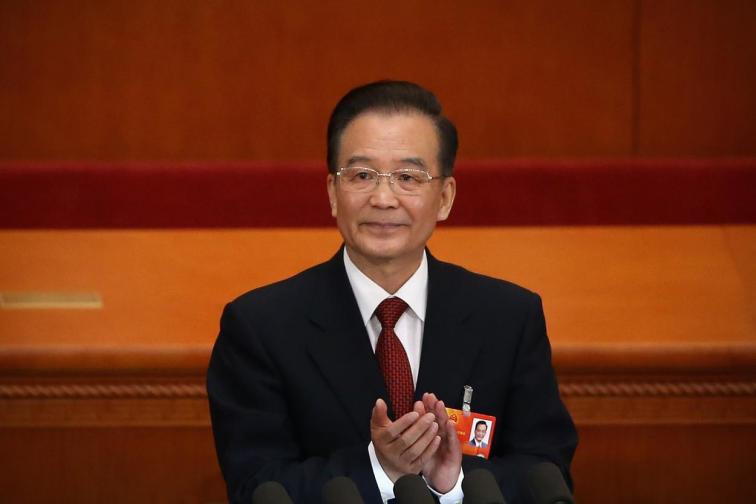
Former Chinese Premier Wen Jiabao. (Photo by Feng Li/Getty Images)
[People News] On March 27, photos of 84-year-old Wen Jiabao appearing publicly at the China University of Geosciences in Beijing began to spread widely online. Just as speculation about the authenticity of these images was rife, a video of Wen Jiabao surfaced on March 29 and quickly gained traction in overseas media.
In the video, despite his white hair, Wen Jiabao appears to be in good spirits, smiling and frequently bowing and waving to the crowd, who enthusiastically shouted, "Hello, Premier!"
Wen Jiabao was accompanied by individuals believed to be bodyguards and personnel from relevant departments. Observations from netizens indicate that he continues to enjoy the retirement benefits of a state-level official, complete with military commission support, former general staff, military vehicles with VA plates for escort, and a Hongqi-configured car.
Wen Jiabao earned both his undergraduate and master's degrees from Beijing Institute of Geology, now known as China University of Geosciences. He worked for a total of 17 years at the Gansu Geological Bureau and the National Bureau of Geology and Mineral Resources from 1968 to 1985. Currently, there are no official reports confirming his visit to the China University of Geosciences. However, his frequent public appearances have led many to believe that not only have previous rumours of his house arrest been dispelled, but they also suggest that he operates without any restrictions within the Chinese Communist Party.
Inside Story: A Life-and-Death Showdown Using 'Withdrawal from the Party' as a Weapon
Is Wen Jiabao's sudden appearance at his alma mater simply a display of his retirement life? Or is it a consequence of intense power struggles at the highest levels? What secrets lie behind this situation?
Lao Deng, a self-media figure known for frequently exposing the internal power struggles within the Chinese Communist Party (CCP), disclosed that during his house arrest, Wen Jiabao made a direct call to the General Office of the Central Committee of the CCP, dropping a political "nuclear bomb": "I want to withdraw from the party!" This bold statement hit Xi Jinping at a vulnerable point.
As a former Premier of the State Council, a public announcement of his withdrawal from the CCP would unleash a catastrophic political tsunami both internationally and domestically, effectively signalling the total collapse of the CCP's legitimacy to govern. Should he choose to renounce his party membership and return to being an ordinary citizen, Xi Jinping would lose the legitimate grounds to govern him under "party rules." While this may appear to be a retreat, it is, in fact, a strategic move for survival.
In response to Wen Jiabao's firm stance, reports suggest that Xi Jinping felt a considerable threat. To mitigate this crisis that could potentially lead to systemic collapse, the Xi administration was compelled to make concessions. According to sources, Shi Taifeng, the Minister of the Organisation Department, was dispatched to personally visit Wen Jiabao's home to offer "condolences," essentially to negotiate and de-escalate the situation.
Shi Taifeng's mission was to reassure this reform-minded elder statesman, urging him to consider the broader context and refrain from withdrawing from the party.
Regarding Wen Jiabao's potential "withdrawal from the party," we cannot currently confirm this information. However, it is noteworthy that Wen Jiabao is the first high-ranking party official to apologise to the public. On the eve of his departure from the premiership in 2012, he remarked at a press conference that without political reform, the historical tragedy of the Cultural Revolution could repeat itself, which left a lasting impression. He also acknowledged his responsibility for the various issues that arose in China during his tenure as the head of the national administrative agency, expressing his remorse for this.
Following Wen Jiabao's retirement, the Chinese economy has continued to decline, with the nation appearing to regress rapidly, reminiscent of another Cultural Revolution. It seems he has come to realise that the real impediment to China's development is not a particular leader, but the party itself.
In light of Wen Jiabao's dramatic final confrontation, his later public appearance represented a political deal between both parties: to create the illusion that Wen Jiabao's actions were unrestricted, thereby dispelling rumors regarding his house arrest.
Historical echoes: Hua Guofeng's secret withdrawal from the party
Wen Jiabao's suggestion to 'withdraw from the party' is not an isolated incident among the senior ranks of the Communist Party of China (CPC). Reports have indicated that former top CPC leader Hua Guofeng has secretly withdrawn from the party.
To understand this better, we should look back at history. Around 1980, the CPC Politburo convened nine consecutive meetings to discuss the issue of Hua Guofeng, during which senior figures like Chen Yun openly criticized him for disappointing leadership and called for his resignation. At the Sixth Plenary Session of the 11th Central Committee in 1981, Hua Guofeng's ranking fell from first to last, leading to his forced relinquishment of power.
Hua Guofeng passed away in Beijing on August 20, 2008. At that time, Hong Kong's Ming Pao reported on Hua Guofeng's withdrawal from the party. The report noted that the Japanese media outlet Asahi Shimbun revealed Hua Guofeng's proposal to withdraw from the party on November 2, 2001, which stirred unrest within the party.
Additionally, the Hong Kong monthly magazine Zhengming reported in November 2001 that Hua Guofeng, who was a Central Committee member at the time, did not attend the party's Sixth Plenary Session held in mid-September and later submitted a withdrawal application.
On November 6, 2001, Zhu Bangzao, the spokesperson for the Ministry of Foreign Affairs of the Communist Party of China (CPC), responded to a question from a Japanese journalist about whether Hua Guofeng had requested to withdraw from the party. He stated, "This question is beyond my scope to answer, and please refrain from asking such questions at the Ministry of Foreign Affairs press conferences in the future." At that time, some media analysts suggested that Zhu Bangzao's evasive response indicated that this incident was not without basis.
In 2005, several media outlets reported that Hua Guofeng had proposed to withdraw from the party, citing the CPC's betrayal of the legitimate rights and interests of farmers and workers, as well as the party's representation of corrupt officials and capitalist interests. The then General Secretary Hu Jintao convened a special meeting to address this matter. Reports also indicated that those who followed Hua Guofeng in submitting withdrawal requests included his former office director, his longtime bodyguard, his confidential secretary, and his personal driver.
The only way out: jumping from the sinking ship.
Wen Jiabao is regarded as one of the few reformists within the CPC who still possesses a clear understanding of China's future.
His call for "withdrawing from the party" could serve as a significant example at the highest levels. If even Wen Jiabao, the former second-in-command of the CPC, considers "withdrawing from the party" as a last resort for survival in a critical situation, it reflects that the CPC's internal system has completely lost its capacity for error tolerance and self-repair. Abandoning the "party ticket" may instead secure personal safety and spiritual freedom.
The cases of Wen Jiabao and Hua Guofeng, despite being decades apart, highlight a shared truth: within the power machinery of the Chinese Communist Party, no one is truly safe. This time, Wen Jiabao strategically chose to step back in order to advance, leveraging his 'withdrawal from the party' to engage in a strategic game with the Xi Jinping administration, which granted him a temporary sense of freedom and showcased his deep understanding of the system's inherent evils.
For many officials still entrenched in the system, this serves as a clear warning. As the Red Era approaches its end, making a timely exit from this sinking ship is not only the most rational choice for individuals but also their only path to survival.
The relaxed demeanour of Wen Jiabao at the entrance of China University of Geosciences, along with the smile he wore, conceals a resolute break from an old era, marked by both determination and wisdom.
(First published in People News)
△





News magazine bootstrap themes!
I like this themes, fast loading and look profesional
Thank you Carlos!
You're welcome!
Please support me with give positive rating!
Yes Sure!