
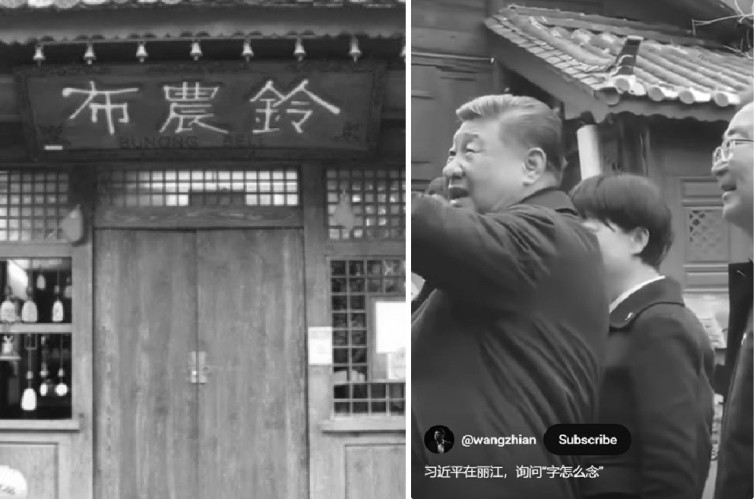
On March 19, while touring Lijiang, Xi Jinping hesitated over the pronunciation of "Bu Nong Ling" due to his low level of education and fear of misreading the characters. (Screenshot composite from video)
[People news] Recently, the 8th issue of 'Qiushi' magazine prominently featured an important article by party leader Xi Jinping titled 'Promoting National Reading, Building a Book Fragrant Society.' This article, compiled from Xi Jinping's various speeches since 2013, ardently advocates reading as a 'magic potion for enlightenment and wisdom, nurturing a lofty spirit.' It calls on the entire party to regard the classics of Marx, Engels, Lenin, Stalin, and Mao as essential to their daily lives and spiritual pursuits. It insists that cadres 'learn what they do,' that young people value time as precious, and that society as a whole should carve out time for reading and learning.
The familiar phrase 'personally deploying and personally guiding' resonates throughout the text. It is profoundly ironic that a leader humorously dubbed a primary school graduate by the public stands at the apex of the educational hierarchy, instructing 1.4 billion Chinese citizens on how to read and learn. The communist doctrines of Marx, Engels, Lenin, and Stalin, which have long been discarded by history, are instead idolised and elevated by him, revealing a shocking level of ignorance.
Is this truly the construction of a book fragrant society? It is evidently a carefully crafted absurdity, calling for the public to read more and read well while simultaneously tightening the grip on freedom of speech and expanding the list of banned books. While advocating for the establishment of a learning-oriented great nation, it also aggressively blocks VPNs, targeting anyone who seeks to read or disseminate truth and knowledge for harsh repression. What does this national reading initiative actually expect the populace to read? Is it the long-decayed ideological poison of Marx, Engels, Lenin, and Stalin, or the sordid power manoeuvres and nonsensical 'great nation techniques' that occupy Xi Jinping's mind?
A typo star on the international diplomatic stage.
Xi Jinping has repeatedly insisted that leading officials should take the initiative in reading and cultivating their character, which is quite ironic. This Tsinghua University PhD, Xi Jinping, is indeed rather superficial; his 'reading' performances in international contexts have become a source of ridicule.
On the morning of April 14, Xi Jinping met with Spanish Prime Minister Sanchez. In an effort to appear knowledgeable, he used several obscure terms. Additionally, while reading from his script, he consistently mispronounced words, confusing '秩序' (order) with '斥序' and '叢林' (jungle) with '蔥林'.
At the 2019 St. Petersburg International Economic Forum, when the host asked a simple question, he immediately looked down and said, 'Let me see if this content is in my little notebook.' This prompted laughter from the audience as he casually flipped through his notebook to read verbatim. This clip went viral internationally, but domestically, even the term '小本本' (little notebook) has become a forbidden phrase.
During the 2025 Xi-Trump meeting, he was completely absorbed in flipping through his little notebook, even annotating the pinyin next to '芬太尼' (fentanyl). Mispronouncing words has become routine; at the G20 Hangzhou Summit, he mistakenly read '通商寬農' (trade and agriculture) as '通商寬衣' (trade and undressing), at the Belt and Road Summit he misread '精湛細膩' (exquisite and delicate) as '精甚細膩', and at the United Nations General Assembly, he pronounced '特殊' (special) as '出殊', '混淆' (confuse) as '混餚', and '殲滅' (annihilate) as '千滅'. Online, videos compiling 'Xi Jinping's typos' circulated widely, highlighting his awkward moments with the teleprompter and notes, making him a living example in the diplomatic arena.
Harbin Engineering University discarded Xi Jinping's works into the trash.
The ideological and political course at the Marxism Institute of the university has long been regarded as the most disliked and frequently skipped class by students. Since Xi Jinping took office, the situation has worsened, with 'Introduction to Xi Jinping Thought' being forcibly added as a compulsory course alongside 'Introduction to Mao Zedong Thought', monopolising academic credits. The content is often empty and tedious, filled with clichés, leading students to either scroll through their mobile phones or sleep during lectures. As the final exams approach, these textbooks frequently end up being sold off as waste at low prices or simply discarded.
A particularly striking example occurred at Harbin Engineering University, where the school organised a public welfare book donation event, prominently featuring stacks of Xi Jinping's works. However, these books were largely ignored, and ultimately, the brand new volumes were found piled up next to a trash can, igniting heated discussions online. After images of this incident circulated, netizens mocked the situation, saying, 'Good job on waste sorting' and 'This is true waste recycling.' Similar sentiments have spread across universities nationwide, with comments like, 'It's sad that Chinese graduate students have to absorb this kind of garbage,' 'This really needs to penetrate the brain, heart, and soul,' and 'Transforming simplified Chinese into completely meaningless literature is also a kind of superpower.'
This serves as a harsh rebuke to Xi Jinping's vision of a 'Book Aroma Society.'
Officials caught reading banned books face severe repercussions as Xi Jinping takes decisive measures.
In a society where few truly believe in Marxism-Leninism, not a single person can be found in Zhongnanhai, let alone among officials of various ranks within the system. Beyond merely lying flat, many officials are contemplating their own futures. Where is China headed? As a result, numerous officials seize various opportunities to collect and read banned political books to grasp the truth. This reality deeply unsettles Xi's regime, prompting him to take strong measures to prevent officials from fundamentally betraying the political system.
According to a report by Voice of America, by the end of October 2024, at least 15 senior officials of the Chinese Communist Party (CCP) have been accused by the party's disciplinary inspection system of reading or possessing banned books. In 2023, 8 individuals faced similar accusations, and since 2019, a total of 29 officials have been implicated in the circulation of banned literature within the party. Why is the list of officials engaging in this activity growing, particularly among provincial and ministerial-level officials? Notable figures include Wang Xiaoguang, former Vice Governor of Guizhou Province; Lin Gang, former Vice Mayor of Guiyang City, Guizhou Province; Zhang Zulun, former Vice Governor of Yunnan Province; Liu Liange, former Party Secretary and Chairman of the Bank of China; Zhou Qingyu, former Party Committee Member and Vice President of the China Development Bank; Zhu Congjiu, former Vice Governor of Zhejiang Province; Zhang Guilin, former Director of the Beijing State-owned Assets Supervision and Administration Commission; and Xu Shiping, former President and Editor-in-Chief of Haidongfang Network. This situation underscores the escalating internal crisis within the CCP. Many officials are dissatisfied with Xi Jinping, and some are eager to broaden their perspectives, escape indoctrination, and pursue democracy and freedom. The act of reading banned books and openly criticising the central government has become a source of political anxiety for Xi Jinping. There is no fragrance of books, only literary persecution.
Ren Zhiqiang was sentenced to 18 years in prison merely for privately insulting Xi Jinping. The Hong Kong Causeway Bay Bookstore was shut down after selling a few books that revealed high-level scandals; its owner disappeared, and the entire freedom of publishing in Hong Kong was buried along with it. Recently, VPNs have been aggressively blocked by the Chinese Communist Party, and the Great Firewall continues to rise. Over the past decade, Xi Jinping has transformed speech control from a simple firewall into a comprehensive iron curtain, extending from political gag orders to economic censorship and military taboos. On platforms like WeChat, Douyin, and Xiaohongshu, any disagreement with the Communist Party's logic results in account suspensions and interrogations. China has become the world's largest information island and a prison for words, with its people trapped within the official narrative. The best way to silence a little bird is to insist that 'the little bird is singing' regardless of its actual condition.
The books that are most essential to read are precisely those that are banned.
The article in Qiushi is filled with lofty rhetoric, yet it deliberately sidesteps the most critical issue: in a dark reality where freedom of speech, publishing, and academic freedom have been completely extinguished, how can we discuss national reading? In this absurd and bleak era, the most crucial books to read are those that are strictly prohibited, and the ones that should be banned are Xi Jinping and his nonsensical ideologies.
Isn't the Qiushi article a form of high-level satire? The more it fervently advocates for a bookish society, the more it reveals the extreme fragility of the dictator's psyche. What Xi Jinping fears most is that the people will truly understand history, the world, and the future, see through the Communist Party, abandon it, and resist its authority.
(First published by People News) △




News magazine bootstrap themes!
I like this themes, fast loading and look profesional
Thank you Carlos!
You're welcome!
Please support me with give positive rating!
Yes Sure!