
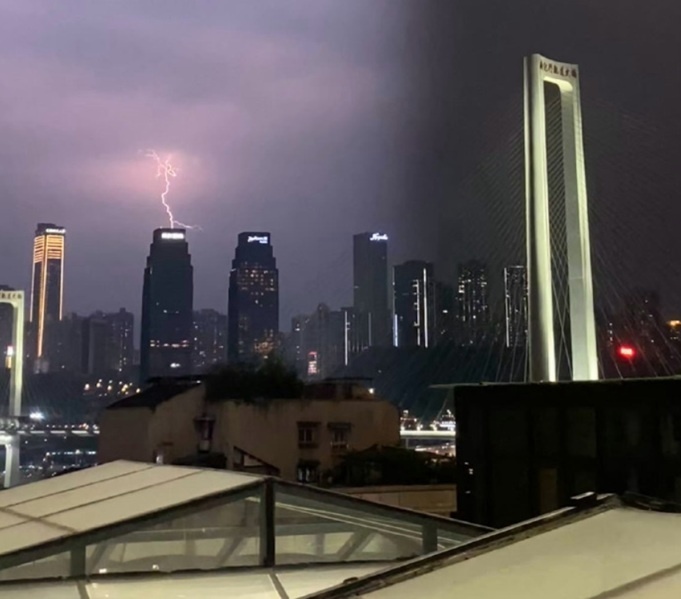
On April 19, 2026, the incident of 'Shidai Fengjun 419 Struck by Lightning' quickly became a trending topic, igniting widespread discussion. (Video screenshot)
[People News] On April 19, the topic of 'Chongqing Shidai Fengjun 419 Struck by Lightning' being labelled as 'divine retribution' rapidly gained traction on social media, leading to extensive debate.
According to data from the Chongqing Meteorological Station, from 6 PM on the 19th to 4 AM on the 20th, Chongqing recorded a total of 8,068 lightning strikes, primarily in the western region, with some occurrences in the central and southeastern areas as well.
During the thunderstorm, the headquarters of Shidai Fengjun, located on the 18th floor of the Yangtze River International Building, was directly hit by lightning on its rooftop. Several live video clips captured by citizens show the powerful lightning current being channelled into the ground through the building's lightning protection system, creating a dramatic scene. Fortunately, there were no injuries or damage to the building, and the topic quickly climbed the trending list.
The comment section was abuzz with discussions about the 'Shidai Fengjun Building Struck by Lightning' incident. Some netizens speculated, 'Does this signify that something special is about to happen?' 'Is someone facing a tribulation?'
Shidai Fengjun is a multimedia film and entertainment company in China. Besides artist management, it is also engaged in film investment and production, music production, variety show production, and other related businesses.
Following the rise of TFBOYS, 'Times Fengjun' has successfully introduced boy bands like 'Times Youth League' and 'T.O.P Landing Youth', gaining a reputation for nurturing 'trainee idols'. However, it has been embroiled in controversy due to various issues, including marketing practices likened to 'cutting leeks', disputes over artist management, frequent statements that lack real improvements, and divisions among fans. Recently, the strict real-name registration system for concerts of its boy bands has drawn significant criticism, prompting many fans to humorously label the incident as a form of 'heavenly punishment'. Many fans have voiced sentiments such as, 'Even the heavens can't bear to watch this' and 'It was due for a strike long ago'.
In reality, the Chinese Communist Party (CCP) has consistently maintained tight control over the entertainment industry. This was particularly evident in 2021 when the CCP announced its plans to reform the sector, aiming not only to use it as a revenue-generating tool but also to realign the cultural and entertainment industry with the propaganda objectives of the Party. The CCP emphasised the importance of 'Party-state red culture', insisting that both major celebrities and minor internet influencers be transformed into advocates for red political ideology.
Numerous commentators have noted that the entire cultural and entertainment sector, from traditional film and television to new media, serves as a 'weapon' for the CCP, functioning as an essential 'cultural army' outside the military. This army is not to idolize entertainment stars but rather to revere Xi Jinping or other officially celebrated heroic figures.
Since the establishment of the CCP, private media operations have been prohibited. The CCP exerts control over all forms of media, including television, radio, newspapers, magazines, and later internet platforms, using them as instruments to propagate Communist Party ideology, brainwash the populace, suppress dissent, intimidate the public, and distort or obscure the truth.
Xinhua reports that China's cultural and entertainment industry must 'tell compelling Chinese stories, strengthen cultural confidence, enhance communication effectiveness, and avoid merely catering to others or being overly simplistic and rigid,' in order to 'unite a strong spiritual force for the comprehensive construction of a modern socialist country and the achievement of the second centenary goal.'
It is clear that the Chinese Communist Party (CCP) permits the entertainment industry to exist primarily for the purpose of brainwashing the Chinese people. The CCP leverages concepts of 'morality' and 'Dao' from traditional culture to frame its dictatorial actions as aligned with heavenly principles or historical necessity, thus justifying its infringement on individual rights.
Additionally, the CCP frequently creates 'heroic figures' such as Lei Feng, Huang Jiguang, and Liu Hulan, who share the common traits of 'unconditional loyalty' and 'dedication to the Party.' The CCP's propaganda consistently stresses that 'collective interests take precedence over individual interests.' In this context, when personal interests clash with the Party's will, individuals are expected to willingly 'sacrifice,' as exemplified by the 'Ice Sculpture Company' on the battlefield of Changjin Lake or the so-called 'glory of death' depicted in the song 'Blood-Stained Glory.' This idea of viewing death for the Party as a noble act has been forcefully instilled in the minds of the Chinese populace from a young age. In the eyes of the CCP, the lives of ordinary citizens are of little value, and their deaths are even less significant; what matters is conditioning them to willingly sacrifice themselves for the CCP, turning the populace into offerings for the Party's blood banner. The Chinese cultural and entertainment industry serves as a sharp tool in the hands of the CCP.
Thus, when someone suggests that 'the 419 of Shidai Fengjun was struck by lightning' is a form of 'heavenly punishment,' it is unsurprising that this claim resonates with many netizens.
(First published in People News) △






News magazine bootstrap themes!
I like this themes, fast loading and look profesional
Thank you Carlos!
You're welcome!
Please support me with give positive rating!
Yes Sure!