
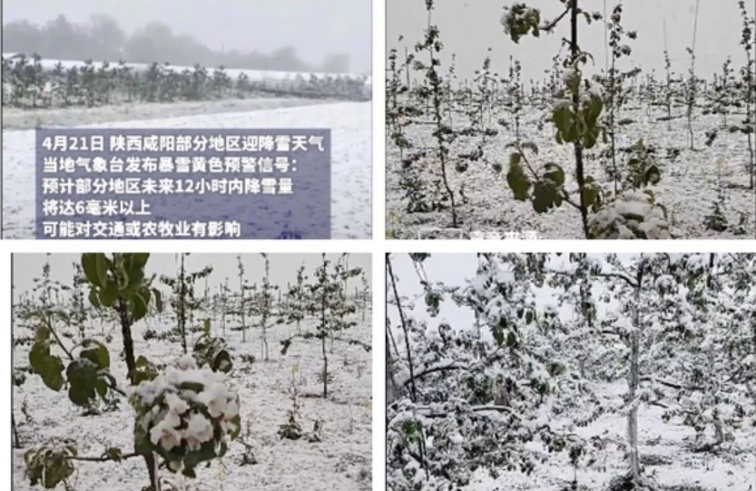
On the morning of April 21, 2026, heavy snow fell suddenly in Baoji, Tongchuan, Xianyang, and other regions of Shaanxi. (Network screenshot)
[People News] On April 21, shortly after the 'Grain Rain' solar term, many areas in Shaanxi experienced the unusual phenomenon of 'April snow', which has drawn significant public attention. This unexpected 'late spring cold' could have a serious impact on the year-end harvest, and for local farmers who have been struggling economically for a long time, it can truly be described as 'the roof leaks just as the night rain falls'.
According to reports from Chinese media, on that morning, heavy snow fell suddenly in Baoji, Tongchuan, Xianyang, and other areas, with particularly significant snowfall observed in Xunyi County, Changwu County, and Binzhou City in northern Xianyang, where some regions even saw snow accumulation, which is clearly out of sync with the season.
The Xianyang Meteorological Station issued a yellow warning for road icing that morning, stating that due to the effects of low temperatures, rain and snow, several areas, including Binzhou City, Xunyi County, and Changwu County, may experience road icing conditions that could impact traffic within the next 24 hours. The Binzhou City Meteorological Station also issued a similar warning earlier and activated a blue frost warning, predicting that temperatures would drop below 0°C from that night until the early morning of the following day, further increasing safety risks.
Simultaneously, Xi'an, which had seen temperatures nearing 30℃ the previous week, experienced significant rainfall, causing temperatures to drop sharply to around 10℃. Meteorological experts indicated that this unusual weather was primarily influenced by the eastward movement of the westerly trough and the southward flow of cold air from the base of a cold vortex. This led to widespread precipitation, temperature drops, and strong winds across the province, exemplifying a typical 'cliff-like drop in temperature'.
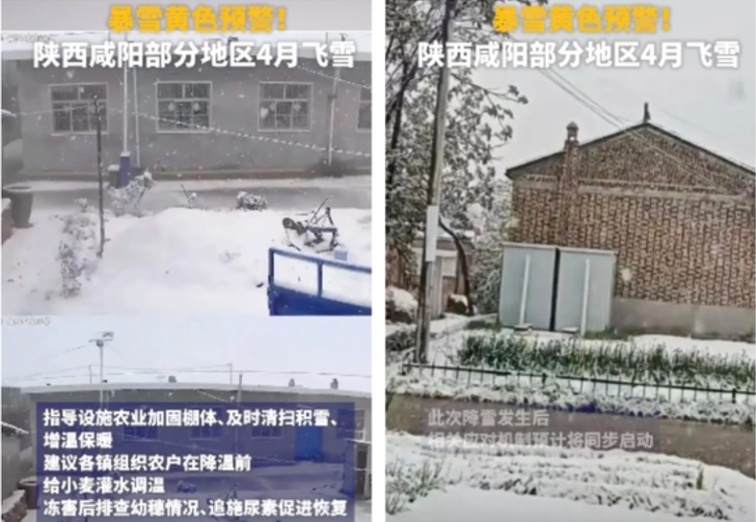
On the morning of April 21, 2026, heavy snow unexpectedly fell in Baoji, Tongchuan, and Xianyang in Shaanxi Province. (Screenshot from the internet)
There is a farming saying: 'No snow after Qingming, no frost after Guyu.' Traditionally, it is believed that heavy snow should not occur after the Qingming solar term, and severe frost should not happen after Guyu. Guyu, which occurs at the end of spring, signifies that the weather should be warming up, making snowfall at this time a serious 'late spring cold' phenomenon. The period around Guyu is crucial for farmers as they begin transplanting seedlings and sowing new crops, which require warm rain for growth. If heavy snow falls during this time, it can lead to crops (especially seedlings) freezing or developing poorly due to low temperatures, a situation commonly referred to as 'frost on seedlings after Guyu', which can severely affect the harvest at the end of the year.
The recent snowfall in Shaanxi Province came just two weeks before the start of summer, coinciding with a crucial period for crop growth at the transition from spring to summer, which has a direct impact on agricultural production. According to reports from The Paper, local fruit farmers have indicated that they are currently in the peak flowering stage for apples. If they experience low temperatures, rain, or frost, it could severely affect pollination and fruit set rates, potentially leading to reduced yields.
Experts have pointed out that April is a vital time for fruit tree flowering and crop growth, during which plants have relatively weak cold resistance. The occurrence of snowfall or frost can easily result in flower bud frostbite and seedling death, subsequently affecting the overall yield of food and cash crops. If low temperatures persist, the impact on fruit trees such as apples and pears will be particularly pronounced.
Historically, the per capita disposable income of rural residents in Shaanxi has ranked low among Chinese provinces, typically around the 26th or 27th position, with the absolute income gap widening year by year. The low income of farmers represents the most significant shortcoming in the province's efforts regarding agriculture, rural areas, and farmers. Agricultural production income in Shaanxi is challenging to secure effectively, and the phenomenon of 'farming for a year is not as profitable as working elsewhere' is quite prevalent. Additionally, the local government's agricultural subsidy levels are relatively low, making it difficult to create substantial income-boosting incentives.
On a broader scale, this extreme weather can be aptly described as 'a roof leaking just as it rains at night' for the affected local farmers. △








News magazine bootstrap themes!
I like this themes, fast loading and look profesional
Thank you Carlos!
You're welcome!
Please support me with give positive rating!
Yes Sure!