
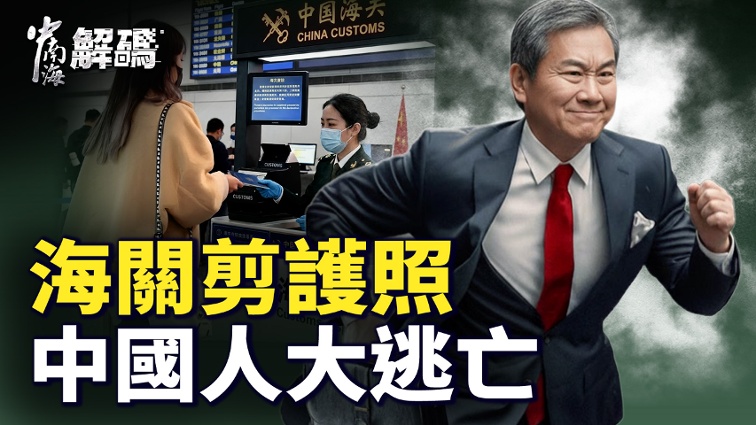
The wealthy, professors, and doctors are all on the run; passports have become state-owned assets (video)
[People News] Hello, dear audience, and welcome to "Decoding Zhongnanhai." I am Sun Ning.
If you still possess a personal passport, take a moment to examine it closely. In today’s mainland China, this little red book is shifting from being your personal property to becoming a 'state-owned asset' of your organisation.
Previously, the crackdown on passport confiscation primarily targeted 'officials above the department level' within the system. However, now primary and secondary school teachers, public hospital doctors, ordinary employees of state-owned enterprises, and even bank tellers and community grid workers—essentially anyone reliant on 'state provisions'—will find that once a notice is issued, their passports must be securely stored in their unit's safe. Planning to travel abroad to visit family? First, you must fill out forms and obtain signatures from leaders at various levels. By the time you navigate through all these hurdles and finally receive your passport, you will need to return it within a week of your return home; delay even a day, and you risk losing your stable job.
So, for ordinary individuals outside the system, does having a passport mean they can embark on an impromptu trip? The answer is: you may not even be able to get your passport processed.
To obtain a passport, you must provide extensive personal information: you need to screenshot the transaction records of all bank cards registered in your name, print out every transaction detail from WeChat and Alipay for the past year, and, most astonishingly, generate a communication verification report for all phone cards registered under your name through the official system.
If you already possess a passport that is nearing expiration and wish to renew it, you may be disappointed. The authorities will likely refuse your request with various excuses such as 'system upgrade' or 'temporarily not processing', and may even demand the original invitation letter from an overseas company along with proof of tax payment.
This travel document, which should be a fundamental right of citizens, has now become a privilege granted by the Party. The door to the outside world is gradually closing.
Meanwhile, those who remain inside are witnessing their own transformation into trapped creatures within this vast internal cycle, unable to migrate freely.
Iron Curtain: 'Life and Death Reckoning' at the Border Checkpoint
If you are fortunate enough to have both a passport and a visa, do not celebrate just yet. A harrowing 'life and death reckoning' awaits you at the airport customs checkpoint.
The current border inspection practices of the Communist Party have taken the concept of 'easy entry, strict exit' to an extreme. Before you even reach the checkpoint, AI algorithms in the background have already conducted a thorough investigation of your background.
Have you become a 'dishonest person subject to enforcement' due to economic difficulties leading to mortgage defaults? You will be held back. Are you connected to a collapsed real estate company or a P2P financial platform? You will be held back. If you have made any mild complaints online, or if your relatives abroad have engaged in any sensitive activities, you will still be held back today!
This explains why, in recent years, various bizarre incidents have been widely reported on overseas social networks, where individuals have been intercepted by customs and even had their passports and green cards cut on the spot.
Within the international student community, a well-known true story is circulating. A young man who had finally received an admission letter from a Canadian university faced repeated questioning by customs when he was about to leave the country. When he honestly replied, "I am currently in my first semester of freshman year, and the school is offering online courses," the border inspection officer immediately summoned a supervisor. Citing "insufficient reason for departure," the officer took out scissors and cut a corner of his passport. The cold remark, "Since it's an online course, you can just study at home, why go out?" instantly shattered a family's years of preparation for studying abroad into fragments.
A true exposé once went viral on overseas social media platforms. A Chinese mother, who had lived abroad for many years and held a U.S. green card, was preparing to return to the U.S. with her baby, who is a U.S. citizen. At the customs gate of Guangzhou Baiyun Airport, she was suddenly forcibly intercepted by border inspection personnel. The law enforcement officers not only questioned her about the details of her life abroad and checked her domestic financial transactions, but also, without any legal justification, took out scissors and violently cut her U.S. green card into pieces.
The Chinese Communist Party's "slaughterhouse-style" law enforcement has turned customs checkpoints into execution grounds.
The elite class is collectively fleeing for a better life.
In today's China, everyone is frantically focused on the same word—"润" (run).
Whether it’s the wealthy entrepreneurs at the pinnacle of society, high-level intellectuals, or the middle class who have worked tirelessly for decades to establish themselves in cities like Beijing, Shanghai, Guangzhou, and Shenzhen, everyone is exploring every possible avenue to escape abroad.
According to reports from reputable international media, Alibaba founder Ma Yun has relocated with his family to Tokyo, Japan, where his social life has shifted to private clubs in Ginza. Similarly, ByteDance founder Zhang Yiming has spent many years in Singapore, making it his primary residence and workplace. Duan Yongping, the founder of Bu Bu Gao and the enigmatic 'soul mentor' behind Pinduoduo, has been living in California, USA, for several years now.
As these industry leaders forge ahead, thousands of small and medium-sized private entrepreneurs are eagerly following their lead. Singapore and Japan are nearly overwhelmed by the influx of Chinese capital, with hundreds of wealthy 'family offices' emerging in Singapore, half of whose owners communicate in familiar dialects from various regions of mainland China.
On the front lines of the workforce, this mass exodus resembles a silent 'vote with their feet.'
In major tech companies like Tencent, Alibaba, and Meituan, a significant wave of 'job-hopping to Japan and the EU' is currently sweeping through, targeting top architects and algorithm experts. These individuals, who are the backbone of China's high-tech sector, are willing to accept drastic salary cuts and demotions in order to relocate their families to cities like Tokyo, Amsterdam, or Berlin. They realise that they lack the privilege of special exit approvals; once they are locked in, by the time they reach 35, they risk becoming like a 'human mine' that has been drained, unceremoniously discarded into the unemployment heap.
In addition to workplace elites, prominent figures in the entertainment industry are also leveraging their wealth to cross national borders. Notable director Feng Xiaogang has been seen settling in Los Angeles, while famous actors Jiang Shan, Xu Fan, and Zhang Tielin have been reported to frequently live abroad or have already changed their nationalities. Additionally, the accomplished actor Sun Honglei has been spotted multiple times by netizens on the streets of Melbourne.
Cultural elites are not the only ones fleeing; the backbone of academia and the medical field is also on the move. Professors from prestigious institutions like Tsinghua and Fudan, as well as renowned doctors from top hospitals, are opting to leave before retirement. They are willing to forfeit substantial pensions in China and, under the pressure of political scrutiny, are choosing 'internal retirement' to apply for EU golden visas or Canadian skilled immigration, relocating their families abroad.
This collective exodus of social elites reflects a painful compromise of their principles. They connect on social media, humorously referring to themselves as 'survivors with bodies leaving the port.' They have relinquished all privileges and networks in their home country, facing the challenges of language barriers, cultural isolation, and a decline in social status as they struggle to rebuild their lives from the ground up overseas.
Their desires are simple: they want to escape the unpredictable whip of oppression, provide their children with an education free from indoctrination, and find a path to a normal life where they can breathe freely without the constant fear of persecution.
Changing circumstances: The American dream has shattered, and the new direction is towards Germany.
In the last two to three years, when discussing desperate survival in a dead-end situation, the first thought that comes to mind for many is America. The 'US-Mexico border route,' which stretches across Central and South America and traverses the Darién Gap, has facilitated the journey of tens of thousands of Chinese individuals to the United States.
However, today, this classic route, once popular and referred to as 'Runmei', has completely become a dead end.
Under pressure from Washington, Ecuador has revoked its visa-free policy for Chinese citizens, effectively cutting off the starting point for many. Meanwhile, Mexico has intensified its military and police presence at the borders, significantly ramping up interception and direct repatriation efforts.
Simultaneously, U.S. law enforcement has tightened immigration policies, abandoning the previous practice of 'arrest and release, waiting for a hearing' for captured Chinese migrants. Instead, they have implemented a cold and efficient system of collective cross-border repatriation. Charter flights are now landing directly at U.S. airports, repatriating those who have managed to 'escape' back to their home country in large groups. The American dream of countless individuals has been utterly shattered.
As the door to the Americas has been completely sealed shut, anxious and desperate escapees have quickly forged a new route on the other side of the globe—the route to Germany.
According to a report by 'Deutsche Welle', this new route is known internationally as the 'Balkan migration route'. Traditionally, for the past decade, it has served as a passage for refugees from the Middle East and North Africa to enter Europe, but recently, an increasing number of Chinese individuals have been seen navigating this thorny path.
Among these migrants are small business owners whose livelihoods were devastated during the pandemic and who are now burdened with significant debts, intellectuals fleeing oppressive regulations, and many unemployed students unwilling to be 'human resources' in their home country.
Line walkers typically begin their journey by flying to Belgrade, the capital of Serbia in Eastern Europe, or to the neighbouring country of Bosnia and Herzegovina. This choice is largely due to the fact that both Serbia and Bosnia and Herzegovina currently offer visa-free entry for Chinese citizens. This means that as long as you can successfully obtain a passport and navigate the questioning at Chinese customs, you can physically arrive on European soil.
The real challenge starts at the border. Line walkers take a bus to Bihać, a border city between Bosnia and Herzegovina and Croatia. Croatia is a member of the European Union and the Schengen Area, so stepping into Croatia is akin to entering the land of the free world. However, travelling between the two countries requires not only overcoming the treacherous wilderness and icy rivers but also evading the heavily patrolling border police.
Nineteen-year-old Wang Qing, from Shandong, China, waded into the frigid river at the border on a bitterly cold winter night. He shivered in the pitch-black mountains and forests, hiding for several hours while waiting for a vehicle to pick him up. On this route, the enforcement tactics of the Croatian border police are notoriously harsh; many Chinese line walkers have been subjected to pepper spray, had their phones smashed, and even faced violent expulsions. After several failed attempts, Wang Qing eventually spent 2,000 euros to hire a smuggler, hiding in a farmer's straw shed at the border for several days before he finally managed to cross the water and successfully enter the Schengen Area.
Once they have successfully crossed the border into Bosnia and Herzegovina and entered the heart of Croatia, the route-takers can take advantage of the convenience of travelling within the Schengen Area without the need for identification checks. They can board international trains or long-distance buses, passing through Slovenia and Austria, all the way to their final destination on this route—Germany.
Why do so many people choose Germany as their endpoint? It is because Germany has a well-established asylum system and humanitarian laws that are the most advanced in Europe. After arriving in Germany and submitting their asylum applications, Chinese route-takers are entitled to free accommodation and health insurance as refugees, and they can also receive approximately 400 euros in cash allowances each month.
According to official statistics from the Federal Office for Migration and Refugees in Germany, the number of individuals seeking asylum in Germany with Chinese passports has been on the rise in recent years.
If people could live and work peacefully in their hometowns, no one would willingly risk their life, dignity, and property to become an uncertain “illegal resident” in a foreign country. For these route-takers, taking this path is a “last resort.” As they express it: “Staying in the country is a slow death; leaving offers at least a glimmer of hope.”
The Uncontainable Soul
How ironic history can be. A powerful nation that claims to have entered a “prosperous era” focuses all its efforts on preventing, inspecting, and even shredding the passports and green cards of its own citizens at the airport.
The authorities believe that by restricting the issuance of passports, implementing a five-tier political review, and setting up steel knives and scissors at border checkpoints, they can confine wealth and population within the grand cage of their propaganda.
In today’s China, what is truly locked away may not just be a passport, but rather the imagination of an entire generation regarding their future. As an increasing number of people are willing to abandon everything familiar in exchange for a one-way ticket and an address in a foreign land, the more pressing question is not why they wish to leave, but rather what has transpired in the country that drives its citizens to desperately seek to escape.
The ongoing 'passport defence war' and 'life-and-death escape wave' are not mere stories; they represent the real-life experiences of countless ordinary Chinese individuals grappling with issues of fate and freedom at this very moment.
Thank you for watching this video. If you have personal experiences or thoughts on the current exit policies and overseas immigration, please feel free to share your comments in the discussion section. We look forward to seeing you next time.
'Decoding Zhongnanhai'
△







News magazine bootstrap themes!
I like this themes, fast loading and look profesional
Thank you Carlos!
You're welcome!
Please support me with give positive rating!
Yes Sure!