
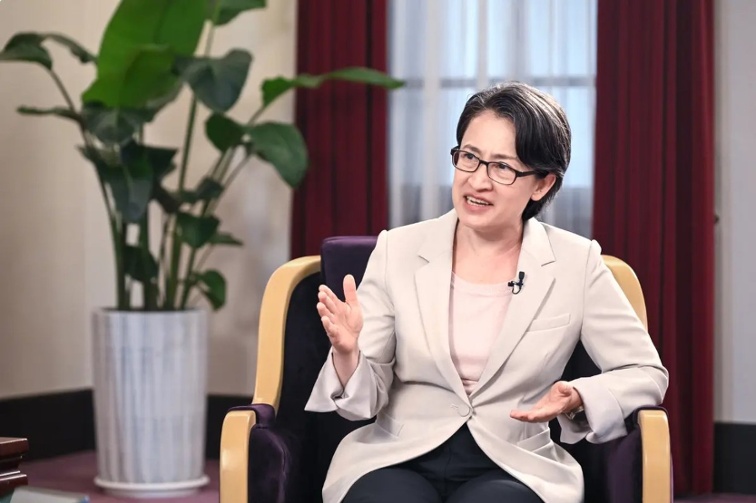
The Vice President of the Republic of China, Hsiao Bi-khim, participated in an interview with The Dajiyuan. (Song Bilong / The Dajiyuan)
[People News] Six years ago, when Hsiao Bi-khim took office in Washington, D.C. as Taiwan's newly appointed representative, she faced the aggressive 'Wolf Warrior' diplomacy of the Chinese Communist Party.
It has been demonstrated that Hsiao Bi-khim has forged her own path, successfully presenting the image of the Taiwanese people as 'War Cats': small in stature but formidable, agile, adaptable, always vigilant, and most importantly, embodying an indelible spirit of independence.
The Art of 'Small Against Big': Achieving a Win-Win Situation for Longevity
Now, six years later, Hsiao Bi-khim has risen to become Taiwan's second-highest official, and this image appears to have stood the test of time.
She remarked, 'Cats cannot be forced; they have their own ideas.'
Hsiao Bi-khim emphasized that Taiwan operates in a similar manner.
In her interview with The Dajiyuan at the Presidential Office, the Vice President stated, 'Taiwan can be soft, warm, and inviting, but it is equally important to keep our claws sharp for self-protection.'
She explained that applying this philosophy to diplomacy involves seeking common interests and balancing power. Regarding U.S.-Taiwan relations, it is essential to build consensus across the various political spectrums within the United States Congress.
Xiao Meiqin emphasized that by utilizing their respective strengths, Taipei and Washington can enhance their existing capabilities, stating, "This is where the attraction lies, and it is also the reason why Taiwan and the United States will be stronger when working together."
From a young age, she has excelled in communication and remains undaunted by intimidation.
Born in Japan, Xiao Meiqin is the daughter of a Presbyterian pastor from Taiwan and a music teacher from North Carolina. She recalls that as soon as she could speak, she took on the role of a communication bridge, translating between her parents who spoke different languages.
At the age of 24, she entered the political arena. Within six years, she secured a seat in Taiwan's Legislative Yuan, becoming one of the youngest legislators at that time.
In 2006, while serving in the Legislative Yuan alongside current Taiwanese President Lai Ching-te, Xiao Meiqin supported a resolution that called for an international investigation into the organ harvesting practices endorsed by the Beijing authorities. The Dajiyuan was the first to expose the CCP's organ harvesting incidents.
Xiao Meiqin noted that as Taiwan's first president with a medical background, Lai Ching-te "places great importance on these fundamental rights."
As her popularity increased, Beijing branded her a "stubborn pro-independence figure" and accused her of "colluding with the United States" to pursue Taiwan's independence. The CCP regime has placed her on a blacklist twice.
Xiao Meiqin described these actions as intimidation tactics.
She stated, "We will not allow the Chinese Communist Party to define who we are." She pointed out that, like many others targeted by the CCP regime, she is facing these "sanctions" with confidence.
Xiao Meiqin emphasized that she has no personal business interests in China, making these 'sanctions' purely symbolic. Beijing is unable to prevent her from defending Taiwan's interests and the values it represents.
Living with threats has become a daily reality.
The threats from Beijing have integrated into the daily lives of the Taiwanese people and are escalating continuously.
The Chinese Communist regime regards Taiwan as a breakaway province and has been sending military aircraft to harass Taiwan on a daily basis in recent years. Furthermore, Beijing consistently obstructs Taipei's participation in any international organizational activities and seeks to isolate Taiwan on the global stage by enticing its diplomatic allies with financial incentives and generous promises.
Naturally, the threats from the Chinese Communist Party can also take on various forms.
In 2024, during Xiao Meiqin's three-day visit to Prague, reports revealed that Chinese diplomats and agents were tracking her and even orchestrated a car accident just weeks before she assumed the vice presidency.
In January of this year, Czech authorities arrested a reporter from a Chinese state media outlet who had attempted to collect defamatory materials against pro-Taiwan politicians.
Despite its small size, Taiwan is enhancing its countermeasures.
Xiao Meiqin noted that the increasingly covert tactics employed by the Chinese Communist Party have placed Taiwan in a defensive stance.
However, she asserted that Taiwan is actively seeking appropriate methods to counter these threats and to assert its unique identity.
The National Security Bureau of Taiwan has reported an increase in public discontent in China, driven by the strict control of the Communist Party and ongoing economic challenges.
In this context, Taiwan has recently established an online portal that enables Chinese citizens to report intelligence leads.
Despite having a population of just over 23 million, Taiwan exerts a significant influence in the global market that far exceeds its size.
Referred to as 'Silicon Island,' Taiwan is responsible for producing nearly two-thirds of the world's chips and almost all advanced microchips, making it an indispensable part of the modern digital economy.
By 2025, Taiwan is expected to surpass Germany and become the fourth-largest trading partner of the United States.
Without a formal alliance, the close relationship between the U.S. and Taiwan has continued through multiple administrations, ensuring peace in the Taiwan Strait—a vital route for global trade—especially in the face of the aggressive Chinese Communist Party. Each year, goods valued at trillions of dollars traverse this waterway, which is about 110 miles (approximately 177 kilometers) wide.
Hsiao Bi-khim characterized the U.S.-Taiwan relationship as 'one of the most influential partnerships in the world.'
She remarked, 'This is a partnership that can foster global prosperity.'
This relationship is also deepening. In January of this year, Taipei and Washington announced a significant chip agreement that reduced trade barriers and encouraged Taiwan to invest $250 billion in U.S. semiconductor and energy infrastructure.
The struggle between freedom and communism
In February, the conservative think tank The Heritage Foundation ranked Taiwan as the fifth largest free economy in the world, while the Chinese Communist Party was ranked 154th on that list.
In the opinion of Hsiao Mei-chin, the Taiwan model stands in stark contrast to the model of the Chinese Communist Party across the strait.
She emphasized that a rules-based order, the rule of law, fundamental rights, and the freedom to innovate are the genuine drivers of economic growth.
Hsiao Mei-chin noted that a competition is currently taking place on economic, political, and ideological fronts, but she is confident about which model will ultimately prevail. The facts are clear.
She remarked that the Chinese Communist Party "continues to promote their version of socialism and communism," while Taiwan firmly believes that "democracy can yield positive outcomes."
For decades, the West has been deeply intertwined with China's economy, hoping that by integrating China into the global trade system and aiding its prosperity, it would eventually lead to political freedom.
Hsiao Mei-chin pointed out that this hope has not materialized.
"We have witnessed significant economic growth, yet we have not seen the political openness or progress that many anticipated; instead, in some areas, we observe regression," she stated. "This is a reality we must take into account when seeking the most effective way to address the situation in China."
According to data from the International Monetary Fund, Taiwan's per capita GDP is projected to be three times that of mainland China by 2026.
Actively Strengthening Itself to Bring Prosperity to the World
At present, Taiwan is working to enhance its defense capabilities. President Lai Ching-te aims to increase military spending from the current 3% of GDP to 5% by 2030. In early June, Taiwan conducted a test launch of a U.S.-made rocket system towards the mainland, simulating a defense against a potential invasion by the Chinese Communist Party.
However, the government of Lai Ching-te is still encountering several challenges. The opposition party, which leans more towards Beijing, has blocked government military spending proposals numerous times before a reduced budget was finally approved.
Nonetheless, Hsiao Bi-khim emphasized that these developments highlight Taiwan's transparency and accountability systems.
She stated that the key issue in ensuring Taiwan's security right now is 'allocating funds to where they are urgently needed,' and her party will continue to stress the significance of the budget proposal to Taiwanese society.
Hsiao Bi-khim noted that Taiwan has integrated itself into 'every layer' of the global artificial intelligence (AI) and technology supply chain.
She remarked that the people of Taiwan are both stabilizers and builders of peace, and they are also working to contribute to the international arena in various other ways.
This encapsulates Hsiao Bi-khim's vision of 'war cat diplomacy': Taiwan may be small, but it remains a force that cannot be overlooked.
She stated, 'Cats are small, but they can leap ten times their own height or even higher.' 'Additionally, cats have nine lives.'
Jan Jekielek also contributed to this article.
△






News magazine bootstrap themes!
I like this themes, fast loading and look profesional
Thank you Carlos!
You're welcome!
Please support me with give positive rating!
Yes Sure!