
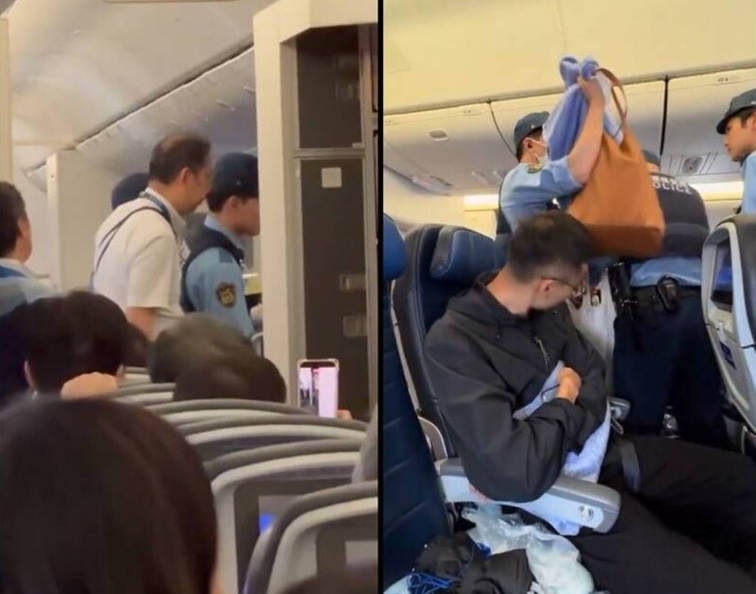
On a United Airlines flight from Shanghai Pudong Airport to San Francisco, a Chinese woman caused a disturbance, leading the captain to make an emergency landing at Narita Airport in Japan. Japanese police promptly boarded the aircraft to apprehend her. (Image sourced from X)
[People News] The incident occurred on June 24 when a woman in her fifties created a scene on the United Airlines flight, resulting in an emergency landing at Narita Airport. Japanese police quickly intervened to arrest her. The woman was seen screaming and resisting, but was ultimately forcibly removed from the plane. Footage of the incident has circulated online, sparking discussions on social media.
Shortly after takeoff, the United Airlines flight from Shanghai to San Francisco reported a disturbance caused by the Chinese woman, who allegedly threw utensils at flight attendants, splashed food, and even spat. The captain decided to divert to Narita Airport in Japan, where Japanese police boarded the plane to apprehend her. Despite her screaming and resistance, she was forcibly removed from the aircraft, and the footage of the incident has gone viral, igniting discussions on social media.
According to reports from Liberty Times, United Airlines flight UA858 from Shanghai to San Francisco on the 24th unexpectedly diverted to Narita Airport in Tokyo mid-flight. It was reported that a middle-aged Chinese woman had a dispute with a flight attendant, during which she allegedly threw utensils, splashed food, and spat, prompting the captain to make an emergency landing at Narita Airport, where Japanese police boarded the plane to apprehend her.
Reports indicate that the flight was delayed for 2 hours before it could continue on to San Francisco. This incident has generated considerable discussion online, with many Japanese netizens expressing their dissatisfaction. Surprisingly, some Chinese netizens falsely claimed that the woman involved was a Japanese person masquerading as a Chinese individual. Others suggested that Japan was overreacting to a minor issue. These comments have reignited the controversy, leading to netizens angrily criticizing, 'I really don't understand why Chinese travelers love to cause trouble so much?' 'Some individuals can not only delay a flight by 2 hours but also cause three countries to face social embarrassment together.' 'This kind of blame-shifting to Japan is ridiculous; the real issues are flight management and passenger behavior.' 'It's highly likely that a Chinese passenger insisted on foreign flight attendants speaking Chinese...'
Additionally, some netizens claiming to be fellow passengers reported that the woman displayed unusual behavior even before boarding. In addition to talking to herself repeatedly at the boarding gate, she loudly cursed in both Chinese and English, claiming she was 'being persecuted.' During her meal, she insulted the flight attendants, maliciously threw her food on the ground, and continued to spit. Despite being warned, she remained defiant, which led the captain to decide on an emergency landing in Japan.
This incident has drawn significant attention from many netizens.
A user on platform X, 'Luo Xiang - Breaking the Wall,' posted that this disruptive Chinese woman could face economic compensation ranging from tens of thousands to hundreds of thousands of dollars. This includes additional fuel costs incurred from the emergency landing, parking fees, crew overtime costs, and compensation for delays experienced by other passengers, among other expenses.
On platform X, netizens commented: "The Red Guard aunt is famous again," "This is undoubtedly the toxic legacy of the Cultural Revolution, which harms future generations. Those raised under the Red Guards have developed a selfish and inhumane personality. "Everyone educated by the Communist Party from a young age carries some toxicity, albeit to varying degrees. "Mainland Chinese fear power but not morality! This time, Japan must take strong action, making an example of one to deter many, in order to thoroughly suppress this group of rascals from the mainland!
"This issue goes beyond mere 'personal quality' or 'occasional loss of control'; it is an inevitable outcome of the thinking patterns and behavioral habits shaped by long-term dictatorial rule."
User "PYYviva" on X remarked: "The Cultural Revolution enabled some individuals in China to exploit violence and tantrums for personal gain! This harmful trend has persisted to this day! The current high-pressure environment makes people more prone to arrogance and hysteria! Additionally, the distorted feminist culture in the mainland encourages some women to be even more reckless and hysterically vocal!
User "Ropers Steffanie" posted: "This extreme behavior indeed reflects a certain toxic thinking inertia. Having become accustomed to an environment where 'making a scene equals victory' and where rules shift with power, they inevitably encounter obstacles in an international context that values the rule of law and contracts due to cognitive dissonance. This is not just a personal quality issue; it is a collective scar stemming from a lack of awareness of rules."
Over the past decade, certain Chinese tourists have made international headlines due to inappropriate behavior on airplanes, at tourist attractions, in hotels, or in public spaces, such as disrupting flight order, damaging cultural relics, and violating local regulations. While these incidents do not represent all Chinese tourists, the frequent occurrence of such 'Chinese auntie' incidents in various countries has led to a deeper analysis of this phenomenon by outsiders:
The erosion of traditional gentleness by 'wolf nature and rebellion culture'
Many cultural scholars and historical commentators (including independent overseas sinologists and political bloggers) often trace the behavior of some tourists who lack public awareness back to historical movements in China over the past few decades. A common perspective is that the Chinese Communist Party's denial of traditional values has resulted in negative consequences.
Traditionally, Chinese culture emphasized values such as 'gentleness, kindness, frugality, and yielding' and the principle of 'do not impose on others what you do not desire for yourself.' However, the ten-year Cultural Revolution shattered these traditional ethics, replacing them with a mindset that promotes 'rebellion is justified' and 'the joy of fighting against heaven' alongside atheistic education.
Another contributing factor is that some individuals lack a sense of reverence and possess a sense of entitlement. When society lacks respect for the way of heaven, deities, or traditional morals, people's behavior can easily cross boundaries. Furthermore, some individuals may have adapted to a 'whoever is loud wins' or 'spending money makes one a big shot' mentality in their home country, bringing this 'wolf nature' of competing for resources into the public spaces of international aviation or civilized societies. This results in significant cultural conflicts that ultimately tarnish the overall international image of Chinese tourists.
User Luo Xiang highlighted in a post that the decades-long philosophy of struggle, education on class antagonism, and the historical narrative of 'rebellion is justified' have left an indelible mark on the minds of some citizens. The toxic legacy of dictatorship has created two extremes: complete obedience or fierce resistance, while a mature middle ground of citizens—those who respect authority while safeguarding boundaries, uphold rights while fulfilling responsibilities—remains rare. Civilization is not sustained through high-pressure stability or punitive measures after the fact, but through each individual's reverence for rules, respect for others, and accountability to oneself. The damage caused by dictatorship goes beyond immediate events; it permeates thought, habits, and intergenerational transmission. Only by confronting, analyzing, and transcending this legacy can citizens truly free themselves from this heavy historical burden and stand on the world stage as mature individuals!
This situation reaffirms a fundamental truth: while money and grand narratives can secure short-term consumer privileges, they cannot buy genuine respect.
When a regime has historically stripped traditional culture of its warmth and instilled a mindset of competition in all aspects, even if its citizens achieve economic prosperity, they will still encounter spiritual isolation when entering the international civilized community. Taiwanese tourists have successfully established a line of civilization for themselves on the international stage with a small badge; this reflects both a sense of helpless self-preservation under geopolitical pressures and the stark reality of cultural literacy disparities.
△






News magazine bootstrap themes!
I like this themes, fast loading and look profesional
Thank you Carlos!
You're welcome!
Please support me with give positive rating!
Yes Sure!