
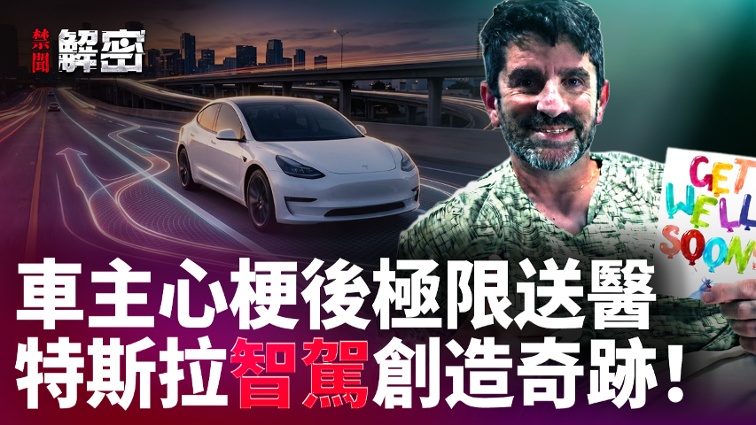
Tesla's Smart Driving Saves Lives at Midnight: This is True Leadership (Video)
[People News] Hello, everyone, and welcome to 'Forbidden News Uncovered.' I am Sun Ning.
Imagine a cold, steel machine that, in a moment of life and death, suddenly becomes a 'full-time driver' sent by the gods, snatching a life back from the clutches of death. Would you believe it?
This is not a fictional scenario from a Hollywood sci-fi film, nor is it a myth created by Silicon Valley tech enthusiasts to boost their stock prices. This is a technological miracle occurring right now in our real world, crafted from cold, hard code and cameras.
While the entire automotive industry is still celebrating the success rate of automated parking, and numerous Chinese manufacturers are still showcasing black technology in automatic lane changes and obstacle avoidance at press conferences, Tesla, a tech giant once doubted and criticized by many, has quietly crossed the technological singularity. With a stunning midnight speed run that shocked the world, it proclaimed to humanity: the ultimate form of smart driving is not about freeing your hands to use your phone, but about becoming your only lifeline in moments when humanity is powerless and life is at risk.
Today, let’s put aside the complicated marketing jargon and delve into this technological epic directed and performed by Tesla's fully autonomous driving. We will explore how it creates incredible remote rescue miracles and examine Elon Musk's grand vision, which borders on obsession.
19 Minutes of Life-and-Death Relay
Let’s rewind to the early morning of November 15, 2025.
On the highways of Georgia, USA, the night is pitch black. Mr. Brant, a 62-year-old car owner, is driving alone in his newly acquired 2026 Tesla Model Y, traveling along I-20 from Atlanta to Birmingham to visit his mother.
Suddenly, he is struck by a wave of intense, unexpected pain in his chest. This is one of the most perilous conditions in medicine—STEMI [ˈstɛmi], a large area of acute myocardial infarction, where the critical rescue time is measured in minutes, and the mortality rate can exceed 50%!
At this moment, Brant's vision begins to blur rapidly, his body drenched in cold sweat, and his hands, wracked with severe pain and spasms, can no longer maintain a firm grip on the steering wheel of this two-ton steel beast traveling at over a hundred kilometers per hour.
In the final 90 seconds before losing consciousness completely, Brant musters the last bit of strength in his body to shakily call his son. He manages to utter a few indistinct words to explain his situation, and then he makes a life-altering decision—on the Tesla's central control screen, he switches the FSD (Full Self-Driving) system to the most aggressive mode, 'Mad Max'—the extreme passage mode.
After completing this action, the next moment, his head droops heavily, and he slips into a state of unconsciousness.
With the steering wheel now devoid of human hands, the vehicle descends into a deathly silence, with only the hazard lights flashing frantically in the darkness.
At that moment, a "remote rescue" that perfectly intertwined Tesla's FSD and remote mobile network officially began!
Jack, the son who was several dozen kilometers away, heard his father's weak voice on the phone and immediately broke out in a cold sweat. However, he remained calm; technology was his strongest ally. As an authorized driver on his father's Tesla account, Jack quickly pulled out his phone and opened the Tesla App.
With wireless signals spanning dozens of kilometers, the real-time GPS, speed, and route of his father's vehicle instantly appeared on Jack's phone screen. He frantically searched the map and accurately identified the nearest hospital—the Tanner Medical Center Emergency Room. Without any hesitation, he decisively pressed the "Send Destination to Vehicle Navigation" button on his phone!
This life-saving command, given the highest priority, surged like an electric current into the "brain" of the Tesla Model Y, which was racing alone on the highway.
What happened next was astonishing. From the moment this Tesla received the command, it transformed into a cold, precise, and tireless "mechanical guardian"!
With the activation of the 'Mad Max' mode, the end-to-end neural network model of the Full Self-Driving (FSD) system has entered a phase of extreme operation. It is no longer just a gentle family car; it seems to sense that the owner's life is slipping away! At speeds exceeding 110 kilometers per hour, it changes lanes wildly, utilizing eight pure visual cameras to accurately calculate the trajectory of every vehicle ahead in the dark, skillfully executing one high-difficulty maneuver after another in the gaps of traffic.
However, a more thrilling situation arises. When a remote command was issued, the vehicle just missed the nearest highway exit. If it had been a human novice driver, they might have experienced a mental breakdown at that moment.
Yet, Tesla's AI brain remained unfazed. In a matter of seconds, it quickly replanned the route, continued forward, found the next ramp, and smoothly exited the highway, decelerating to navigate the complex urban surface streets.
At an unfamiliar intersection where it had never driven before, confronted with complex traffic signals and a dense flow of vehicles, this Tesla, operating without any human control, executed a remarkable maneuver—without any human intervention, it accurately predicted the safe distance from oncoming traffic and made a decisive, sharp U-turn, directly returning to the fastest route to the hospital!
As it passed through traffic lights and precisely avoided pedestrians on the crosswalk, during a self-driven return journey of approximately 15 kilometers, this car did not experience a single scrape and did not commit any traffic violations!
Meanwhile, Jack, the son who was far away, watched as the vehicle sped towards the hospital while he called Tanner Medical Center to inform the emergency room staff that a critical patient was en route and would soon arrive, requesting the hospital to prepare for admission.
At 4:17 AM, accompanied by the jarring sound of tyres screeching against the pavement, the Model Y came to a steady stop at the front entrance of the Tanner Medical Center emergency room. The vehicle shifted into park, the four doors automatically unlocked, and the horn inside blared an urgent alarm.
The medical staff, who had been on high alert at the entrance, quickly opened the car doors and lifted the unconscious Mr. Brant onto a stretcher. After undergoing emergency surgical intervention, he was stabilized. The doctor later expressed concern, stating that all three of the patient's arteries were completely blocked, and if it had been even five minutes later, a large area of myocardial necrosis would have led to cardiac arrest; he would not have been able to exit that vehicle!
Tesla successfully drove 15 kilometers alone in the middle of the night, ultimately saving its owner. It demonstrated to the world one thing: when humanity cannot resist disease and death with flesh and blood, Musk's intelligent driving system is fulfilling the highest commitment to protect human life with the most advanced silicon-based algorithms!
Musk's Grand Vision
As this dramatic 15-kilometer life-and-death race created a massive stir on social media, with countless people moved to tears and calling it a miracle, Elon Musk may have simply been calmly reposting and liking on X.
In Musk's view, this life-saving miracle is just an insignificant footnote in the journey of Tesla's intelligent driving system as it evolves towards its ultimate form.
Many people continue to misunderstand Elon Musk, viewing him as a savvy businessman and a marketing genius adept at packaging stocks with technological concepts. Some ridicule him as a madman, while others label him a fraud. However, if you truly grasp the underlying logic of Tesla, you will understand that Musk's ambitions and grand objectives have never been about selling a certain number of electric vehicles or making billions in profits. His goal, from the very beginning, is profoundly daunting: he seeks to alter the trajectory of human civilization and to use technology to alleviate the suffering caused by humanity's own physiological limitations.
While the global automotive industry remains embroiled in heated disputes over procurement quotas for a few NVIDIA chips, SpaceX and Tesla issued a joint announcement on August 6, officially declaring the construction of the world's largest super wafer factory—Terafab [ˈtɛrəˌfæb]—in Grimes County, Texas, USA!
The announcement of this project has plunged the global semiconductor industry and technology sector into a state of prolonged shock.
With an initial investment of $16.8 billion and a total projected investment of $119 billion, what does this signify? This amount is equivalent to the total annual equipment and factory construction expenditures of the global semiconductor industry.
Musk has acquired over 100 million square feet of land in Grimes County, which is comparable to 10 Tesla Gigafactories, 15 Pentagon buildings, or 35 Apple Park campuses. His ambition is to construct the largest and most valuable single structure in human history at this site.
Traditional chip manufacturing is characterized by fragmentation: designs are created in the United States, production is outsourced to Asia, and packaging occurs in another location. In a world where the global supply chain is constantly at risk of disruption, this model is as fragile as paper.
The arrival of Terafab has completely disrupted the established order of the chip industry. Musk aims to achieve an unprecedented level of "vertical integration of the entire industry chain" at this site. Within this massive trillion-dollar factory, chip design, photolithography manufacturing, memory device production, advanced packaging, and even comprehensive performance testing are all conducted under one roof, completed on a fully automated production line that stretches for hundreds of meters!
He has even enlisted the support of the established semiconductor giant Intel to provide technical backing, directly implementing the 14A process, which represents the pinnacle of human microscopic manufacturing, specifically the "1.4-nanometer level" advanced process technology.
What is even more concerning is Terafab's energy supply and the direction of its production capacity.
High-end wafer fabs are notoriously known as "power-hungry beasts." To prevent power grid failures from causing operational disruptions, SpaceX and Tesla have announced that they will not rely on any public power grid; instead, they will construct their own dedicated natural gas power plants and deploy tens of thousands of Tesla industrial-grade energy storage battery arrays. The entire Terafab will operate as a 100% energy self-sufficient, uninterrupted independent technology kingdom!
Elon Musk's factory is targeting an incredible annual production capacity of 1 terawatt, which translates to 1 trillion watts of AI computing power chips. This staggering number is 50 times the total current global production capacity of all AI chips! Furthermore, Musk has explicitly stated that these chips will not be sold externally; they will be used solely for internal purposes.
So, what does he plan to do with these enormous self-developed chips, created using a 1.4-nanometer process?
The answer is that 25% of the production capacity will be allocated for use on Earth, aimed at fully upgrading the Full Self-Driving (FSD) systems in Tesla vehicles and providing hardware iterations for mass-produced intelligent robots. The remaining 75% of the capacity has led Musk to make a decision so bold that no entrepreneur on Earth would even dare to conceive it—sending it into space!
These high-performance chips, after being modified for radiation hardening, will be launched into low Earth orbit aboard SpaceX's colossal rocket, the Starship.
Why send them to space? Musk recognizes that the advancement of AI on Earth is facing challenges due to limited land resources and insufficient electricity. In space, there is an infinite, ever-burning sun that can provide a continuous power supply, along with ultra-low temperatures near absolute zero, creating a natural, cost-free cooling environment.
While Chinese automotive companies are still debating whether their car screens can handle a few more swipes or if their computing power cards are adequate, Musk's AI brain has already liberated itself from the constraints of Earth's gravity, exploring interstellar space and delivering a dimensionality reduction strike against surface civilization!
Who do you want to trust with your life?
After viewing Tesla's '15-Kilometer Midnight Savior' and Elon Musk's Terafab factory, which is designed to establish a computing network in space, we now shift our focus back to the domestic public opinion landscape.
This contrast evokes a profound sense of absurdity and irony.
In recent years, China's new energy and smart vehicle market has displayed a troubling level of extravagance. Each new car launch event has nearly transformed into a grand 'idiom solitaire' spectacle and a self-congratulatory marketing fest.
'Best SUV under two million!'
'Industry first, leading competitors by over three generations!'
'In this domain, we have truly achieved a remarkable lead!'
Executives passionately rally on stage, while paid commenters inundate the comment sections.
Such is the world, always brimming with noise.
We can continue to revel on social media over a domestic vehicle that has added a color TV feature, and we can keep chanting slogans beneath the Weibo posts of executives from major automotive companies. However, when the night falls silent, and we find ourselves driving alone on the long highway, each of us should reflect:
If a crisis were to strike tomorrow, if death were to suddenly confront me, which type of technology would I be willing to entrust my life to?
Would I place my trust in those marketing myths that boast impressively on PowerPoint presentations and swiftly shift blame when issues arise? Or would I choose to trust that 'alien' Musk, who, despite facing relentless smear campaigns, quietly lays the groundwork for the safety of all humanity through vast computing power, vertical wafer fabrication, and interstellar networks?
Tesla's '15-kilometer midnight savior' marks not an endpoint, but the beginning of a new era. Every action taken by Elon Musk is a step towards redefining the boundaries of our world.
So, what does it mean to truly lead?
True leadership is not about the slogans shouted at press conferences, nor the scores purchased with money, and certainly not the public relations team's attempts to brainwash the masses.
True leadership is exemplified by the 19 minutes of extreme acceleration in the dead of night, achieved without any human intervention; it is the navigation sent from a mobile app to the vehicle over a distance of several dozen kilometers during a crisis; it is the investment of hundreds of billions of dollars to ignite the computational power of human civilization in the skies above!
This is the genuine, unmatched leadership that cannot be surpassed!
Let those self-congratulatory lies be swept away by the wind.
That concludes today’s content. If you enjoyed our program, please give us a thumbs up, subscribe, and activate the notification bell. If you have thoughts on the Tesla midnight savior incident, we welcome your comments in the section below. See you in the next episode!
(‘Forbidden News Decoded’)
△




News magazine bootstrap themes!
I like this themes, fast loading and look profesional
Thank you Carlos!
You're welcome!
Please support me with give positive rating!
Yes Sure!