
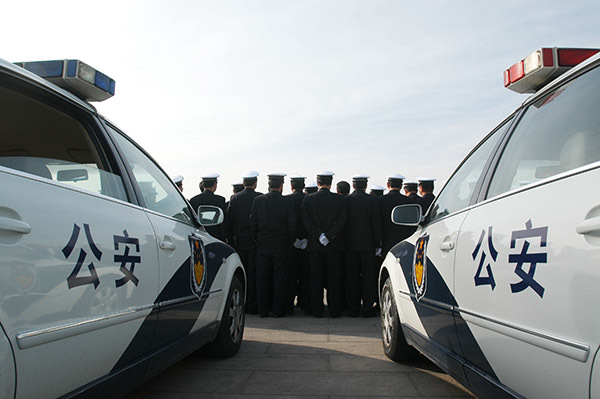
Illustration: CCP Police Vehicle (China Photos/Getty Images)
[People News] Recently, several provinces in the People's Republic of China have faced what can be described as 'turbulent waves' and 'violent storms.' Following the floods in Guangxi and the tornado disaster in Hubei, Typhoon 'Bavi,' the ninth typhoon of the year, made its second landfall in Wenzhou, Zhejiang, around July 12, with maximum wind speeds reaching level 13 (38 meters/second) near the center and a central pressure of 960 hPa.
Images and footage shared by state media and netizens depict the aftermath of the 'violent storms,' where winds howled and rain poured down, causing trees to sway and branches to snap, as if the heavens were furious and intent on overturning the earth. As of the time of this article's submission, the CCP has not provided any information regarding casualties or economic losses resulting from the typhoon in the affected areas. According to meteorological reports from the CCP, the northward trajectory of the typhoon is expected to impact regions such as Huanghuai, North China, and Northeast China, with heavy rainfall anticipated to affect over ten provinces and cities, including Jiangxi, Anhui, Hubei, Henan, and the Beijing-Tianjin-Hebei area. Flights and high-speed rail services in regions like Zhejiang and Shanghai have also been disrupted.
Nevertheless, the CCP is not prioritizing disaster prevention and relief efforts; instead, it is concentrating on maintaining stability and rigorously cracking down on those who 'exploit disasters to incite chaos.' Reports from mainland media indicate that in Zhejiang alone, 28 individuals have been investigated for photographing and sharing images of the 'Bavi' scene online.
For instance, Chinese media reported that on the afternoon of July 11, an internet user named Hu Moumou posted false videos about strong winds and flooding on a certain platform, labeling them with 'Linping, Hangzhou' and 'Xiaoshan, Hangzhou'... On the same afternoon, another internet user named Wang Moumou shared a video on a different platform, asking, 'This is what Hangzhou looks like now; what does your city look like?' Upon verification, this content was found to be false... 'A garage in a certain community in Wenzhou was flooded. This is a rumor. After investigation, the related video was from a previous year's typhoon...
Chinese media cited statements from public security authorities, indicating that those spreading these rumors were doing so to gain attention, and all have been dealt with according to the law by local public security agencies. Interestingly, neither the media nor the authorities clarified which specific laws were being referenced, what charges were being brought, or how they were being handled—whether through education, fines, detention, or prosecution.
Internet users speculated that this might fall under the charge of 'causing chaos during a disaster,' and it is more likely to result in fines. Currently, the Chinese Communist Party (CCP) is short on funds and is finding various ways to extract money from the public; the phrase 'crack down hard' is merely a rhetorical tactic to create an atmosphere conducive to money extraction.
Some internet users also noted that the CCP's current strategy for maintaining stability against the populace is a lone-wolf approach, focusing on strict enforcement and crackdowns. In the case of collective protests, they need to learn to employ softening and appeasement tactics. For example:
On June 27, a large-scale protest erupted in Hefei, Anhui Province, against the construction of a landfill, leading to clashes between police and citizens and causing traffic paralysis. Subsequently, the local district chief and the deputy director of the Hefei Public Security Bureau announced the cancellation of the landfill project on the spot, which was met with cheers from the crowd; the people achieved victory and dispersed.
On July 10, a video emerged online showing a group of first-year high school students in Anlu, Hubei, staging a collective strike to protest the school's decision to reduce the summer vacation from 20 days to just 5 days. The students gathered in the school square and the first-floor hall, chanting slogans such as 'Extend the holiday.' Some held up signs, while others displayed handwritten banners. Subsequent videos revealed that school officials arrived at the scene to engage with the protesting students, suggesting that a few of the outspoken students could have their request for an 'extended holiday' granted. However, for the other students, the officials still attempted to maintain the decision of '5 days off.' These few students, however, were not persuaded and continued their protest. One male student loudly questioned, 'Why do we have rebellions every year?!' Ultimately, the school was compelled to compromise and arranged for an extended holiday that very day.
The Chinese Communist Party (CCP) has allowed this collective protest to achieve an unexpected victory, reflecting a new strategy in maintaining stability that has evolved over the past half-century. This approach helps to release public anger and resentment, demonstrating the CCP's 'awareness of public sentiment,' which is advantageous for the survival of its regime. For the past fifty years, the CCP has responded to all grassroots collective protests with brutal suppression, causing immense harm to the populace economically, politically, and even in terms of human rights. A collective awareness of anti-CCP sentiment has developed among the people. At this juncture, the CCP recognizes that relentless bloody suppression could provoke nationwide unrest, with military, industry, and academia all rising in rebellion, potentially leading to a national 'storm' or 'tempest,' which would be catastrophic for the CCP. Therefore, it is now essential to provide an outlet for public discontent.
However, when it comes to individuals, the Chinese Communist Party (CCP) understands that no matter how many people are slaughtered, it amounts to little more than a light drizzle, a gentle rain, and will not impact the stability of the regime. Therefore, the strict enforcement and harsh crackdowns not only serve to create a deterrent effect—killing one to warn a hundred—but also help to harness the energy of struggle, yielding benefits both economically and in terms of maintaining stability.
Consequently, it is not surprising that those who dare to speak out during disasters face severe crackdowns under the guise of punishing the crimes of a chaotic nation. Furthermore, with 'Bawui' sweeping across the country, arresting 280 individuals is hardly a matter for alarm.
Historically, there has never been a ruling authority that engages in lawless and arbitrary slaughter of its own citizens. This kind of indiscriminate suppression undermines public sentiment and ultimately weakens the foundation of the CCP. Who has emerged victorious? No one has truly won. If one must identify a winner, it is history itself. History will eventually show that the collapse of the CCP occurred amidst the complete destruction of the people's trust.
Natural disasters are unavoidable, but man-made calamities can be worse than natural ones. 'Bawui' continues, and we await what will unfold next.
(People News first published) △







News magazine bootstrap themes!
I like this themes, fast loading and look profesional
Thank you Carlos!
You're welcome!
Please support me with give positive rating!
Yes Sure!