
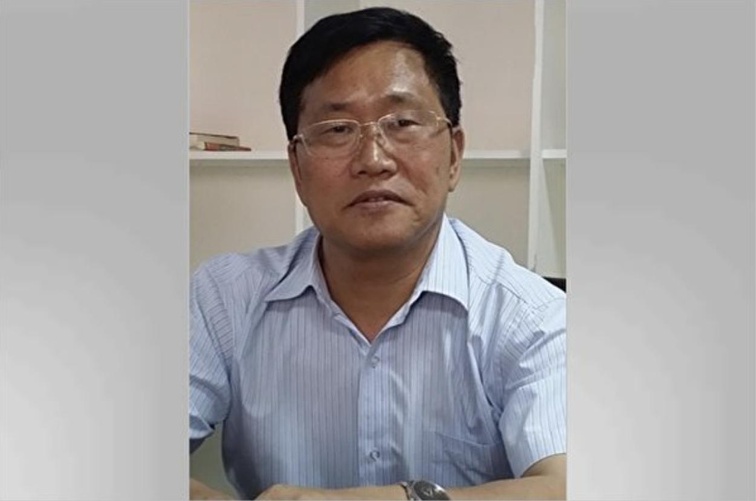
Image: Renowned Chinese criminal law scholar Zhou Shifeng. (Internet Image)
[People News] July 9 marks the 11th anniversary of the 709 incident. Zhou Shifeng, a key figure in the 709 case and former director of Beijing Fengrui Law Firm, has faced numerous restrictions over the past year, including a permanent ban on his WeChat account, travel limitations, and difficulties in meeting friends. Several human rights lawyers who are familiar with Zhou Shifeng informed Radio Free Asia that even after completing his sentence, he remains under surveillance, with significant limitations on his basic communication, litigation rights, and personal freedom.
According to Radio Free Asia, on the eve of the 11th anniversary of the 709 incident, Mr Wang, a human rights lawyer acquainted with Zhou Shifeng's recent circumstances, told Radio Free Asia this Wednesday (8th) that Zhou's WeChat account, which he had been using recently, was permanently banned again on July 2, disabling all social functions, including one-on-one chat. Mr Wang noted that this is the fifth WeChat account of Zhou Shifeng to be permanently banned in the past year: "The first three accounts were banned because he exposed the political persecution cases orchestrated by Sun Lijun's political group in his friend circle, asserting that this group still holds significant power within the political and legal system, and he provided substantial evidence."
Zhou Shifeng then filed a lawsuit against the Beijing Internet Court, which accepted his materials but failed to issue any legal documents for six months. He subsequently reported the issue to the Central Inspection Team, and the Beijing Internet Court responded that they had 'concluded the review,' effectively stripping him of his right to sue. When he followed up later, the court stated that 'the matter has been resolved.'
WeChat Accounts Continuously Banned
Recently, Mr Wang, who had met Zhou Shifeng, mentioned that Zhou suspected the ban on his WeChat account was linked to the internet supervision department of the Public Security Bureau in Anyang, Henan. Zhou wrote to the relevant officials at the Henan Provincial Party Committee, the Provincial Discipline Inspection Commission, and the Provincial Political and Legal Committee to report the issue: 'The letter was subsequently forwarded to the Anyang City Discipline Inspection Commission and then to the Discipline Inspection Department of the Municipal Public Security Bureau, but I have yet to receive a formal response.'
Zhou Shifeng has registered several WeChat accounts, and starting from his fourth account, he stopped posting on Moments and liking posts, yet this account was still permanently banned. He later filed lawsuits against the Nanshan District Court in Shenzhen and the Beijing Internet Court. Mr Wang stated: 'The court's online filing system requires information such as the 'mobile number of the defendant's legal representative or main responsible person', 'landline', and 'type of identification'. This information pertains to the personal details of Tencent's legal representative, which ordinary citizens cannot access, leading to the rejection of my filing.'
Zhou Shifeng confirmed this situation when responding to inquiries from Radio Free Asia. He told the station: 'My five WeChat accounts have been unjustly banned, and there is no judicial remedy available, which has deprived me of the basic means to maintain contact with society. These are fundamental facts, and I am very grateful to all sectors of society and my friends for their concern.'
Zhou Shifeng is one of the prominent figures sentenced in the 709 case. In July 2015, Chinese authorities conducted a large-scale crackdown on rights lawyers, legal workers, and related individuals, an event that became known as the 709 incident. Zhou Shifeng was the director of the Beijing Fengrui Law Firm and was sentenced to seven years in prison. After his release in September 2022, he continues to face long-term restrictions.
He faces obstacles in meeting friends and has restricted travel.
Mr Li, another human rights lawyer in Beijing, informed reporters that after Yu Wensheng, a former lawyer involved in the 709 case, was released from prison, he had intended to meet Zhou Shifeng in his hometown of Anyang. However, the two were ultimately unable to meet. Mr Li remarked, 'Yu Wensheng and Zhou Shifeng are long-time friends who had arranged to meet in Anyang. The day before Yu Wensheng arrived, Beijing's National Security officers rushed to Anyang to forcibly prevent their meeting. This not only restricts personal freedom but also severs the most fundamental friendships.'
Mr Li further noted that it is currently very difficult for the outside world to directly reach Zhou Shifeng, and his current situation and feelings remain unclear. He mentioned that Zhou Shifeng had previously reported to the Central Inspection Team that the 709 case was a political persecution orchestrated by high-ranking officials in the political and legal system, including Sun Lijun and Fu Zhenghua, and that he himself is a victim. Nevertheless, relevant authorities continue to monitor him.
Another human rights lawyer, Mr Zhang, who is familiar with Zhou Shifeng's rights protection efforts, told Radio Free Asia that over the past year, Zhou Shifeng has consistently submitted materials to various inspection teams and the prosecution system, highlighting the lingering issues of political toxicity from Sun Lijun and Fu Zhenghua within the political and legal system. Mr Zhang stated that Zhou Shifeng has reported these issues to the 16 inspection teams dispatched nationwide during the sixth round of inspections by the Central Committee, as well as to the inspection team stationed at the Tianjin Procuratorate and other departments regarding problems within the Tianjin political and legal system.
Accusations regarding the legacy issues in the political and legal system.
Mainland human rights lawyer Mr Zhang asserts that the 709 case is not just an ordinary case, but rather a fabricated one orchestrated by the political faction of Sun Lijun and Fu Zhenghua. He stated, 'Last June, following the establishment of the Procuratorial Investigation Department at the Supreme People's Procuratorate, I promptly reported to that department and the prosecution department as a key figure in the 709 case. This April, just as the Central Committee's seventh round of inspections commenced, I submitted nine sets of complaint materials, highlighting that the political toxicity from Sun Lijun and Fu Zhenghua remains rampant today.'
According to statistics from human rights organizations, including the China Human Rights Lawyers Concern Group, the '709 Crackdown' that began on July 9, 2015, saw the Chinese Communist Party police arrest, summon, forcibly disappear, or interrogate 319 rights lawyers, legal assistants, human rights defenders, and their family members across over 20 provinces. Among these individuals, 36 were subjected to long-term detention, secret detention, or forced disappearance, while more than 10 core lawyers and rights defenders faced charges of 'subversion of state power' or 'inciting subversion of state power,' receiving prison sentences ranging from 3 to 8 years.
Eleven years after the incident, most of those who were initially taken away, summoned, or briefly detained have been released or have completed their sentences. However, they continue to face ongoing stability maintenance, surveillance, travel restrictions, and professional repression.
In the aftermath of the 709 incident, Yu Wensheng's attempts to leave the country have been obstructed.
In early June this year, Yu Wensheng and his family of three planned to travel from Shenzhen to Hong Kong, but they were stopped by the authorities at the Luohu port. Yu Wensheng posted on platform X: 'On June 9, my wife, child, and I arrived in Shenzhen. My wife and child intended to travel to Hong Kong, but both were informed by border control that 'exiting the country may pose a threat to national security,' and were prohibited from leaving the country, and were briefly detained. Currently, our family of three is all banned from leaving the country.' △





News magazine bootstrap themes!
I like this themes, fast loading and look profesional
Thank you Carlos!
You're welcome!
Please support me with give positive rating!
Yes Sure!