

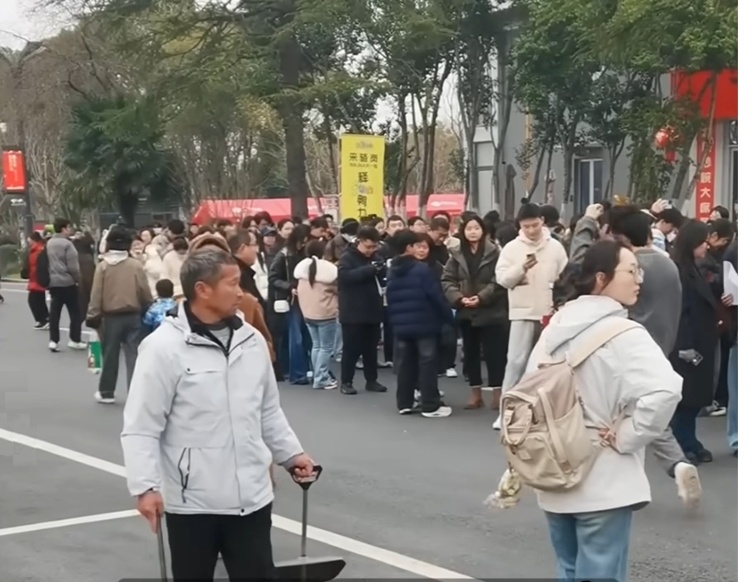
Graduation often leads to unemployment, and the number of young people struggling to find jobs is on the rise, alongside an increasing number of delivery riders in the market. (Video Screenshot)
[People News] As China's economy continues to decline, it has significantly impacted businesses and worsened the employment situation. In recent years, there has been a growing number of videos online in China expressing frustration over job hunting, with this year seeing an even greater increase compared to previous years. Recently, a job-seeking post by a recent graduate titled 'Finding a Job in Beijing is No Longer a Matter of Salary' resonated with many and quickly trended on hot search, but was soon suppressed by the authorities.
This impactful online article 'Finding a Job in Beijing is No Longer a Matter of Salary' accurately addressed the pressing issues of the current environment. After going viral on social media, it drew the attention of the authorities, leading to its rapid removal from mainstream networks and social platforms in China by the censorship department. Nevertheless, the core paragraphs, key arguments, and the heated discussions it generated have been documented by various overseas communities and independent media.
'Finding a Job in Beijing is No Longer a Matter of Salary' is narrated from the first-person perspective of a recent graduate seeking employment in Beijing. It avoids complex economic jargon and instead paints a vivid picture of the stifling employment landscape through genuine everyday details: 'salary' has ceased to be a negotiating tool and has become a mere act of survival charity.
The article states: "Previously, discussions among job seekers revolved around which major company offered a better salary package, which had superior benefits, and whether there were year-end bonuses. However, the recruitment market in Beijing has shifted; it is no longer about choosing based on salary, but rather, candidates often find themselves unqualified to negotiate their pay."
"Interviewers often adopt a tone that feels almost patronizing, suggesting that there are thousands of people waiting for this position. If you think the salary is too low, there’s a line of returnees and graduates from prestigious 985/211 universities ready to step in, even at lower pay. Nowadays, simply having a job, receiving a salary on time, and having your five insurances and one fund covered is considered a significant advantage."
"During an interview for a typical new media operations role (with a monthly salary of around 5000-6000 RMB), candidates included graduates from top overseas universities and former team leaders from major companies with five years of experience. This downward competition leaves ordinary fresh graduates with little chance of survival. Everyone is competing for lower-tier positions, with highly educated individuals taking jobs meant for less experienced workers, leaving those at the bottom with no options."
"On recruitment platforms (like Boss Zhipin and Qiancheng Wuyou), after sending out hundreds of resumes, nearly all responses are automated replies or 'read but not replied.' Many advertised positions are not genuinely hiring; they serve merely to create the facade that 'the company is still operating normally' or to collect free proposals. When you finally attend an interview, you often discover that many of these positions have already been frozen."
Beijing was once the ultimate destination for countless young people pursuing their dreams. However, the cost of living in the city—such as rent and prices—remains high, while opportunities are dwindling at an alarming rate. For those who choose to stay, it means confronting a daily struggle for survival as soon as they wake up; for those who return to their hometowns, they face the collapse of the local economy and the stifling nature of social relationships. Our generation has become known as the 'stalled generation,' caught in a difficult position.

Each year, more than ten million university graduates enter the job market only to find themselves unemployed, leaving many young people feeling lost and helpless about their future. (Screenshot from the video)
Resonance and Echoes of Public Opinion
This online article has struck a chord with many netizens, quickly climbing to the top of trending searches. It not only reflects the situation in Beijing but also highlights the shared structural challenges faced by first-tier cities in China, including Shanghai, Shenzhen, and Guangzhou. In the reposts and comments section, numerous netizens shared similarly moving reflections:
"In the past, I studied to change my fate, but now I realize that studying only makes it harder for me to accept my fate of delivering takeout."
"The current reality is not that we are unwilling to work hard; rather, even the opportunities to endure hardship and be exploited must go through several rounds of harsh screening and interviews."
"The most brutal part of this article is that it strips away all the superficial gloss, laying bare the most genuine survival crisis for everyone to see."
"It’s really not just about salary anymore; it’s about whether you can even find a job!"
"In the past, our R&D positions were primarily filled by master's graduates from Southeast University, Nanjing University, Zhejiang University, Chengdu University of Electronic Science and Technology, and Xi'an University of Electronic Science and Technology. This year, my neighboring department actually hired two master's graduates from Peking University... This is the first time I've seen this in over a decade."
"Finding a job now is truly no longer just about salary; there are so many candidates with higher degrees and more experience than we. The competition is intense, positions are limited, and the employment environment is quite poor. My girlfriend has been searching for a job for six months and still hasn't made any progress..."
I began my career in 2020 and have switched jobs several times since then. My impression is that finding a job has become increasingly challenging each year. In the past, even without any certificates or significant experience, I could still receive interview invitations from some medium-sized companies. Now, there are hardly any interviews, let alone job offers. Previously, regardless of whether I was hired, I at least had interviews; now, there are hardly any interviews, much less job offers.
This reflects the reality I experience. In my small company, I posted a job for a clerk with weekends off and social insurance during the internship period, and I received over 500 resumes, including many from graduates. Of course, most of them still come from vocational colleges or regular undergraduate programs.
Previously, I thought cleaning jobs were for certain types of people, like new housewives or similar. However, today I met female master's degree holders working as cleaners, a female executive born in 1996 also working as a cleaner, and many others whose names I can't recall...
Today, finding a job is no longer just about negotiating salary. In the current job market, many people are experiencing a frustrating shift from 'finding a good job' to 'just finding any job.' As opportunities diminish and individuals face stringent conditions of cost-cutting and multiple roles for one person, they are compelled to lower their expectations merely to secure a job that can provide a stable livelihood. This does not indicate that people have become easier to satisfy; rather, the environment forces them to compromise.
Some overseas netizens commented: "Ten years, just ten years, and the three pillars of the Chinese economy have completely stalled. We are witnessing waves of salary cuts, unpaid wages, rising unemployment, business closures, disruptions in supply chains, return waves, negative assets, the 996 work culture, lying flat, and involution... The blind boasting about GDP and other economic figures can no longer deceive the people; their firsthand experiences are the most genuine. The most alarming deflation has also emerged. A group of war wolf-like fanatics, who have been riding high for a decade, have finally awakened to the reality of the situation."

The wages for summer workers are merely 8 yuan per hour. (Video screenshot)
Revealing the truth, the post was swiftly censored.
After this article gained traction, the Chinese Communist Party (CCP) authorities quickly removed it with remarkable efficiency.
For decades, the CCP has repeatedly vowed to "lead the Chinese people to wealth and a happy life," and in recent years, this has escalated to grand political slogans such as "the East rises while the West declines," "high-quality development," and "positive recovery." This article pierced through the facade of a peaceful and prosperous society that the authorities have constructed, directly exposing the hardships faced by the public and resonating with many netizens.
In the CCP's stability-maintaining logic, "individual anger" is not a threat; rather, it is "collective despair" that poses a danger. When one person struggles to find a job, they may doubt themselves and endure in silence; however, when millions read this article and suddenly realize that "so many others, including top elites in Beijing, are facing the same challenges," individual frustration can transform into collective anger and awakening.
This collective resonance and despair serve as a powder keg for triggering mass incidents, social unrest, and even collective resistance movements like the 'White Paper Movement.' Authorities must act swiftly to extinguish these flames before they can spread widely.
Historically, many regime upheavals have often started with marginalized elites who are 'knowledgeable, articulate, yet abandoned by the system.' The youth job-seeking demographic in Beijing largely consists of well-educated middle-class children and graduates from prestigious universities. These individuals possess strong writing skills, online communication capabilities, and the potential for social mobilization. When this group of 'high-level intellectuals' realizes that after more than a decade of hard study, they cannot even secure the basic means of survival, they begin to express their frustrations and dissatisfaction online, analyzing and summarizing political issues. This poses a significant political risk to the authorities. The removal of articles is intended to sever the channels through which these educated youths can connect and build consensus.
The most pressing issue is that, in the face of this structural collapse of employment, the authorities are unable to provide effective solutions. State-owned enterprises cannot absorb the large number of graduates, private companies have been severely repressed to the point of near collapse, and foreign investments are hastily withdrawing due to political risks. Given the inability to 'solve the problem' in reality and create sufficient job opportunities, the quickest and cheapest way to maintain the regime's image of being 'all-powerful' is to 'eliminate those who raise the issues and the articles.' The disappearance of this online article serves as another footnote to this 'employment crisis'—the system cannot address the challenges of job hunting, but it can efficiently remove posts that highlight the difficulties of finding work.
For the Chinese Communist Party, such online articles act like a 'mirror that reveals the truth,' exposing the many flaws behind the facade of prosperity. The swift deletion of articles and their removal from platforms is a reflexive action driven by the authorities' 'extreme insecurity and fear.' However, this approach of burying their heads in the sand will only lead to deeper undercurrents and grievances among the lower strata of society, waiting for the next eruption.
(First published by People News)







News magazine bootstrap themes!
I like this themes, fast loading and look profesional
Thank you Carlos!
You're welcome!
Please support me with give positive rating!
Yes Sure!