
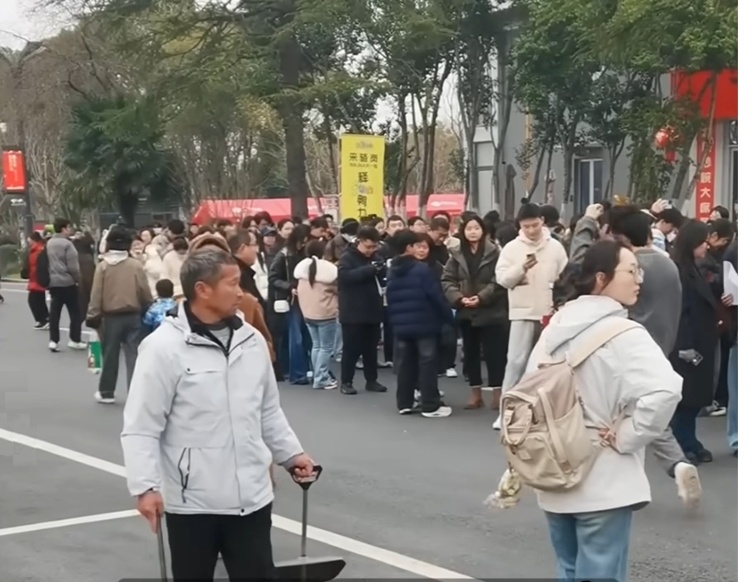
Finding a job has become the most significant setback in life for many highly educated young people, including those with bachelor's and master's degrees. (Video screenshot)
[People News] As summer arrives, it marks the time when college students graduate and enter the job market. This year, more than 1 million master's graduates have entered the workforce. However, what awaits them is not a lucrative white-collar job with an annual salary of a million, but an even harsher employment landscape than what they faced three years ago upon graduating with their bachelor's degrees. This summer is a heartbreaking one for countless Chinese parents whose hopes have been dashed.
After spending three years in graduate school, incurring tens of thousands more in tuition, and sacrificing three years of youth, why is it that the higher the education level, the narrower the path to employment? Who has orchestrated this elaborate educational Ponzi scheme? How many ordinary families will it exploit?
The Number of Master's Graduates Exceeds One Million
According to a recent report from the Ministry of Education of the Communist Party of China, the "2025 National Education Development Statistical Bulletin" indicates that by 2025, a total of 1.4385 million graduate students will be enrolled nationwide, including 201,600 doctoral students and 1,236,800 master's students. Meanwhile, 1.1665 million graduate students are expected to graduate, comprising 112,900 doctoral students and 1,053,600 master's students. This year marks the first time that the number of master's graduates in mainland China has surpassed 1 million.
So, was their job search process smooth?
Recent reports from mainland media have highlighted the growing competition for graduate employment. Many graduates interviewed expressed that even with a master's degree, they still encounter intense competition in the job market. Some graduates from 'double non' universities (those not classified as 985 or 211) openly admitted to facing educational barriers multiple times. A significant number of master's graduates have resorted to temporary jobs, such as food delivery, to make ends meet due to the difficulty in finding suitable employment.
'Double non' master's graduates struggle to meet entry requirements
According to mainland media reports, Liu Can (pseudonym), a master's student in accounting from a 'double non' university in Beijing, shared her experiences of facing educational discrimination during the spring recruitment season. At a job fair for state-owned enterprises, recruiters explicitly stated after reviewing her resume, 'We only hire graduates from double first-class universities.' In several interviews, she noticed that most of the over 20 candidates competing alongside her came from prestigious 985 and 211 universities and had internship experience at major companies, leading to a harsh elimination process for ordinary master's graduates in the first round.
Wang Yue, a master's student from the renowned journalism department at Communication University of China, possesses extensive internship experience with prominent media outlets but has repeatedly faced obstacles in his job search. He applied for a reporter position at a certain institution in Beijing, which was only hiring 4 individuals, yet over 200 master's graduates from top 985 universities like Tsinghua and Peking University applied, resulting in fierce competition. Ultimately, Wang Yue was not selected, and his subsequent applications to media organizations such as CCTV also did not yield any offers. He expressed his frustration, stating, 'It seems that there are always more master's graduates than available jobs in the employment market.'
Amid the ongoing decline of China's economy over the years, the youth unemployment rate has consistently hovered around 20%. Each year, more than ten million bachelor's and master's graduates enter the job market, resulting in an oversupply of master's and doctoral degrees, a devaluation of educational qualifications, and the widespread phenomenon of 'degree inversion.' Consequently, many young people are compelled to take on atypical jobs such as food delivery and courier services.
A female master's graduate shared on Xiaohongshu that she has taken up a job as a food delivery rider. She remarked, 'In this era of rapid devaluation of educational qualifications, earning a master's degree does not elevate your status; it merely drapes you in an unremovable long gown, and ultimately, you still end up delivering food.' Numerous master's graduates have reflected that after two or three years of graduate studies, not only did the courses fail to provide substantial benefits, but they also missed out on job opportunities that were available when they graduated with their bachelor's degree.
Job hunting has become the greatest frustration in life.
An Xin, an HR personnel from a Fortune 500 real estate company in Beijing, indicated that the management trainee positions require applicants to hold a master's degree. During the initial screening, the company prioritizes candidates based on their alma mater and undergraduate background. Most candidates who progress to the interview stage possess both prestigious educational qualifications and internship experiences at major internet companies. When these highly educated young individuals are asked, 'What is the biggest setback you have faced?' their response is almost invariably 'this year's job search.'
Li Jie, who previously worked in the marketing department at JD.com, noted that in 2018, most new hires in the department were undergraduates, but by 2020, the majority of newly recruited interns were master's graduates from top universities. Although the job responsibilities had not changed significantly, the employment threshold had indeed risen.
This reflects the structural disaster of the 'mass devaluation of educational qualifications.'
The latest data from the Ministry of Education of the Communist Party of China indicates that the number of master's degree graduates has exceeded one million for the first time, reaching 1.0536 million. This figure, which should have represented a 'brilliant report card' for the expansion of higher education, has instead turned into a structural disaster characterized by a 'mass devaluation of degrees' and 'collective unemployment among highly educated individuals' in the context of the current economic collapse.
So, why are there so many master's graduates? This situation is a direct consequence of the Communist Party's previous efforts to mask the unemployment rate.
The 'expansion of enrollment as a buffer pool' has now burst.
Around 2020, as the economy began to decline and the pandemic took its toll, it became exceedingly difficult for undergraduate graduates to secure employment. To maintain a favorable appearance in the statistics, the Communist Party mandated a 'massive expansion of graduate enrollment,' luring hundreds of thousands of young people, who were meant to enter the job market, to continue paying high tuition fees and return to university to 'study for an additional two or three years' for master's or even doctoral degrees, effectively using this as a buffer against employment pressures.
Now, two or three years later, this buffer pool has overflowed. As this influx of one million master's graduates enters the job market, the domestic economic environment has not improved; in fact, it has deteriorated due to the government's crackdown on private enterprises, including the internet, tutoring, and real estate sectors, which are facing significant crises. Coupled with the decoupling from the West, this has led to a dismal economic recovery and a historic 'great contraction' in high-end white-collar job opportunities.
Therefore, it is evident that the core issue of highly educated graduates struggling to find employment is yet another negative outcome of the Communist Party's system, which prioritizes 'political command over everything, disregarding scientific principles.'
A healthy society is characterized by industrial upgrades that generate a demand for high-end talent. In contrast, the Chinese Communist Party is facing a decline in industry, the failure of private enterprises, and the withdrawal of foreign investment, while higher education is pursuing a 'Great Leap Forward' style expansion in enrollment.
This increase in 'graduate enrollment' to tackle the employment challenges faced by highly educated graduates is merely a misguided strategy that has unraveled in just two or three years. The ultimate burden falls on countless families who have depleted their savings to help their children earn master's degrees, as well as on young graduates who, despite holding these degrees, find themselves forced into jobs as food delivery drivers. This cohort of educated youth, who should have been the backbone of the nation, has instead been coerced by the system into becoming 'cheap labor weighed down by educational credentials,' which represents one of the most profound tragedies of our time.
The 'educational Great Leap Forward' has shattered the fundamental dignity, faith, and hope for survival of countless Chinese families. The anguish felt by parents can no longer be simply described as 'disappointment'; it is a deep spiritual paralysis and despair resulting from being thoroughly deceived by the system.
The 'blood money' spent on education and the crisis of returning to poverty
It is crucial to recognize that in China, raising a master's or doctoral student is a gamble that risks the entire family's wealth accumulated over decades for ordinary wage earners or farming families. From the exorbitant tutoring fees and housing costs associated with school districts from elementary through high school, to the high tuition and living expenses for universities and research institutes, many families have overdrawn their pensions and even taken on significant debt to support this endeavor.
Parents initially calculated the financial implications: they invested a significant amount of money early on, hoping that their children would graduate and secure a respectable white-collar job, thus achieving social mobility and supporting their parents in retirement. However, the million-dollar investment has led to their children being unemployed, now working as delivery drivers in the rain for meager wages. This means that the substantial initial investment has completely gone to waste, plunging the family into a dual crisis of economic hardship and retirement.
As millions of highly educated young people are forced onto the streets, official propaganda shamelessly claims that 'a master's degree delivering food is a profession without distinctions of high or low,' and that it serves as 'an inspirational model of flexible employment,' even blaming young people for 'not being able to shed the long gown of Kong Yiji.' This has made parents realize that the system has always viewed their children merely as a 'human cushion' to mitigate unemployment rates and maintain political stability.
After spending vast sums and pouring their efforts into their education, they ultimately send their children, clad in doctoral robes and master's caps, into the ranks of delivery workers. This represents the cruelest political deception against China's middle- and lower-class families.
The bursting of this 'education bubble' is becoming a silent yet painful experience of blood and tears that will affect generations in countless families across the nation.
And when will such tragedies finally come to an end?
(Published first by People News)
△






News magazine bootstrap themes!
I like this themes, fast loading and look profesional
Thank you Carlos!
You're welcome!
Please support me with give positive rating!
Yes Sure!