
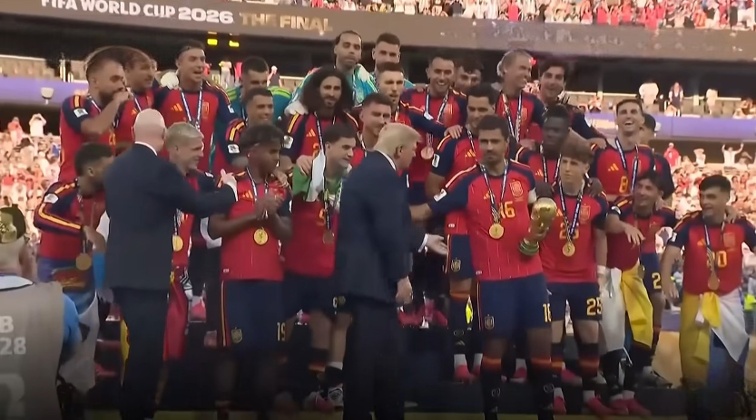
On July 19, 2026, U.S. President Trump presented awards to the Spanish team for winning the FIFA World Cup. (Video screenshot)
[People News] The 2026 World Cup has expanded to 48 teams, with the Asian region receiving an unprecedented 9 slots. Despite this favorable situation, the Chinese men's football team failed to advance from the Asian group stage. While the Chinese Communist Party (CCP) feels embarrassed by this outcome, state media continues to indulge in the bad habit of taking credit for others' successes. When the Spanish men's football team lifted the trophy symbolizing the highest honor, CCP state media eagerly claimed that 'Chinese-style carbohydrates,' specifically sweet potato rice (known as 红薯饭 in China), played a crucial role in Spain's championship journey!
This shameless behavior of the CCP state media has even drawn criticism from Taiwanese writer Zhu Youxun, who took to Facebook to express his frustration. He pointed out that not only is China trying to claim this honor, but they also got the origin of sweet potatoes wrong. Sweet potatoes were actually introduced to East Asia when Spain colonized the Philippines.
In his post, Zhu Youxun remarked, 'I stumbled upon a report where a Chinese media outlet claimed that Spain's victory in the World Cup was due to eating 'Chinese-style carbohydrates.' I have to ask, what are Chinese-style carbohydrates? Upon closer inspection, it turned out to be sweet potatoes. Classmates, sweet potatoes were brought to East Asia by the Spanish from Central and South America. The significant population growth in China during the Ming and Qing dynasties was largely due to the sweet potatoes they introduced, which expanded the arable land for food production. What Chinese-style carbohydrates? They were eating sweet potatoes long before you did!'
Zhu Youxun quoted a poem by the Qing Dynasty poet Shi Qiongfang, which uses sweet potatoes as its theme: 'Grapes green milk tribute from the west, leaving Christian fruit from the southern state. This melon is rumored to have come from Luzon, a land that does not cherish treasures presenting strange materials...'
Zhu Youxun remarked, 'The poem is quite clear; it refers to the 'Wanli years' when ships from overseas arrived, and 'this melon is rumored to come from Luzon', indicating that the ships were coming from the direction of the Philippines. Can you guess who was colonizing the Philippines during that time? Which country's ships would set sail from there and navigate the East Asian seas?'
Facebook user 'Chen Yijing' commented in the discussion section: 'That was indeed the period of Spanish colonization of the Philippines.'
Zhu Youxun's post sparked a lively discussion among many Facebook users. They expressed:
'Sweet potato/tomato/millet/guava/ginger, it's actually quite clear.'
'Chinese media don't read books. But we can't blame them; those who have read would find it hard to continue in this job.'
'They want to stitch everything into their narcissistic system, but reality and history frustrate them.'
'People from the Communist Party of China can't even get close to the World Cup with their Chinese-style carbohydrates!'
'As the Chinese saying goes, a lack of culture is truly frightening.'
'Whatever, everything is China's anyway! (Note: this is sarcasm) The Chinese team can't make it to the World Cup, but 'Chinese food' did, and it even won! China is indeed the strongest!'
'They aimed to glorify themselves but ended up in embarrassment.'
Some even mockingly used Communist Party rhetoric to say: 'Spain has been an inseparable part of China since ancient times.'
The Chinese Communist Party's official media has a habitual tendency to 'hitch a ride on the heat' and 'hitch a ride on the honor', particularly when Taiwan achieves notable results in international competitions. They often assert that 'the victory of the Taiwan team is the pride of all Chinese people', framing Taiwan's achievements as part of China's glory and openly including these victories in their list of 'great, glorious, and correct' honors.
This attitude, described by Taiwanese netizens as 'hitching a ride on the heat' and 'spiritual victory method', reflects a sentiment of 'not allowing you to use the name during normal times, but acting like relatives when you win'.
For instance, after Taiwan secured a 4-0 victory over Japan to win the championship at the 2024 P12 World Baseball Championship, many Chinese netizens and official media discussed it in terms such as 'Chinese Taiwan team', 'the common pride of compatriots on both sides of the strait', and 'proving that Chinese people can also excel at baseball'. This rhetoric suggests that not only is Taiwan's territory an inseparable part of China, but also that the sports honors achieved by Taiwan belong to China.
At that time, Taiwanese fans expressed their dissatisfaction, and Japanese fans also found this behavior of 'politicizing sports competition and imposing identity' to be quite abrupt and inappropriate. Fans from both Taiwan and Japan unanimously stated, 'Please do not attribute Taiwan's efforts to other countries.'
Some commentators argue that the Chinese Communist Party's official media, when confronted with Taiwan's achievements in international sports, must maintain the official stance that 'Taiwan is a part of China'. Thus, referring to the Taiwan team as the 'Chinese Taiwan team' and promoting it as 'the pride of the Chinese children' is a necessary action aligned with the political correctness dictated by the Chinese Communist Party under the narrative of 'the rise of a great power'.
In the overarching narrative of the Chinese Communist Party (CCP), there is a constant emphasis on the idea that 'individual achievements arise from the cultivation of the collective and the Party.' Whether it is an athlete winning a championship, a scientist making a breakthrough, or a business achieving success, the ultimate framing is always 'thanks to the Party's leadership and the country's nurturing,' with individual efforts and talents being inevitably downplayed and obscured by the system.
In this context, sports are not pursued for personal health or the spirit of competition, but rather to 'demonstrate the superiority of the system' and 'showcase national prestige.'
Many Chinese netizens have developed a habit of categorizing all top honors associated with 'Chinese' or 'Taiwan' as 'victories of the broader Chinese nation,' which serves to bolster national pride and confidence in a great power: 'As long as you share blood ties or geographical connections with us, your glory rightfully belongs to this grand collective.'
The 'united front-style congratulations' from Chinese netizens and state media, along with the 'harvesting-style discourse,' have not succeeded in achieving the CCP's goal of 'enhancing cross-strait identity.' Instead, after each major competition, they have only deepened the Taiwanese public's wariness towards China and further solidified the local identity and sentiments of the Taiwanese people.
Taiwanese netizens have pointed out that Taiwan has faced long-term political suppression in international competitions, such as being unable to use its national flag, name, or anthem, and can only refer to itself as 'Chinese Taipei.' There have even been demands for event organizers to change names and suppress Taiwanese fans' support items. However, when Taiwan achieves the top position in the world through its own strength, Chinese internet users come to 'share the glory.' This attitude of 'not allowing you to use your name normally, but acting like relatives when you win' is commonly described by Taiwanese netizens as 'riding the coattails' and employing a 'spiritual victory method.'
To counter this phenomenon of being 'represented,' in recent years, whenever the Taiwanese team wins a championship, the Taiwanese community has erupted in large-scale 'TEAM TAIWAN' hashtag campaigns and national flag flooding actions. This serves to clearly delineate the boundaries of sports glory between the two sides through high-profile declarations of local identity.
(Originally published by People News)
△






News magazine bootstrap themes!
I like this themes, fast loading and look profesional
Thank you Carlos!
You're welcome!
Please support me with give positive rating!
Yes Sure!