
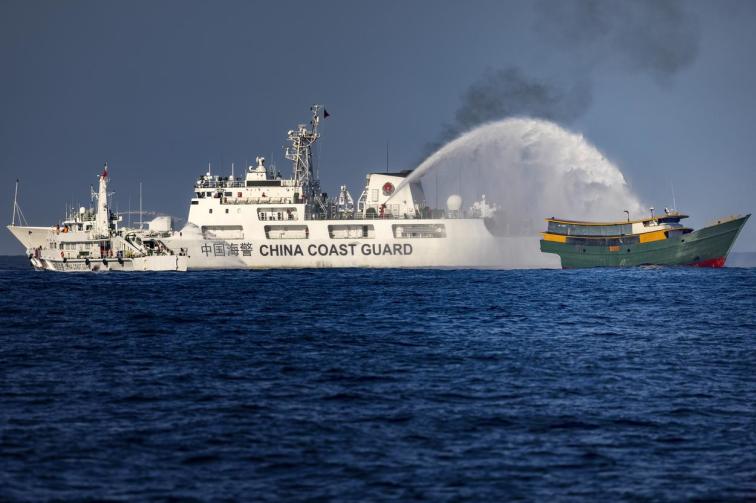
On March 5, 2024, a collision occurred in international waters between a Philippine supply ship and a China Coast Guard vessel. The windshield of the Philippine ship was shattered by a high-pressure water cannon fired by the China Coast Guard, resulting in minor injuries to four Filipinos. (Photo by Ezra Acayan/Getty Images)
[People News] As the ASEAN Foreign Ministers' Meeting takes place, Philippine Foreign Minister Maria Theresa Lazaro lodged a serious protest on Wednesday (July 22) with Chinese Foreign Minister Wang Yi regarding Beijing's recent "violent actions" in the South China Sea and its use of artificial intelligence (AI) to create videos that insult Filipinos. U.S. Secretary of State Marco Rubio, who attended the meeting, also reaffirmed his strong support for the Philippines.
According to TheDajiyuan, Foreign Minister Lazaro stated on social media: "I met with Chinese (Communist Party) Foreign Minister Wang Yi during the ASEAN meeting for an open discussion on Philippines-China relations. I reiterated our strong protest against the unacceptable actions of the Chinese side towards Filipino personnel near Ayungin Shoal (also known as Second Thomas Shoal), as well as the disturbing images presented in the video by China Daily."
The Philippine Department of Foreign Affairs noted in a statement that Lazaro held the first foreign minister-level bilateral meeting with the Chinese side in two years during the ASEAN Foreign Ministers' Meeting in Manila. The statement emphasized that "disagreements over legal and political issues cannot justify the use of disturbing imagery," and clearly condemned the July 10 incident where China Daily used AI-generated videos to portray Filipinos as monkeys, describing this act as "extremely offensive, painful, and unacceptable."
The Philippine Foreign Minister reiterated the country's consistent stance on the South China Sea, demanding that the Chinese side dismantle any structures.
As tensions escalate in the South China Sea and the ASEAN Foreign Ministers' Meeting gets underway, a collision and conflict occurred on Monday near the 'BRP Sierra Madre' military vessel, which is currently grounded at Ren'ai Reef. Both sides have provided sharply contrasting accounts of the incident.
Philippine authorities have accused Chinese Coast Guard personnel of striking Filipino soldiers with wooden sticks, while Beijing has countered that it was the Filipino personnel who initiated a malicious attack using paddles and wooden sticks.
Lazaro stated that during a closed-door meeting, she reiterated a strong protest to Wang Yi, and both sides discussed the importance of maintaining open communication channels, managing tensions, and seeking substantial ways to make progress. The discussions encompassed political and security matters, maritime and law enforcement issues, as well as developments in regional and international contexts.
She noted that both sides specifically addressed the progress of the 'ASEAN-China Code of Conduct' (COC) negotiations and expressed a continued willingness to collaborate in completing the negotiations within this year.
Lazaro conveyed to the Chinese side the Philippines' consistent principled stance on South China Sea issues, expressing deep concern over Beijing's actions that infringe upon its maritime rights and interests, and reiterated the demand for the removal of remaining structures at Scarborough Shoal (Bajo de Masinloc, also known as the Zhongsha Islands).
Since the standoff between China and the Philippines at Huangyan Island in 2012, the Chinese Communist Party (CCP) has maintained control over the waters surrounding the reef, frequently obstructing Filipino fishermen from accessing their traditional fishing grounds. This includes deploying floating barriers and establishing permanent facilities. In response, the Philippines sought arbitration from the Permanent Court of Arbitration (PCA) concerning the South China Sea dispute. In 2016, the tribunal issued a landmark ruling, stating that the CCP's claim of the 'nine-dash line' and its assertion of historical rights in the South China Sea 'lacked legal basis,' and recognized Huangyan Island as a traditional fishing ground for fishermen from multiple nations.
Despite this, the Beijing authorities have consistently refused to accept or acknowledge the ruling, continuing to militarize and expand their facilities in the region. The South China Sea is a crucial waterway through which 60% of global trade flows. In recent years, as Beijing has adopted increasingly aggressive tactics to assert its claims, confrontations in the South China Sea have become more frequent.
Rubio and U.S. Ambassador Back the Philippines
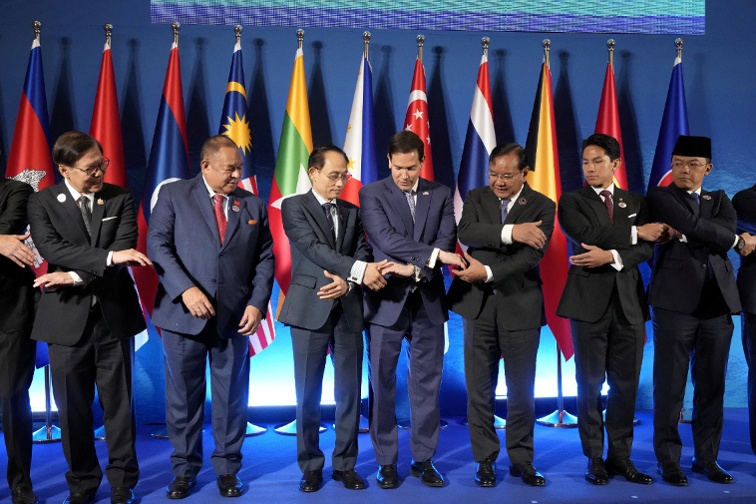
U.S. Secretary of State Marco Rubio, Russian Foreign Minister Sergey Lavrov, and Kaja Kallas, the European Union's High Representative for Foreign Affairs and Security Policy, all participated in the ASEAN Foreign Ministers' Meeting.
The U.S. has taken a firm stance against the CCP's aggressive actions. U.S. Ambassador to Manila Lee Lipton accused the CCP on Tuesday of actions in the South China Sea that could 'threaten regional stability and starkly contrast with the professionalism and discipline of the Philippine military.'
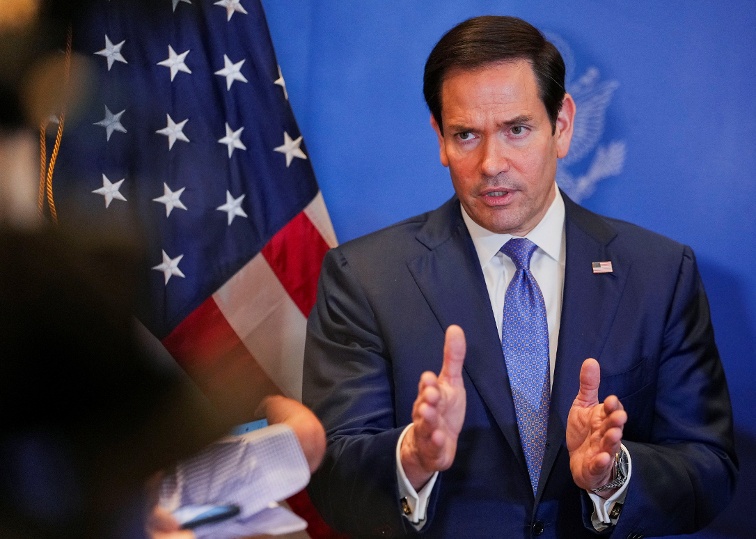
According to a report by Reuters, Marco Rubio stated after his meeting with Wang Yi on Wednesday evening that the current conflict has an 'escalatory nature' and is 'not beneficial to anyone.' He further noted that he reminded Wang Yi of Washington's defense treaty with the Philippines, asserting that the U.S. 'intends to abide by that treaty.'
In response to the U.S. support for the Philippines, the Chinese Embassy in Manila remarked that the U.S. 'is attempting to provoke tensions in the South China Sea, sow discord, and incite trouble in the region.'
Australian Foreign Minister Penny Wong, who was also present at the ASEAN meeting, expressed to reporters that the provocative actions taking place in the South China Sea are a cause for concern for Australia, and Asian countries now face choices on how to respond to this situation.
The 'Quad,' which includes the United States, India, Australia, and Japan, also convened in Manila on Wednesday and released a statement underscoring their 'strong opposition to any attempts to unilaterally change the status quo through force or coercion,' including in the East China Sea and South China Sea.
△





News magazine bootstrap themes!
I like this themes, fast loading and look profesional
Thank you Carlos!
You're welcome!
Please support me with give positive rating!
Yes Sure!