
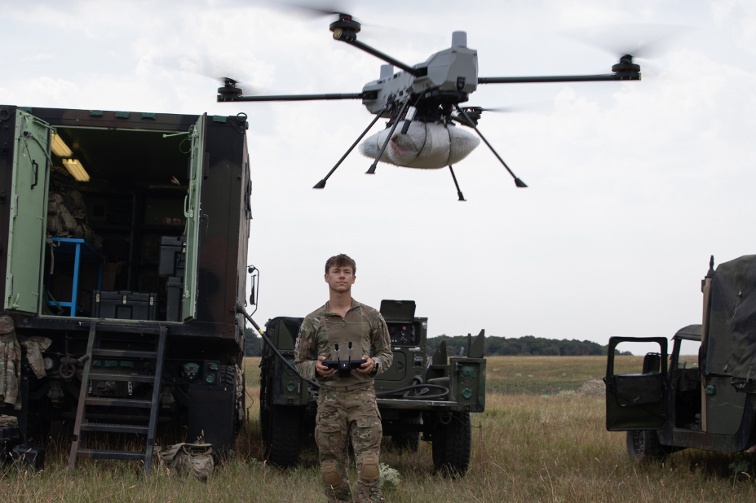
FILE PHOTO: Army Spc. Max Boatner operates a C100 drone during a field demonstration as part of Agile Spirit, a multinational training exercise, at Norio Training Area, Georgia, Aug. 2, 2025. (Army National Guard Sgt. 1st Class Brittany Conley/DOW)
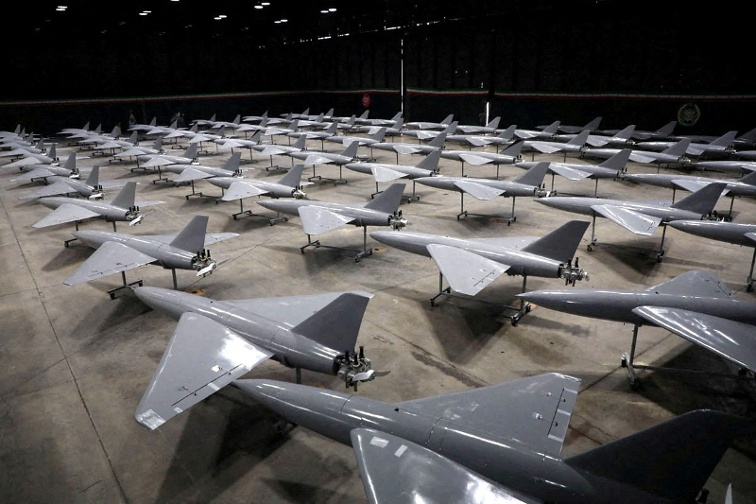
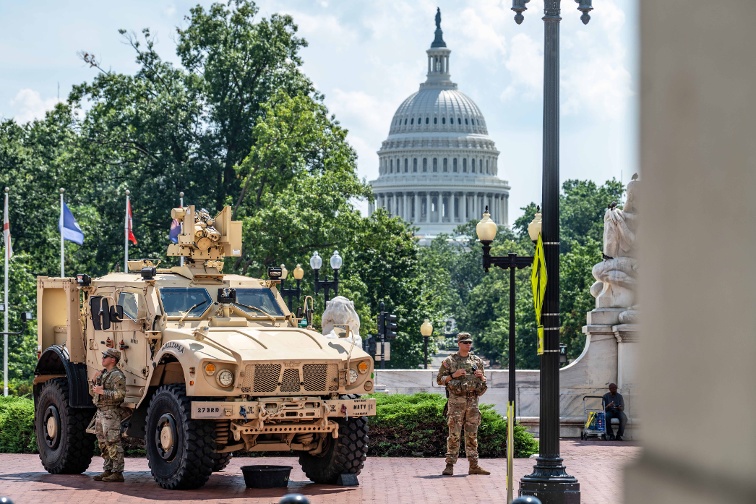
(The Center Square) – The Department of War wants $14.4 billion next year for counter-drone defenses, including at more than 250 sites, but a congressional analysis suggests protecting every military installation would cost far more.
The fiscal 2027 request would cover counter-drone defenses at more than 250 sites, budget documents show. The military tracks 824 installations in the Bureau of Transportation Statistics database, more than three times that number.
To illustrate the cost, the Congressional Budget Office modeled a benchmark installation, a five-mile-by-five-mile area covering the critical parts of a typical base. Outfitting it with the most comprehensive layered defense would cost about $74 million, plus $5 million a year to operate, the agency estimated in a July report. Protecting 100 such sites would cost about $7.4 billion, with $500 million in annual operating costs.
CBO said the costs scale linearly and illustrated the calculation for up to 100 sites. Neither the agency nor the Pentagon budget documents put a price on protecting all 824 installations, although CBO's own figures imply a total in the tens of billions.
CBO's estimates assume the services would operate the systems with existing troops rather than add personnel. Staffing each site with a dedicated 66-soldier company would cost about $6.6 million a year more, CBO said. The estimates also exclude research and development, which the Pentagon funds separately at more than $300 million a year.
The counter-drone effort is spread across the services. The Army wants $1.9 billion for its program. In August 2025, the Pentagon consolidated oversight under a new joint task force, JIATF-401, after the Secretary of War found that the growing number of counter-drone organizations "often are unconnected to each other" and that the department "needs a single focal point." The task force replaced an earlier counter-drone office established in 2020.
In December 2023, drones were repeatedly observed over Joint Base Langley-Eustis in Virginia during a 17-day period, and the Pentagon could not respond at the speed and scale needed.
U.S. Rep. Rob Wittman, R-Va., who chairs the House subcommittee that requested the CBO report, said in 2025 that the military lacked the ability to "find, fix, track, and ultimately engage" enemy drones at home and abroad.
The systems are also chasing a moving target. Many current defenses work by interfering with the radio link between a drone and its operator, but newer drones guided by fiber-optic cable or flying autonomously don't use that link, CBO noted. Large swarms can overwhelm even the most comprehensive defense the agency examined.
The Department of War did not immediately respond to questions about whether it intends to defend all 824 installations, or what that would cost.




News magazine bootstrap themes!
I like this themes, fast loading and look profesional
Thank you Carlos!
You're welcome!
Please support me with give positive rating!
Yes Sure!