
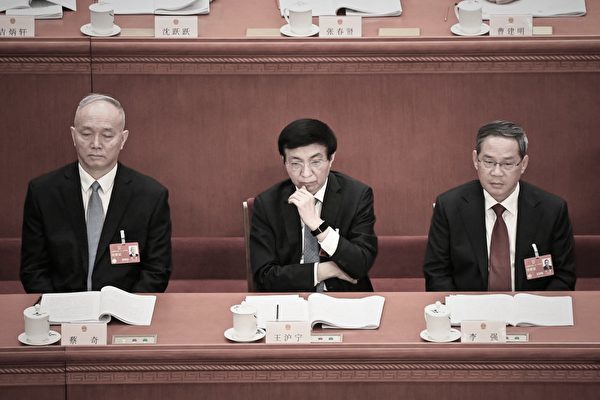
On March 7, 2023, (from left to right) Cai Qi, Wang Huning, and Li Qiang at the Chinese Communist Party's National People's Congress. (Greg Baker/AFP via Getty Images)
[People News] On November 3, documents and explanatory materials relating to the Fifth Plenary Session of the 20th Central Committee of the Chinese Communist Party (CCP) were published and distributed in Beijing. Generally speaking, following a plenary session of the CCP Central Committee, the People’s Publishing House publishes an interpretation of the plenary session documents. Since these interpretations are written by officials at the ministerial level and above, the publication is commonly referred to as the “Ministerial Edition.” Within the “Ministerial Edition,” articles are arranged according to the authors’ official ranks: state-level, vice-state-level, ministerial-level, and vice-ministerial-level. After publication, the corresponding articles are also published one by one in the People’s Daily.
In other words, after the articles written by members of the Politburo Standing Committee, senior CCP officials, and possibly other high-ranking officials have been compiled and published, the People’s Daily will publish them individually. These articles serve as a window through which lower-ranking officials learn about and study the spirit of the plenary session. They also provide the foundation for officials at various levels to produce all kinds of formulaic speeches and articles.
This year is no exception. On November 3, the People’s Daily published, on its main news page, a signed article by Wang Huning, a member of the CCP Politburo Standing Committee and Chairman of the National Committee of the Chinese People’s Political Consultative Conference (CPPCC), titled “Deeply Understanding the Major Significance of Consistently Advancing Full and Rigorous Party Self-Governance.” On November 4, the People’s Daily published, also on its main news page, a signed article by Cai Qi, a member of the CCP Politburo Standing Committee and Secretary of the CCP Central Secretariat, titled “Taking Xi Jinping’s Thought on Party Building as the Fundamental Guide for Consistently Advancing Full and Rigorous Party Self-Governance.”
As was the case last year, following the Fourth Plenary Session, when senior CCP officials published their articles, other state media outlets and social media accounts directly mentioned in their headlines that a particular official had published a signed article in the People’s Daily. This is markedly different from the practice over the past decade, when reports generally did not mention the names of Politburo Standing Committee members other than Xi Jinping in their headlines.
What is puzzling is that last year, the first Politburo Standing Committee member to publish a signed article was Li Qiang. This year, however, Li Qiang is nowhere to be seen. Instead, Wang Huning was the first to publish an article, followed by Cai Qi. Both men also published articles last year. Last year, Ding Xuexiang, Vice Premier, and Wang Yi, State Councillor and Foreign Minister, published articles immediately after Cai Qi. Whether these two will follow the same order this year remains to be seen. The People’s Daily will provide the answer on November 5 and 6.
In last year’s articles by Li Qiang, Wang Huning, and Cai Qi, Li mentioned Xi Jinping only five times, while Cai mentioned him seven times—both figures representing a noticeable reduction from the level of praise for Xi seen in previous years. Wang Huning, however, who has consistently flattered Xi, mentioned him 14 times.
Yet, upon reading Wang Huning’s article this year, one can clearly sense that this politically astute chameleon has once again changed his tone. Throughout the article, the emphasis is placed on the CCP itself, highlighting the Party’s leadership role and the importance of exercising strict governance over the Party. This language closely mirrors numerous formulations found in the plenary session communiqué and the relevant decisions. Wang’s article includes phrases such as “upholding and strengthening the centralised and unified leadership of the Party Central Committee,” “always maintaining a high degree of unity with the Party Central Committee with Xi Jinping at its core, and resolutely implementing the decisions and deployments of the Party Central Committee,” and “strictly implementing democratic centralism and improving the mechanisms for carrying out major decisions and deployments of the Party Central Committee.”
Wang mentioned Xi Jinping eight times in the article. However, on three of those occasions, Xi was referred to as the “core” of the Party Central Committee. Last year, this particular formulation appeared only once.
Why has a man who, even last year, continued to demonstrate such high-profile loyalty to Xi despite mounting signs of Xi’s weakening power, changed his language after just over a year? The only explanation is that, amid shifts in the balance of power at the highest levels of the CCP, Xi’s authority has not only been weakened but has also placed him at a relative disadvantage. Wang Huning, who is adept at reading the political winds and adjusting his position accordingly, has chosen to align himself with those CCP elders and military power brokers who advocate “upholding the centralised and unified leadership of the Party Central Committee.”
Cai Qi’s article is similar to Wang Huning’s in this respect. Although the entire article praises Xi Jinping’s thinking on Party building, and although it still contains the loyalty formula known as the “Two Upholds and Two Safeguards”, it does not directly lavish praise on Xi himself. Moreover, there is one particularly noteworthy passage in Cai’s article. It states: “‘Upholding the centralised and unified leadership of the Party Central Committee’ is the highest principle of Party leadership, emphasising that under any circumstances and at any time, one must maintain a high degree of unity with the Party Central Committee.” It further states: “We must unequivocally uphold the Party’s overall leadership and the centralised and unified leadership of the Party Central Committee.”
It is important to remember that, before the CCP’s Third Plenary Session in 2024, the highest political principle of the CCP was “resolutely implementing the Two Upholds.” This referred to upholding Xi Jinping’s position as the core of the Party Central Committee and the entire Party, and safeguarding the authority and centralised, unified leadership of the Party Central Committee with Xi at its core. For example, on March 29, 2022, the People’s Daily published an article titled “Resolutely Implementing the ‘Two Upholds’—The Highest Political Principle and Fundamental Political Rule of the Party.” It stated that the Resolution adopted at the Sixth Plenary Session of the 19th CCP Central Committee emphasised the “Two Upholds,” describing them as “the common will formed by the entire Party since the 18th National Congress” and “the highest political principle and fundamental political rule that must always be upheld.” The article further called for a deep understanding of their significance as the CCP’s “highest political principle and fundamental political rule”...
However, beginning with the CCP Politburo meeting held on January 20, 2025, the CCP’s highest political principle shifted to “upholding the centralised and unified leadership of the Party Central Committee.” Over the past year or so, this formulation has been repeatedly emphasised by both the CCP’s state media and military media. The change in the highest political principle reflects precisely the weakening of Xi Jinping’s power.
Now that Xi’s close associate Cai Qi has once again explicitly emphasised this principle in his article, it helps explain why the “Two Upholds and Two Safeguards” formula disappeared from the communiqué of the Fifth Plenary Session, and why the emphasis has shifted to “upholding the centralised and unified leadership of the Party Central Committee.”
All these signs point to the fact that Xi’s power has indeed been weakened. This is because the powerful figures within the Party who are capable of curtailing his authority do not want him to continue in office for another term. Nevertheless, in order to preserve the Party and protect their own power, Xi Jinping and these figures are still making mutual concessions, maintaining a certain balance. This also explains why the outside world sees two seemingly contradictory developments: on the one hand, Xi still appears to dominate the media and continues to be mentioned repeatedly by state media; on the other hand, the language of loyalty that once emphasised absolute allegiance to Xi is gradually being toned down. However, such a compromise will eventually be broken. Regardless of which side ultimately prevails, both Xi Jinping and the CCP are destined for a tragic end.
(First published by People News.) △






News magazine bootstrap themes!
I like this themes, fast loading and look profesional
Thank you Carlos!
You're welcome!
Please support me with give positive rating!
Yes Sure!