
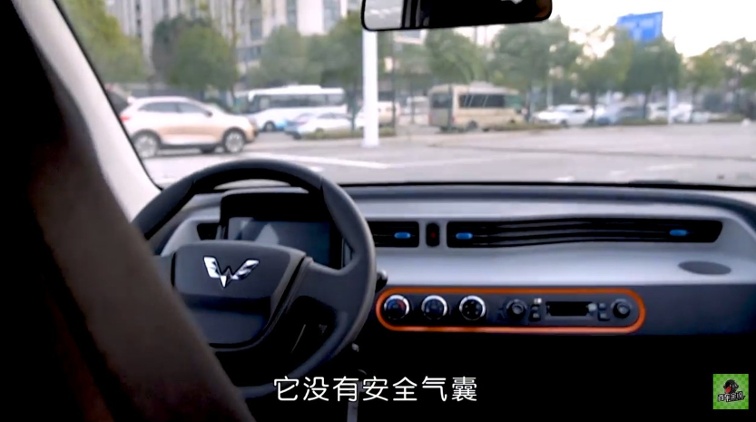
According to the YouTube channel 【Bai Che Quan Shuo】, the Wuling Hongguang MINI EV is well-known mainly for being 'affordable', but Chinese netizens frequently complain about its lack of airbags and vehicle stability systems. (Video screenshot/Bai Che Quan Shuo)
[People News] The once-popular micro electric vehicles (primarily referring to A00 class models priced below 50,000 yuan) have suddenly seen a drop in sales this year! In the first half of 2026, sales of micro electric vehicles plummeted by 55% compared to the previous year. In response, many Chinese netizens have voiced their concerns about the extremely poor safety of these vehicles, stating, 'It's simply risking lives to save money.' They lamented, 'The world has long suffered from poor quality small cars.'
On August 10, data released by the China Passenger Car Association revealed that in the first half of this year, sales of micro electric vehicles priced below 50,000 yuan (RMB, the same below) fell by 55%. Specifically, Geely Panda's sales dropped by 78.2% year-on-year, while Wuling Bingo's sales fell by 79.3% year-on-year. The Wuling Hongguang MINI EV, which was launched in 2020, once achieved peak annual sales of 554,000 vehicles, but by 2025, its sales had plummeted to less than 120,000 vehicles, marking a staggering decline of 78%.
Meanwhile, aside from models priced above 400,000 yuan, other price segments have seen varying degrees of decline. Retail prices for models priced between 50,000 and 100,000 yuan dropped by 20%, those between 100,000 and 150,000 yuan fell by 27%, models priced between 150,000 and 200,000 yuan decreased by 18%, those between 200,000 and 300,000 yuan saw an 8% decline, and models priced between 300,000 and 400,000 yuan experienced a 23% drop.
Reports indicate that the decline in micro electric vehicle sales is partly due to the increasing number of manufacturers entering the market, resulting in intense competition. Additionally, Yang Jing, a director at Fitch Ratings, told Jiemian News that starting in 2023, the downward price trend for small cars has significantly squeezed the micro car market. Consumers of micro cars are particularly price-sensitive and exhibit low brand loyalty, leading to changes in their preferred models due to price fluctuations.
Moreover, the loss of policy incentives is another contributing factor. In 2026, the electric vehicle purchase tax will shift from a full exemption to a 50% levy, raising the purchase cost of low-priced cars by several thousand yuan. The subsidy for replacing old cars with new ones will also change from a fixed amount to a percentage of the car price, resulting in a substantial reduction in subsidies for low-priced small cars.
Looking at the overall car market in the first half of this year, data from the Passenger Car Association reveals that retail sales in China's passenger car market fell by 20.2% year-on-year during this period.
As for the outlook for the car market in the second half of the year, the forecasting team at the Passenger Car Association has revised its retail growth forecast for 2026 down to -14% as of mid-June, marking the most pessimistic prediction for June in history.
"The world has long suffered from 'low-quality small cars.'"
The significant decline in sales of micro electric vehicles in China, represented by models such as the Hongguang MINIEV, Chery QQ Ice Cream, and Geely Panda Mini—often referred to as the 'upgraded version of Laotou Le' or A00 class small cars—has sparked intense discussions among Chinese netizens on platforms like Weibo, Xiaohongshu, Zhihu, and various automotive forums. The opinions expressed mainly highlight several key points.
Firstly, many netizens believe that the drop in sales is an inevitable outcome, as these low-cost micro cars reveal numerous critical flaws after actual use. While these vehicles are affordable (priced between 20,000 to 40,000 RMB), they are constructed with thin steel plates, have few airbags, and feature simplified anti-collision beams. Consequently, in the event of an accident on a main road or highway, their safety performance is alarmingly poor, leading to the sentiment that 'saving money comes at the cost of one's life.'
Additionally, the resale value of micro cars is shockingly low. Many owners express frustration that when they attempt to sell their vehicles after two or three years, used car dealers either refuse to accept them or offer prices that are 'ridiculously low,' with the sentiment that 'the money saved on fuel is entirely lost to depreciation.'
Furthermore, the serious exaggeration of charging capabilities and range has left netizens feeling highly inconvenienced, particularly in winter when the range is effectively halved and there is a lack of fast-charging technology (especially in earlier models). This has led many commuters to lament, 'I can afford it, but using it is too stressful.'
'BYD has flipped the table'
At a press conference on May 28 this year, BYD officially announced that following its commitment last July to ensure safety for smart parking, the company has once again pledged to provide a one-year safety guarantee for the urban navigation assisted driving function. If an accident occurs due to the assisted driving system and the traffic police determine that the vehicle is at fault, BYD will cover all direct economic losses in full.
Free, unlimited, and it won't affect your commercial insurance premium for the second year.
Netizens claim that this is BYD's (Biyadi) strategic maneuver, effectively pulling high-level intelligent driving from the era of parameter competition into the era of accountability. This tactic is quite aggressive! How can car manufacturers that rely on purchasing intelligent driving solutions compete? How can those companies that use car owners as free test subjects without fully validating their algorithms keep up?
Shifting from 'running toys' to 'real family cars'
Many netizens observing the automotive market have pointed out that the primary reason for the decline in microcars is that 'the price reductions of larger vehicles have completely squeezed the market space for microcars.'
With A0/A class models like the BYD Seagull (Hai'ao), Qin PLUS DM-i, Wuling Bingo, and Geely Xingyuan now priced significantly between 60,000 and 70,000 RMB, they not only offer more space, longer ranges, fast charging, and complete airbag systems, but their cost-effectiveness far exceeds that of microcars.
A common comment on social media platforms is: 'For just an additional 10,000 to 20,000 RMB, you can upgrade from a 'running toy' to a 'real family car.' So who would still choose to buy a microcar?'
The withdrawal of policy incentives and the loss of 'license advantages'
In first-tier cities like Shanghai and Beijing, netizens have a strong awareness of the policies affecting the decline in microcar sales.
Previously, many people purchased microcars to 'secure a spot' or to obtain free new energy green licenses in major cities. However, as cities like Shanghai have begun to cancel the issuance of free green licenses for micro electric vehicles that fall below certain length or price thresholds, the sales of these vehicles in first- and second-tier cities have plummeted.
Furthermore, some local governments have intensified their regulation of low-speed electric vehicles, commonly referred to as 'laotou le.' Initially, they believed that these vehicles could attract customers to transition to micro electric cars. However, due to rising overall costs—including the need for a driver's license, insurance, and parking fees—many consumers have opted to forgo purchasing a vehicle altogether or switch to electric bicycles instead.
Consumers Vote with Their Feet
Netizens have also indicated a shift in consumer attitudes: micro cars, with their appealing designs (such as pastel colors and collaborative editions), have drawn interest from many recent graduates and female buyers. Yet, as this demographic begins to look for new vehicles, or as later buyers come to realize the limited space and practicality issues, the initial 'novelty' of these cars is starting to wear off.
This is particularly evident in rural markets, which previously experienced a surge in popularity. Most families that needed to buy have already made their purchases, resulting in a lack of subsequent buying power. Moreover, consumers in lower-tier markets have a significantly greater demand for larger vehicles that can transport goods and accommodate entire families, far surpassing the interest in micro cars.
In conclusion, from the perspective of Chinese netizens, micro cars have fulfilled their historical role—they have played a crucial part in the initial wave of electric vehicle education in China. However, as the competition in the electric vehicle market escalates, consumers will naturally choose to 'vote with their feet,' favoring standard models that provide greater safety, more space, and an overall better experience.
In fact, as early as 2023, a prominent automotive technology self-media outlet noted that the market is undergoing a harsh 'consumption upgrade' and a necessary reshuffle. 'The era of grassroots innovation, where assembling a few batteries and adding a plastic shell could lead to monthly sales of tens of thousands and herald the electrification movement, has definitively ended. The stage that remains is destined for those automotive products that are safer and more dignified.'
△






News magazine bootstrap themes!
I like this themes, fast loading and look profesional
Thank you Carlos!
You're welcome!
Please support me with give positive rating!
Yes Sure!