
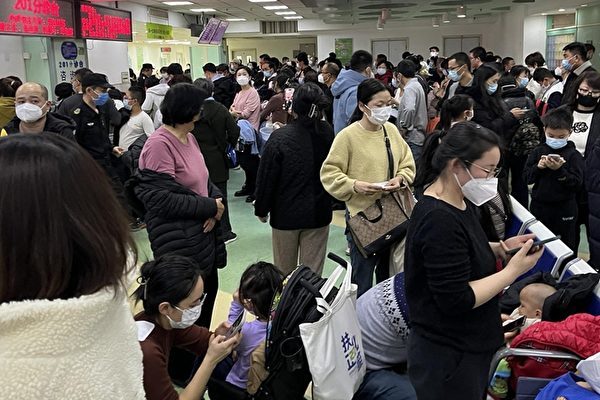
On November 21, 2023, Beijing Children's Hospital was overwhelmed with patients. (Video screenshot)
[People News] Friends in Beijing report that H1N1 is currently rampant, with many students frequently taking sick leave due to symptoms such as high fever, cough, sore throat, and general discomfort. This prompted me to search online for more information.
Numerous netizens in Beijing have expressed their concerns, stating that this wave of H1N1 is "too severe," sharing various accounts of their children and themselves contracting the virus.
"In Haidian District, my son contracted H1N1, and by that Monday, half of his class was absent. During class, two more children developed fevers and were picked up by their parents. The following day, we were informed that classes would be held online."
"A sixth grader in Desheng started running a fever on Sunday night and has been diagnosed with H1N1. It’s quite a struggle."
"I was infected from November 4th to 11th and missed a week of school."
"In class, all the boys were taken down; it started when one boy invited the entire class to his birthday party over the weekend. However, others continued attending classes, and the teacher allowed us to wear masks."
"My child fell ill quickly, going from normal temperature to 39.5 degrees in less than 10 minutes."
"Classes have been suspended for two days now, and we are learning from home. It is reported that there are over ten cases of H1N1 in one class."
"In the suburban area of Fangshan, my child complained of feeling cold after school on Monday, and that night he developed a fever. We didn’t go to the hospital for a check-up, so we’re unsure if it’s H1N1... The teacher mentioned that several classmates have developed fevers and taken sick leave."
"In Chaoyang District, after our physical fitness test, four classes were suspended overall; in our class, 44 out of 35 students have fallen ill."
"In the suburban area of Shunyi, my child has already been taken down."
"Not only schools but even workplaces are affected by H1N1, with no one coming in; I am currently experiencing a fever myself."
Since last night (the 17th), I have been running a fever and have spent the entire day today suffering from headaches, nausea, and a strong urge to vomit. It has been a day filled with pain, and I was crying out at home. Last night, I took some medicine, and my fever has subsided. I caught this illness from my husband, who also recovered quickly after drinking plenty of water.
I have been coughing for half a month, and it has developed into bronchial asthma.
This wave of influenza virus is particularly contagious, so it is crucial to protect yourself and your family.
…………
According to the latest monitoring by the Chinese Centre for Disease Control and Prevention, November marks the peak period for the influenza season. This year, the circulating strains exhibit new characteristics: three strains of influenza—H1N1, H3N2, and B Victoria—are simultaneously active, resulting in a more complex strain composition. This may increase the risk of individuals being infected by different strains in a short period and could extend the influenza epidemic season, thereby raising the risk of infection.
Media outlets in mainland China have reported further insights from Li Tongzeng, the director of the Infectious Disease Department at Beijing You'an Hospital, affiliated with Capital Medical University. He noted that all three strains of influenza are circulating simultaneously this year, with H3N2 being slightly dominant and H1N1 showing an upward trend. There is a possibility that the dominant strain may change in the future. The cross-protective ability between different influenza strains is relatively weak, meaning that after being infected with H1N1, one can still contract the B strain; similarly, infection with H3N2 offers weak protection against H1N1, making reinfection possible.
According to Dr Li, both H1N1 and H3N2 exhibit similar clinical symptoms, including fever, headache, sore throat, cough, widespread muscle aches, and significant fatigue. Both strains can lead to pneumonia in high-risk groups, with infants also at risk for encephalitis, and young individuals potentially facing complications such as myocarditis.
A notable difference between the two is that children infected with H3N2 are more likely to experience gastrointestinal symptoms like nausea, vomiting, abdominal pain, and diarrhoea; however, overall, the differences are not substantial.
Given that both H1N1 and COVID-19 are respiratory infectious diseases, there have been longstanding concerns that the Chinese Communist Party (CCP) might be using H1N1 as a smokescreen for the COVID-19 pandemic. The overseas media outlet Epoch Times has already highlighted that while the plague may appear erratic, it is fundamentally aimed at the Communist Party. Those who trust the CCP, including party members, individuals brainwashed by the regime, and children, must heed the truth and distance themselves from the CCP if they wish to escape the plague.
(Originally published by People News) △





News magazine bootstrap themes!
I like this themes, fast loading and look profesional
Thank you Carlos!
You're welcome!
Please support me with give positive rating!
Yes Sure!