
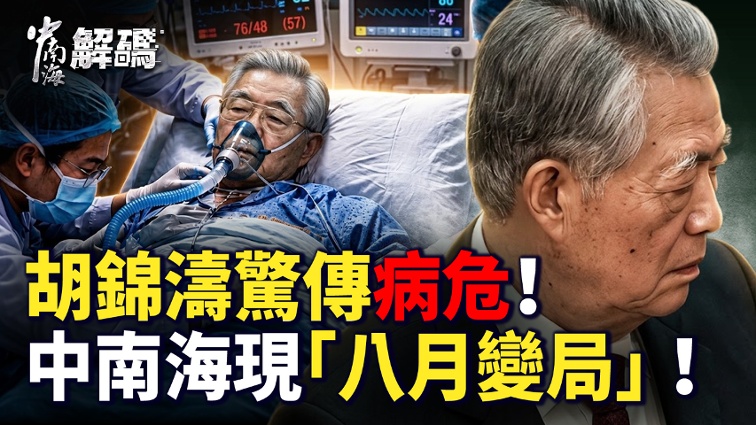
Hu Jintao Reportedly in Critical Condition, Potential Changes in Zhongnanhai This August (Video)
[People's Daily report] Hello, dear viewers, and welcome to "Decoding Zhongnanhai." I am Sun Ning.
In August 2026, the sky over Beijing appeared particularly eerie and overcast.
Just a few days ago, several sudden torrential downpours swept through the Beijing and Hebei regions. This unusual weather seemed to cast a shadow over the political atmosphere in Beijing, masking the seemingly impenetrable yet tumultuous internal dynamics of political change within the red walls.
On August 14, overseas media personality Jiang Wangzheng unexpectedly revealed on social platform X that Hu Jintao, the 83-year-old former General Secretary of the Communist Party of China, had experienced a rapid decline in health during the Beidaihe meeting and is currently in a state of effective "brain death," relying solely on cold machines to sustain his final breaths.
Simultaneously, the Communist Party of China made an unusual high-profile announcement: a commemorative meeting for the 100th anniversary of the late party leader Jiang Zemin's birth will be held at the Great Hall of the People on August 17. Authorities even signaled in advance that all current and former "national-level" elders, as long as they still have breath, must "collectively appear" or report their names externally.
As a symbol of an era nears its end on a sickbed, another long-gone symbol of power is being resurrected. Is this merely a coincidence, or a carefully orchestrated political drama? What kind of strategy is the current supreme leader Xi Jinping pursuing?
Today, we will delve into the latest intelligence from various sources regarding Zhongnanhai to peel back the layers and understand this "August Thunder" that could determine the future political trajectory of the Communist Party of China.
Hu Jintao's alarming health news.
This political storm that has reverberated both domestically and internationally stems from a sudden revelation by overseas current affairs commentator Jiang Wangzheng.
According to exclusive information obtained by Jiang Wangzheng, 83-year-old Hu Jintao's health has sharply declined since the beginning of summer this year. By mid-August, his condition had reached a critical stage, with the medical team issuing a notice of critical illness. There are rumors that he has essentially lost all brain function and is in a state of actual 'brain death,' relying solely on modern medical equipment to sustain the last signs of life.
Even more specifically, and shocking to the public, is the detail that Hu Jintao's daughter and son-in-law, who live in the United States, have received an emergency notification from the Central Office in Beijing and have discreetly flown to Beijing under strict confidentiality.
Simultaneously, Hu Jintao's only son, Hu Haifeng, who currently serves as the Deputy Minister of the Ministry of Civil Affairs of the Communist Party of China, has formally requested leave from the Ministry's office. Hu Haifeng's wife, son, daughter-in-law, and grandson have also returned to Beijing from Shanghai by special train. The entire family has urgently gathered in the capital with the sole purpose of seeing Hu Jintao one last time and being prepared to handle the worst possible outcome at any moment.
Since the 'shocking incident' at the 20th National Congress of the Communist Party of China in 2022, Hu Jintao has completely vanished from the public eye. For over two years, he has not made any public appearances, regardless of how significant the national celebrations of the Communist Party or the funerals of other senior officials have been.
Hu Jintao's most recent mention in reports from the Chinese Communist Party's official media occurred in March of this year, during the announcement of former State Councilor Song Ping's death due to illness. The People's Daily noted that 'Hu Jintao went to the hospital to visit or express condolences.' This suggests that despite his extreme weakness at the time, Hu Jintao still retained a basic level of awareness and political significance.
However, just a few months later, from spring to the height of summer, news surfaced from Beijing indicating that his entire family had gathered urgently, with his daughter returning from the United States. Given the Chinese Communist Party's stringent regulations regarding overseas Chinese affairs, it is highly unlikely that the overseas family members of a state-level elder would receive special approval to return home so quickly and publicly unless it was a matter of life and death. Hu Haifeng's 'leave of absence' further underscores the urgency of this situation.
Frequent Anomalies in Zhongnanhai
If Hu Jintao has indeed reached the end of his life, it would not simply be the passing of a retired elder for the current leadership of the Chinese Communist Party; it would represent a political bomb capable of causing a seismic shift in the political landscape.
Drawing from the latest information over the past week from internal sources in Beijing, cross-strait intelligence circles, and various political observers, we can analyze this life-threatening rumor from three perspectives.
The first perspective is the medical and physiological inevitability.
Hu Jintao has been suffering from severe 'Parkinson's disease,' which has been an open secret for over a decade. At the closing ceremony of the 20th National Congress, his trembling fingers, rigid facial expressions, and the need for assistance while walking were all indicative of the late stages of this disease.
At the age of 83, the most lethal threats to patients with 'Parkinson's disease' are often not the disease itself, but complications such as aspiration pneumonia due to swallowing difficulties or multiple organ failure. From a medical standpoint, reports of his worsening condition, including the possibility of brain death, are entirely consistent with the pathological progression of late-stage 'Parkinson's disease.'
The critical condition of Hu Jintao also presents a striking historical coincidence.
Many keen political observers have noted the chilling parallels between the current atmosphere in Beijing and that of 1976, fifty years ago.
In 1976, the three prominent leaders of the Chinese Communist Party—Zhou Enlai, Zhu De, and Mao Zedong—passed away within the same year. That year also saw a devastating earthquake in Tangshan and a meteor shower in Jilin, which caused widespread anxiety among the people.
Reflecting on the past few years: Jiang Zemin died at the end of 2022, Li Keqiang unexpectedly passed away in the autumn of 2023, and Zhu Rongji has just recently died. If Hu Jintao does not survive this August, then the two generations of Communist Party leaders, 'Jiang and Hu,' along with their contemporaries, will have swiftly become part of history.
Recently, unusual celestial events and persistent heavy rainfall in the Beijing area have undoubtedly added a layer of political metaphor for the Chinese public, who strongly believe in 'heavenly signs,' suggesting 'heavenly warnings and a change of dynasty.'
Recent reports indicate that the Beijing Municipal Public Security Bureau and the Cyberspace Administration have significantly escalated their internet surveillance efforts over the past 48 hours. Discussions on WeChat and Weibo involving terms such as 'former boss', 'Tiger of Lhasa', 'facial paralysis', and 'Senior Hu' have been precisely blocked. The name 'Hu Jintao' is now classified as 'forbidden text', raising suspicions that this is a preemptive measure for maintaining stability ahead of a significant event.
The CCP is commemorating Jiang Zemin with great fanfare.
As rumors about Hu Jintao's health circulate overseas and tensions rise within Zhongnanhai, an unexpected yet significant announcement has emerged from Chang'an Avenue: the CCP has decided to hold a grand meeting at the Great Hall of the People around August 17 to commemorate the 100th anniversary of Jiang Zemin's birth.
Jiang Zemin, born on August 17, 1926, marks a centennial this year. According to the CCP's party rules for commemorating every ten and hundred years, this meeting is expected. However, the scale of preparation and the intensity of the publicity from the CCP have far exceeded external expectations.
In the current political landscape, Xi Jinping has established an absolute 'one-man system', effectively purging the Jiang faction and the Youth League faction from the power structure. This raises the question: why is Xi Jinping making such a grand effort to commemorate a deceased party leader at this time?
This move reveals three major political motives behind Xi Jinping's carefully calculated strategy.
Firstly, the intention is to 'borrow a corpse to resurrect the soul', utilizing Jiang Zemin's political legacy to validate Xi Jinping's current challenges.
At present, China is experiencing the most intense economic downturn since the reform and opening up, characterized by real estate crises, soaring local debts, a significant exodus of foreign capital, and persistently high youth unemployment rates. There is a considerable buildup of grievances and dissatisfaction within the party and among the public regarding Xi Jinping's 'left turn' policies over the past few years.
By commemorating Jiang Zemin in a high-profile manner at this moment, Xi Jinping aims to convey a message within the Chinese Communist Party (CCP): I have not entirely rejected the previous development path; I am also an inheritor of Jiang Zemin's political legacy. He seeks to harness Jiang Zemin's lingering influence within the party, particularly among the economic bureaucratic elite, to calm discontent and mitigate the political pressures he is facing.
Secondly, the commemoration of Jiang Zemin serves as a significant diversion of public opinion.
The news regarding Hu Jintao's critical illness has stirred considerable attention both within the upper echelons of the CCP and abroad, leaving the current leadership feeling quite vulnerable. If discussions about Hu Jintao's condition are allowed to escalate, it will inevitably lead the public to connect it with conspiracy theories surrounding Li Keqiang's sudden death and the brutal internal strife that resulted in the downfall of the Tuanpai faction, thereby raising doubts about the legitimacy of the current regime.
At this pivotal moment, Xi Jinping has resurrected this 'political zombie' Jiang Zemin, employing extensive official coverage and commemorative events to overshadow and mitigate the negative news regarding Hu Jintao's health. This strategy is referred to in communication studies as 'agenda-setting', where a theme controlled by the authorities is used to suppress spontaneous public discourse.
Ultimately, the primary motivation behind Xi Jinping's commemoration of Jiang is to assert his position as the 'core of the party', serving as a stabilizing force.
This conference is not being held in honor of Jiang Zemin, but rather to ensure that the living express their loyalty to Xi Jinping. During the conference, Xi Jinping is set to deliver a significant speech. He intends to redefine Jiang Zemin's life in a way that seamlessly integrates the 'achievements' of the Jiang Zemin era into his own 'new era.' This represents a complete consolidation of power—sending a message to the entire party, whether they belong to the Jiang faction or other factions, that their former leader has passed away, and the legacy he left is now solely under my control, Xi Jinping.
To support this political performance, senior officials in Zhongnanhai have introduced an unusually strong measure:
According to insiders, for this Jiang Zemin memorial conference, the authorities issued a strict directive— all current and former 'state-level' Politburo Standing Committee members must attend, provided their health allows it; for those who genuinely cannot attend due to serious illness, they must be individually listed on the official published roster, detailing their 'phone congratulations' or 'other means of expressing remembrance.'
Why is the Communist Party making such a concerted effort to publicly announce and enforce this 'family portrait of elders' list?
Because in the realm of opaque politics, the presence or absence of the elders' names serves as a key indicator of political stability.
Recently, there have been persistent rumors abroad that the elder faction within the Communist Party is highly dissatisfied with Xi Jinping's current policies, and there were even heated disputes during the Beidaihe meeting. Some claim that the elders have collectively turned against him, while others assert that Zhongnanhai has already experienced internal divisions.
Xi Jinping is acutely aware of the significant impact that these rumors can have on the morale of local officials and the military. As a result, he requires this conference to serve as a grand 'political show' on a massive scale.
When all the living elder statesmen at the national level, regardless of their past factional affiliations or any private grievances, gather together on the podium of the Great Hall of the People today, or when their names appear in an orderly fashion on the front page of the People's Daily, it creates an illusion for both international and domestic audiences: the leadership of the Communist Party is unshakeable, the elders collectively support the current leadership, there is no division within the party, and certainly no so-called 'palace coup'.
This represents a forced 'political bundling'. Xi Jinping is using the centenary of Jiang Zemin's death as an undeniable party stronghold, compelling all the elders to publicly show their support. Your presence signifies your compliance with the broader agenda; having your name on the list indicates that you have submitted a 'loyalty pledge' to the current core leadership. The list for this conference is less a tribute to Jiang Zemin and more a 'political roll call' for the living.
The Crossroads of History
The politics of Zhongnanhai is intimidating because it often conceals the most brutal power struggles beneath a calm exterior; within the grandest commemorative events, the most intricate calculations are at play.
From Jiang Wangzheng revealing Hu Jintao's critical health condition and his family urgently traveling to Beijing, to various reports indicating an upgrade in Beijing's internet stability measures, and then to Xi Jinping leveraging this situation to prominently hold Jiang Zemin's death anniversary conference, compelling all national-level Standing Committee members to make a collective appearance. This series of striking actions is fundamentally a 'patch' for the tumultuous and precarious political landscape of the Communist Party.
Hu Jintao, whether he is indeed gravely ill and near death as rumored, or still influencing the situation in some mysterious way, has undeniably reached the end of his era. Jiang Zemin's memorial service will serve as the 'Last Supper' for the elder statesmen of the Chinese Communist Party. Following this event, the names on the list will continue to diminish, and the collective memory of leadership behind the red walls will be entirely erased.
Yet, when all the political elders have departed, and all factions have been dismantled, leaving only Xi Jinping on the stage, what path will the vast nation of China take? Will it advance towards the great rejuvenation he has promised, or will it descend into another unpredictable historical abyss?
History never remains silent; it is simply waiting for the moment to unveil itself.
That wraps up today's content. If you enjoyed our program, please like, subscribe, and activate the notification bell. If you have any thoughts on Hu Jintao's rumored critical condition, feel free to share your comments below. We’ll see you in the next episode!
(‘Decoding Zhongnanhai’)
△




News magazine bootstrap themes!
I like this themes, fast loading and look profesional
Thank you Carlos!
You're welcome!
Please support me with give positive rating!
Yes Sure!