

Kim Jong-un departed from Beijing to return to his country on the evening of the 4th. (Video screenshot)
[People News] On August 17, U.S. President Trump met with a 16-year-old lifeguard in the Oval Office and later spoke to reporters. Trump confirmed that North Korean leader Kim Jong-un has responded positively to his request for dialogue, stating that Kim's "attitude is very positive."
Trump described his relationship with Kim Jong-un: "I understand him, and he understands me. You insist on conducting military exercises, but I can get along well with him. You know, he doesn't like Biden, he doesn't like Obama, he doesn't like anyone, but he gets along very well with me. So what I'm doing is making the world safer, which is completely contrary to what the media reports."
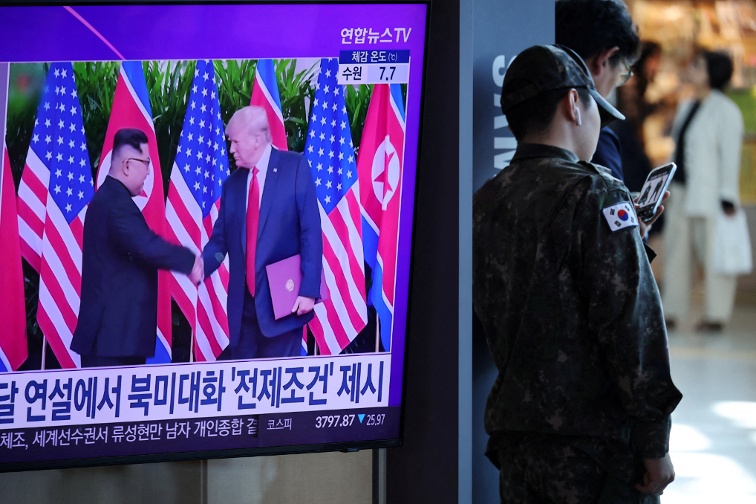
Two days earlier, on August 15, Trump had shared a photo from his 2019 meeting with Kim Jong-un at Panmunjom on social media, emphasizing that the two have a "good relationship."
On August 16, Trump criticized the upcoming U.S.-South Korea joint military exercises on social media, stating that they are not only expensive but also send a "completely inappropriate and hostile" signal to North Korea. He noted that during his presidency, North Korea has not engaged in threatening behavior and has "maintained respect." Consequently, he instructed Defense Secretary Mark Esper to significantly reduce the scale of the joint military exercises, while also expressing dissatisfaction with South Korean President Lee Jae-myung's passive stance on the issue of Iran's denuclearization.
While Trump's statements may include some deliberate exaggeration, it is indeed true that Kim Jong-un harbors a certain fondness for both Trump and the United States. In fact, Kim's trust in the U.S. likely surpasses his trust in the Chinese Communist Party (CCP).
In January 2023, former U.S. Secretary of State Mike Pompeo recounted an incident in his memoir, "Never Give an Inch: Fighting for the America I Love":
In March 2018, during his visit to Pyongyang as the Director of the Central Intelligence Agency (CIA), he recounted a meeting with Kim Jong-un where he said, "The CCP has always claimed that 'once U.S. troops leave South Korea, Chairman Kim will be very happy.'" Upon hearing this, Kim Jong-un laughed and shouted, 'The Chinese are all liars,' while excitedly pounding the table. Pompeo noted, "Kim Jong-un expressed that to protect himself from the CCP's rule, he needs Americans in South Korea, and the CCP requires the U.S. to withdraw its troops to treat the Korean Peninsula as it does Tibet and Xinjiang."
This exchange highlights Kim Jong-un's awareness of the significant threat posed by the CCP. Pompeo remarked, "Kim Jong-un needs protection from the threat of the CCP. I underestimated how crucial this was for him. The North Koreans do not resent the U.S. for bolstering its missile and ground combat capabilities on the Korean Peninsula at all."
In his book, Pompeo describes Kim Jong-un, who executed his uncle Zhang Chengzhe and others, as a 'bloodthirsty toad,' but he asserts that 'the most dangerous person in the world' is Xi Jinping. Pompeo remarked, 'I have never seen (Xi Jinping) smile without ulterior motives. The CCP has provided Kim Jong-un with almost no room for negotiation or compromise. The North Korean issue should often be viewed as a conflict involving the CCP's agents.'
Rationally, Kim Jong-un should be immensely grateful for the CCP's ongoing support, particularly in food and energy. However, his characterization of CCP leaders as 'liars' indicates a fundamental distrust of the CCP. Nevertheless, due to his reliance on their significant economic assistance and the need to stabilize his regime, he is compelled to engage with them.
Former South Korean National Intelligence Service Director Park Ji-won also confirmed in a media interview that Kim Jong-un desires the long-term presence of U.S. troops in South Korea. He noted, 'During the June 15 North-South summit in 2000, Kim Jong-il told former South Korean President Kim Dae-jung that he was 'very distrustful of China.' He added, 'To maintain the balance of power in Northeast Asia, even if the Korean Peninsula unifies, U.S. troops must remain stationed there.' Park Ji-won believes that Kim Jong-il had a profound distrust of the CCP, Russia, and Japan, particularly the CCP, and he asserts that 'the teachings left by Kim Il-sung have been adhered to by both Kim Jong-il and Kim Jong-un.'
What is Kim Il-sung's legacy? Some Japanese media outlets have reported that it is to avoid placing too much trust in the Chinese Communist Party (CCP) and to remain vigilant against it. The actions of the Kim family over three generations clearly demonstrate that they publicly proclaim 'the friendship forged in blood' with the CCP to secure assistance, while in reality, they have consistently been cautious of the CCP and have been willing to say 'no' to it on critical issues. In essence, the three generations of the Kim family—Kim Il-sung, Kim Jong-il, and Kim Jong-un—do not trust the CCP.
During Kim Il-sung's time, although the Korean Workers' Party managed to regain the upper hand on the Korean battlefield with the assistance of the Chinese military and reached a ceasefire agreement following Stalin's death, the situation changed after the Korean War. The presence of hundreds of thousands of Chinese troops in Korea and the actions of many pro-CCP 'Yan'an faction' members who attempted to stage a coup angered Kim Il-sung. In his purges, several key figures from the 'Yan'an faction' were sentenced to death, while others fled to China. Consequently, Kim Il-sung sought personnel from the CCP, and ultimately, the CCP agreed to withdraw its troops in exchange for sparing these individuals, leading Kim Il-sung to relent.
It is likely that Kim Jong-il, who faced pressure from the pro-CCP faction in North Korea to step down, could not genuinely trust the CCP, which was known for its unpredictable shifts in policy. During the Cultural Revolution, he ordered the destruction of the 'Volunteer Army' cemetery, smashing all the tombstones, including the large monument of Mao Anying, as a response to the CCP's intentions to oust him again. This led to a significant cooling in the relationship between North Korea and China.
In the early 1970s, as global circumstances shifted, Kim Il-sung secretly traveled to Beijing to meet with Mao and Zhou, where he apologized to Mao, and the North Korea-China relationship superficially returned to a state of 'reconciliation.' However, after the establishment of diplomatic relations between China and South Korea in 1992, Kim Il-sung became increasingly dissatisfied, and the relationship between the two countries began to deteriorate.
In the late 1990s, China emerged as North Korea's largest trading partner. Beginning in August 2003, the Chinese Communist Party (CCP) initiated the Six-Party Talks aimed at resolving the North Korean nuclear issue to assert its influence. By the time North Korea announced its withdrawal in 2009, the talks had already progressed to their sixth round.
In 2006, North Korea disregarded the CCP's counsel and proceeded with a series of ballistic missile tests, which drew public condemnation from the CCP. As a result, the CCP opted to support several UN resolutions imposing sanctions on North Korea. Kim Jong-il perceived this as a betrayal of trust by the CCP.
Following Kim Jong-il's death at the end of 2011, Kim Jong-un ascended to power. One of his first actions was to prohibit the use of all foreign currencies, including the Chinese yuan, in the market, signaling his intent to reduce dependency on the CCP. Subsequently, the CCP condemned North Korea's nuclear tests multiple times, with state media asserting that the relationship between China and North Korea was no longer a blood alliance but rather a standard relationship between sovereign nations. North Korea responded with countermeasures.
At the start of Xi Jinping's leadership in 2012, tensions persisted in the China-North Korea relationship due to ongoing nuclear tests and missile launches, prompting the CCP to impose sanctions on North Korea. It wasn't until March 2018, when Kim Jong-un visited Beijing, that the relationship began to thaw, with the CCP providing significant aid to North Korea. In June 2019, Xi Jinping's visit to Pyongyang further solidified their ties. However, by 2024, the China-North Korea relationship had not progressed; instead, North Korea's ties with Russia rapidly strengthened, leading to the establishment of a comprehensive strategic partnership and mutual defense agreements, elevating their relationship to that of 'allies.' Kim Jong-un even dispatched tens of thousands of North Korean soldiers to the battlefield in Ukraine and Russia.
A few days ago, on August 15, we marked the anniversary of Japan's surrender during World War II, known as 'Liberation Day' in Korea. Russian President Vladimir Putin sent a congratulatory message to Kim Jong-un, while Chinese President Xi Jinping sent one to South Korean President Yoon Suk-yeol. This situation is bound to provoke some thoughts in Kim Jong-un.
It is important to note that despite North Korea's public support for Russia and its provision of military assistance, Reuters reports that since the onset of the U.S.-Iran conflict on February 28, North Korea has not sent any weapons or supplies to Iran, even though it had previously sold arms to the country. In contrast to China and Russia, which have openly supported Iran in the media, North Korea's Ministry of Foreign Affairs has only issued two statements that are relatively mild in tone.
Clearly, Kim Jong-un does not want to provoke Trump over the Iran issue. During the Ninth Congress of the Workers' Party of Korea held at the end of February, Kim Jong-un also opened a door for dialogue with the United States, stating that if the U.S. recognizes North Korea as a nuclear-armed state and withdraws its hostile policies, the two countries could coexist peacefully.
However, a few years ago, Trump provided North Korea with a developmental roadmap, suggesting that Kim Jong-un should follow Vietnam's example, which entails abandoning nuclear weapons. After denuclearization, North Korea would receive U.S. investment and develop similarly to Vietnam.
Whether Kim Jong-un is willing to pursue this path remains uncertain. However, it is clear that he trusts Trump more than Xi. If Kim Jong-un decides to place his faith in Trump and receives adequate assurances, will Beijing react with alarm?
(First published in People News) △



News magazine bootstrap themes!
I like this themes, fast loading and look profesional
Thank you Carlos!
You're welcome!
Please support me with give positive rating!
Yes Sure!