
In the Underworld Memorial, Observing the Universe: Jiang Zemin's Farewell Ceremony and the Sound of Thunder (Video)
[People News] Hello, dear viewers, and welcome to 'Decoding Zhongnanhai.' I am Sun Ning.
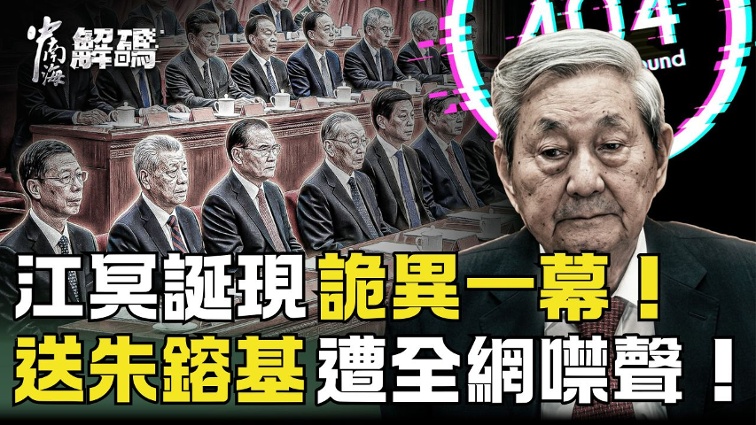
On August 17, a highly publicized yet strangely eerie political event took place at the Great Hall of the People in Beijing—the centenary memorial conference for the late former leader Jiang Zemin.
In the footage aired by the CCP's CCTV, the venue was brilliantly illuminated, with the current top leader leading all standing committee members in attendance, while over a dozen retired elders were 'invited' to sit prominently on the podium. Xi delivered an extensive speech, raising the tone to its highest pitch; the entire scene seemed to be steeped in solemn glory, yet it conveyed an indescribable sense of oddity and rigidity.
What felt even more surreal was that just a day after the grand commemoration of Jiang Zemin's centenary, another influential figure who once dominated Zhongnanhai and facilitated China's entry into the World Trade Organization, the 'Iron-Blooded Prime Minister' Zhu Rongji, was cremated in Beijing. Logically, as a contemporary giant, Zhu Rongji's farewell ceremony should have also served as a significant political indicator. However, the outcome was starkly different. The report from state media Xinhua was chillingly sparse. Aside from the current Politburo Standing Committee members, the names of retired CCP elders were entirely omitted, with only Hu Jintao mentioned, and merely noted as 'sending a wreath to express condolences.' Furthermore, on the internet behind China's high walls, news regarding Zhu Rongji's death and cremation faced widespread silence and censorship across the entire network.
Two titans of the same era have emerged in stark contrast: one was prominently honored during a memorial service, while the other was overlooked and silenced at his funeral. What political messages does this strange juxtaposition convey? What is Xi Jinping truly contemplating amidst this 'heat and cold'?
The 'Loyalty Study' Behind Hair Dyeing
Within the political framework of the Chinese Communist Party (CCP), the rank of leaders, the timing of events, and the standards of commemoration are dictated by a set of extremely stringent 'internal unwritten rules'.
Since the CCP's establishment in 1949, centenary memorials for leaders have typically only involved symposiums. Only six individuals have previously been honored with a 'Centenary Memorial Conference' posthumously, namely Mao Zedong, Zhou Enlai, Liu Shaoqi, Zhu De, Deng Xiaoping, and Chen Yun. Jiang Zemin is now the seventh.
Raising Jiang Zemin to the same level as Mao, Zhou, and Deng as the 'seventh person' is an exceptionally unusual political signal. It is known that during his lifetime, despite being labeled the 'core of the third generation of leadership', many party hardliners and liberals regarded Jiang's ascent as largely coincidental and opportunistic, and his standing within the CCP was nowhere near that of Mao, Zhou, or Deng.
Thus, why is the current supreme leader choosing this moment to grant such a 'lavish tribute' to Jiang Zemin, elevating him to such a formidable historical stature?
In political science, all "commemorations" fundamentally serve the "political needs of the moment." Xi Jinping's exceptional treatment of Jiang Zemin is not rooted in any profound respect or nostalgia he may feel for him. Quite the opposite, during Xi Jinping's first decade in power, Jiang Zemin's faction faced devastating setbacks due to a sweeping anti-corruption campaign, resulting in the near-total purging of key figures such as Zhou Yongkang, Guo Boxiong, Xu Caihou, and various Jiang faction officials.
Given that Jiang's faction has already been thoroughly investigated in the past, why is there now a need for such a high-profile "political makeover" for Jiang Zemin?
This reflects the pragmatism inherent in the politics of the Chinese Communist Party (CCP). With Jiang Zemin deceased, he has become a historical symbol that cannot speak and poses no real threat. This symbol embodies the legalist legacy of the CCP's "third generation of leadership core." At this critical historical moment, where the CCP is grappling with significant pressures in both domestic and foreign affairs, an ailing economy, wavering party loyalty, and societal unrest, Xi Jinping feels an urgent need to commemorate Jiang Zemin publicly. This serves to announce to the entire party, society, and the world that the CCP's legacy is continuous and that he is the rightful inheritor of this legacy. By respecting his predecessors, he asserts that others must also respect him as the current core leader.
This is the underlying message behind the "seventh person": by framing the historical context of predecessors, one reinforces their own absolute authority in the present.
However, no matter how well the political spectacle is staged, the details can reveal its true nature. The television news footage from the 17th, showcasing the "mosaic of lives" of retired CCP elders seated on the podium, drew significant attention from the outside world.
In the Chinese Communist Party's 'black box politics', the collective appearances of the elders at significant events provide a valuable insight into the high-level power structure and internal reshuffling, with their positioning, demeanor, and even appearance details being closely observed. In the images from the 17th, a particularly bizarre and comical visual phenomenon emerged—referred to as the 'hair color code'.
Historically, regardless of their age, high-ranking officials in the Chinese Communist Party were required to dye their hair jet black and shiny while in office, to convey a sense of 'youthful vigor' and to symbolize that 'the party's cause remains eternally youthful'. However, after retirement, the color of their hair—whether black or white—often serves as a barometer of their true political circumstances.
Upon closely examining the images from Jiang Zemin's memorial service, a peculiar phenomenon became evident: those former leaders perceived by the outside world as relatively secure, safe, or completely obedient to Xi Jinping—such as Zhang Dejiang, Li Zhanshu, Li Changchun, Jia Qinglin, Zeng Qinghong, and He Guoqiang—all had their hair dyed an unnaturally shiny black. Even the 'Prince of Tennis', Zhang Gaoli, made an appearance wearing a pitch-black wig.
These individuals seem to be using their extremely unnatural black hair to send a message to the entire party and the top leader: 'My political life is still closely aligned with the core, and I remain loyal to the leader in my heart'.
In stark contrast to these black-haired elders are those who have been marginalized or who feel a sense of helplessness and resentment—these desolate elders. Without exception, they all have white hair.
Among them, the most notable is former Vice President Wang Qishan.
In the footage from the 17th, Wang Qishan sits upright on stage, his once piercing gaze as the 'anti-corruption czar' now absent. He has not dyed his hair, and his sparse gray-white locks make him appear particularly aged. Throughout most of the event, he wears a sorrowful expression, his face marked by desolation, and in some shots, he even seems lost in thought.
It is noteworthy that Wang Qishan was once Xi Jinping's most effective political ally during his first term, playing a crucial role in solidifying Xi's power. However, as his close aides and friends have fallen from grace, Wang Qishan's own situation has become extremely delicate and awkward. His unadorned white hair and his almost unmasked sorrowful expression vividly illustrate a grim political reality: 'when the cunning rabbit dies, the hunting dog is cooked; when the flying birds are gone, the good bow is hidden.'
At this grand assembly, the contrast of black and white hair creates an extraordinarily bizarre political tableau. Those with jet-black dyed hair are desperately trying to curry favor with the power core, seeking safety as survivors; while those with gray hair and sorrowful faces are the disillusioned, sidelined after the power struggles, forced to endure silently in the corners. This stark contrast of light and dark, black and white, completely shatters the warm facade of the entire memorial meeting, exposing the cold and cruel skeletal structure of power beneath.
In addition to the hair colors of the elders, Xi Jinping's lengthy speech at the memorial meeting is also a significant highlight of this grand performance.
In his speech, Xi Jinping delivered an extensive account of Jiang Zemin's life, highlighting one particular assessment that was given significant emphasis. He openly praised Jiang Zemin for his 'firm support and implementation of the central government's correct decisions during the serious political turmoil of 1989, clearly opposing the unrest, and closely relying on the vast number of party members, cadres, and the masses, effectively maintaining stability in Shanghai.'
In simpler terms, this statement serves as a public endorsement of Jiang Zemin for aligning himself with Deng Xiaoping and Li Peng, who used tanks and machine guns to suppress students and citizens during the 1989 Tiananmen Incident. Jiang Zemin's strong support for the military crackdown and his ability to 'stand on the right side' at a crucial moment ultimately facilitated his rise to power.
This is a stark account of historical facts. Reflecting on history, during the June Fourth Incident in 1989, Jiang Zemin was the Secretary of the Shanghai Municipal Committee. At a time when national sentiment was running high and even some senior officials in Beijing were leaning towards resolving issues through moderate dialogue, Jiang Zemin adopted extremely hardline tactics in Shanghai. He aggressively suppressed the World Economic Herald, which was sympathetic to reform and the students, and stifled protest voices in Shanghai. It was this 'absolute political obedience' and 'ruthless approach' that caught the attention of Deng Xiaoping, who was orchestrating events behind the scenes in Beijing and was thoroughly disillusioned with the moderates. Deng Xiaoping viewed Jiang Zemin as someone who 'would not hesitate at critical moments and could safeguard the Communist Party's rule,' which allowed Jiang Zemin to be swiftly elevated from the minor role of Secretary of the Shanghai Municipal Committee to Beijing, miraculously succeeding Zhao Ziyang as General Secretary.
Mr. Cai Shenkun, an independent commentator based in the United States, noted in his assessment of this historical period that Jiang Zemin ascended to the highest political stage of the Communist Party against the bloody backdrop of June Fourth. Today, 37 years later, Xi Jinping has personally rebranded this bloody history as Jiang Zemin's most 'positive' and core political legacy.
In reality, for a long time, 'June Fourth' has been a heavy burden for the Communist Party, a national trauma they wished all young people would forget. Consequently, over the past few decades, their strategy regarding June Fourth has been to downplay, forget, and avoid reporting on it.
However, in Xi Jinping's historical narrative today, 'June Fourth' is no longer a political blemish that needs to be hidden; rather, it has transformed into the most significant indicator that demonstrates the absolute correctness of the Chinese Communist Party's strong stability maintenance and serves as a test of political loyalty among senior officials.
Xi Jinping's public praise for Jiang Zemin's 'decisive and resolute' actions during June Fourth sends a clear message to the entire party: 'When the party's rule is challenged and the system faces turmoil, any moderate, compromising, or peace-seeking approach is a dead end and will be completely purged, as was the case with Zhao Ziyang; only by being politically steadfast like Jiang Zemin, taking ruthless actions, and firmly supporting the central government's strong suppression decisions can one find the sole path of political correctness and promotion.'
This is not just an assessment of history; it is also a set of rules for the current reality.
The cremation of Zhu Rongji has silenced the entire internet.
However, the political narrative of Zhongnanhai has never been straightforward. Just one day after the commemoration of Jiang Zemin's birthday, on August 18, the body of former Chinese Premier Zhu Rongji was cremated in Beijing.
These two events occurred just 24 hours apart. The actions of Zhongnanhai during these two days can be described as a true 'ice and fire' contrast.
On the afternoon of August 18, the state media Xinhua News Agency published a report on Zhu Rongji's cremation.
In this succinct official statement, the Chinese Communist Party (CCP) revealed a striking detail when listing those who attended or expressed condolences: the report densely enumerated the seven current members of the Politburo Standing Committee and Vice President Han Zheng. In stark contrast, when it came to the numerous retired elders, the report only mentioned former General Secretary Hu Jintao by name, stating that he 'sent a wreath to express condolences.' All other retired elders were coldly summarized with the term 'etc.'
The term 'etc.' in CCP political reporting serves as a 'magic word' that wields significant power, capable of manipulating the political atmosphere at will.
Why is it that not a single elder is mentioned in the list of condolences for Zhu Rongji's cremation?
This clearly reflects Xi Jinping's ongoing deep-seated concerns and wariness towards the elder class and what is referred to as 'elder politics.'
Xi Jinping is acutely aware that many officials and retired elders within the Communist Party are deeply dissatisfied with the current economic crisis. They long for the economic prosperity of the Jiang-Zhu and Hu-Wen eras. If a significant number of elders are allowed to publicly attend Zhu Rongji's farewell ceremony, or if official media are permitted to extensively cover the elders' tributes to Zhu Rongji, the event could inadvertently turn into a major gathering of the 'pragmatic faction, reform faction, and elder faction' within the party. Even a simple exchange of glances or a sigh during a handshake among these elders could be interpreted by outsiders as a silent protest against the current policies, potentially forming an invisible political force opposing the current leadership.
In response, Xi Jinping has taken a decisive stance: a blanket ban. With the exception of Hu Jintao, who represents the former highest leadership and has already been sidelined due to health issues since the 20th National Congress, and is allowed to 'send a wreath,' all other elders are strictly prohibited from being included on the guest list and are rendered vague with the term 'etc.'
This is not a farewell to Zhu Rongji at all. It is a clear exercise of power aimed at forcing those elders who could create political dissent into the shadows of history, effectively erasing them.
While the use of 'etc.' in official media to omit the elders is a standard precaution by the upper echelons, the complete silencing of tributes to Zhu Rongji on Chinese social media reflects a panic-driven suppression of public sentiment by the authorities.
On Weibo and Douyin, the majority of accounts and media outlets sharing the obituary or cremation news of Zhu Rongji display 'selected comments' in their comment sections or have them completely disabled. This prevents netizens from freely commenting and discussing as they typically would.
Meanwhile, feedback from The Epoch Times and some overseas observers indicates that if users spontaneously write a eulogy that includes Zhu Rongji's full name on social media, or if they post lengthy evaluations of his past economic reforms—such as the wave of layoffs and the tax-sharing system—they often encounter restrictions on their posts, inability to send them, or the requirement for manual review by the platform. To evade censorship, netizens may even resort to using homophones or omitting the full name.
Additionally, on-site observations by reporters from Taiwan's Central News Agency revealed that on the 18th, the area surrounding Babaoshan Cemetery in Beijing and the overpass on Yuquan Road were under heavy security. Any ordinary citizens or pedestrians attempting to raise their phones to capture images of the hearse or the scene were quickly stopped by plainclothes police wearing headphones and instructed to leave promptly. Consequently, there is virtually no grassroots 'live' video coverage of today's ceremony at Babaoshan available online.
The Conclusion of the Red Stage
Dear viewers, when we juxtapose these two significant political events from the past two days, a clear picture of the power dynamics in Zhongnanhai emerges before us.
At the memorial service for Jiang Zemin, Xi Jinping made a bold and unconventional move by elevating the deceased to a pedestal. He drew a stark line of loyalty with the contrast of black and white hair, using praise for the bloody crackdown of 1989 to legitimize his iron-fisted rule. While it appeared to be an act of 'respecting Jiang,' it was, in fact, an attempt to appropriate the political legacy of his predecessor to endorse his own deeply flawed policies, effectively completing a self-coronation by borrowing power from the deceased.
In stark contrast, at Zhu Rongji's farewell ceremony, Xi Jinping exhibited extreme indifference and caution. The Communist Party's official media used the word 'wait' to forcibly erase the retired elders, fearing they might unite into a dissenting voice; meanwhile, the internet was silenced under the strictest bans, anxious that the overwhelming public nostalgia could become a sharp blade that pierces the current myth.
This reflects the dark humor of contemporary Chinese Communist politics: the deceased Jiang Zemin is forcibly painted in Xi Jinping's colors to intimidate the party and uphold the current regime; conversely, the deceased Zhu Rongji is stripped of any echoes to close off the past and suppress public sentiment.
On the surface, Xi Jinping seems to have orchestrated all of this successfully. He has silenced the elders, muted the netizens, and rearranged history to fit his narrative.
But can history truly be manipulated so casually?
The dead may not speak, but the hearts of the living all possess a scale.
That strange atmosphere in the hall, that complete silence across the internet, does not symbolize stable power; rather, it is the dullest and most dangerous sound of fracture before an era comes to a definitive close.
That concludes today’s content. Thank you for following the People's Daily. I am Sun Ning, and we will see you next time!
(‘Decoding Zhongnanhai’)
△





News magazine bootstrap themes!
I like this themes, fast loading and look profesional
Thank you Carlos!
You're welcome!
Please support me with give positive rating!
Yes Sure!