
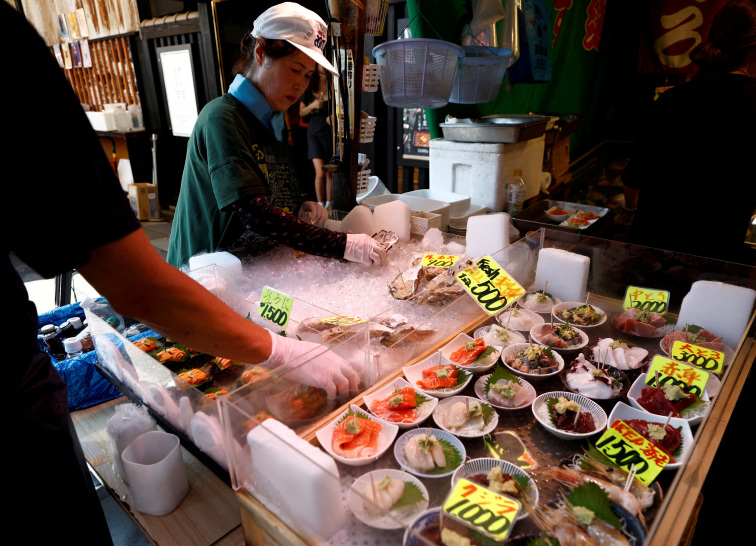
Vendors prepare seafood for sale at Tsukiji Outer Market in Tokyo, Japan, August 12, 2024.
[People News] In August 2023, Japan began discharging treated water from the Fukushima nuclear power plant. In response, the Beijing authorities sought to apply diplomatic and economic pressure on Japan by not only imposing a total ban on the import of Japanese seafood but also launching a massive online disinformation campaign.
However, this propaganda effort, initially aimed at Japan, ultimately backfired like a 'boomerang,' inflicting significant damage on China's fisheries, catering industry, and the livelihoods of coastal communities.
Stephen R. Nagy, a political science professor at the International Christian University (ICU) in Japan, recently analyzed the situation in an article for the Japanese media outlet 'PRESIDENT Online.' He noted that the disinformation tactics employed by the Xi Jinping regime not only failed to isolate Japan but also resulted in Beijing facing the repercussions of its own actions.
Disinformation Uncovered, Xi's Regime Loses Credibility
According to the Liberty Times, Professor Nagy highlighted that the Xi Jinping regime believed that delivering a severe economic blow to Japan would compel it to submit. Consequently, the Chinese government and online communities disseminated a plethora of fabricated content to discredit Japan. This included misusing an old video from 2020 that showed sewage from a broken sewer in Mexico flowing into the ocean, falsely claiming it depicted the Fukushima discharge of nuclear-contaminated water, as well as employing generative AI and digital synthesis technology to create fake images of 'mutant giant octopuses and lobsters.'
Professor Najiyi (Nàjī) noted that the Beijing authorities initially thought that delivering a significant economic blow to Japan would compel it to submit. Consequently, Chinese officials and online communities began disseminating a large volume of fabricated content. This included old footage from 2020 of a sewer rupture in Mexico, with sewage flowing into the sea, falsely asserting that it depicted Fukushima discharging nuclear water. There were even instances of using generative AI and synthetic technology to create fake images of 'mutant giant octopuses and mutant lobsters.'
However, these efforts were swiftly debunked by Agence France-Presse, Sankei Shimbun, and the Taiwan Fact-Checking Center.
This wave of propaganda failed to have any impact abroad, and there was no panic within Japan; instead, it ignited a nationwide consumer movement to 'support domestic seafood.'
The Japanese government decided to stop relying on the Chinese market and actively sought new export channels in the United States, Vietnam, and other countries. They shifted the scallop shelling processing that had previously taken place in China to new processing hubs, such as the port of Ensenada in Mexico, thereby establishing a new supply chain directly to the North American market.
Lies Trigger Salt Rush and Seafood Boycott
While Japan was successfully developing new markets, chaos erupted in China due to the panic-inducing information spread by its own government.
Many citizens were convinced by official media reports claiming that 'the ocean will be severely polluted.' Soon, rumors began circulating on social networks that 'sea salt is unsafe' and 'eating iodized salt can prevent radiation,' which quickly led to a nationwide salt rush. This prompted the state-owned China Salt Group to issue a statement dispelling the rumors, emphasizing that 87% of the edible salt in the Chinese market is well water salt, in an effort to alleviate public panic.
The extreme fear that the public has developed towards all seafood is more serious than the rush for salt. People are not only avoiding Japanese seafood but are also completely rejecting seafood that is caught or farmed in China, resulting in a nationwide trend of 'refusing to eat seafood'.
The livelihoods of coastal fishermen in several provinces have been severely affected.
This wave of panic, sparked by the authorities and amplified by social media, has ultimately inflicted significant damage on coastal fishermen and aquaculture farmers in regions such as Fujian, Shandong, Zhejiang, and Guangdong.
At the time, it was the peak season for sea fishing. In fishing ports in Yantai and Weihai in Shandong, as well as Fuzhou and Lianjiang in Fujian, the seafood that was caught was simply not being purchased. Wholesale prices plummeted, with some fish prices even being slashed by half.
In areas like Lianjiang in Fujian, known as the 'home of abalone', and Rongcheng in Shandong, the abalone, sea cucumbers, and yellow croakers that were ready for harvest could not be sold. Keeping them in the water for an extra day meant incurring additional feed costs, and some even rotted in the water, leading to severe losses for the farmers.
Moreover, around 80,000 Japanese restaurants and seafood eateries across China, which are operated by Chinese and use domestic ingredients, faced a wave of cancellations. Many establishments, in a bid to survive, painted over the word 'Japanese' on their signs overnight. Seafood processing plants, overwhelmed by excess inventory, ceased purchasing seafood caught by new boats, causing a near standstill in the entire coastal fishing industry chain.
One should not harbor ill intentions towards others, as it ultimately leads to self-harm.
As discontent among coastal residents surged and the economic damage became evident, the Chinese Communist Party finally recognized that 'this fire has burned its own people'.
Beginning in September 2023, the Cyberspace Administration and major platforms swiftly moved to ban self-media accounts that were spreading panic by claiming that 'seafood is toxic and coastal radiation levels are excessive.' State media outlets like CCTV and the People's Daily also quickly shifted their narrative, reporting that 'domestic seafood is very safe after testing' and that 'Xinjiang's land seafood has seen a bumper harvest,' making every effort to restore public confidence in domestic seafood.
Professor Najiyi concluded that this incident clearly demonstrates that 'truth and science' are far more powerful than lies. Countries like Japan, which uphold transparency and the rule of law, ultimately gain international trust; whereas authoritarian regimes that rely on misinformation for political maneuvering will only end up harming their own citizens.
△







News magazine bootstrap themes!
I like this themes, fast loading and look profesional
Thank you Carlos!
You're welcome!
Please support me with give positive rating!
Yes Sure!