
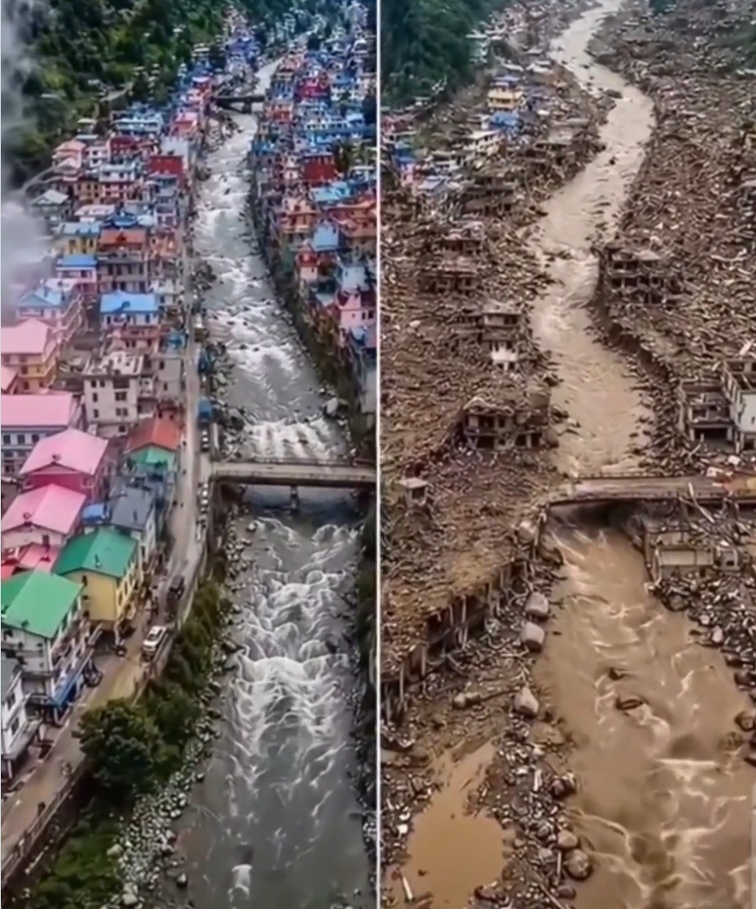
On August 26, a severe mudslide struck the China-Nepal border area in Jilong, Tibet, almost destroying all buildings in its path. (Video screenshot)
[People News] On August 26, a sudden and massive mudslide struck the Jilong port in northern Nepal and Tibet, China. Although it was the same disaster occurring at the same time, the media coverage from both sides of the China-Nepal border presented a strikingly different narrative: Nepalese media focused on the human stories of the disaster, while the Chinese Communist Party's official media concentrated on 'how official agencies operate.'
Nepalese media: The victims of the disaster are the main focus.
In the aftermath of the disaster, Nepal promptly allowed international media access to the affected areas. Reporters from the Associated Press, Reuters, Al Jazeera, and local outlets ventured into the front lines.
What viewers saw on their screens were the harrowing scenes of survivors during the flood, individuals clinging to trees for safety, and the sorrowful moments of identifying loved ones' bodies among the rubble. Continuous live streams and reports emerged on platforms like YouTube, showcasing rescue teams searching through the mud, residents sharing their experiences of missing family members, and the grim sight of numerous bodies appearing in the downstream river.
The Nepalese government provides daily updates on the numbers of deaths, missing persons, and rescued tourists, presenting all information transparently. The tourism department, police, and disaster management agency almost daily release updated figures, accompanied by on-site footage.
Even the reporters from Xinhua News Agency, the official media of the Chinese Communist Party, altered their reporting style after arriving in the disaster-stricken areas of Nepal.
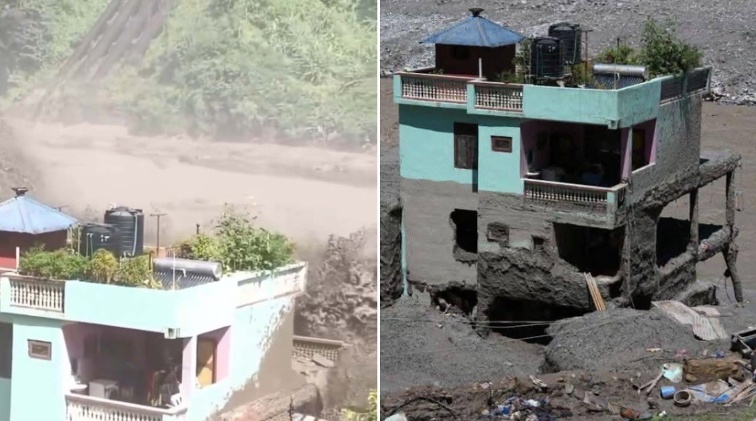
On August 30, after arriving in Nepal, which is not under Communist Party control, reporters from Xinhua News Agency clearly managed to temporarily escape the interference of party ideology. They began to focus on the livelihoods of the people, interviewing local resident Santosh to document the escape of his uncle and aunt on a motorcycle; they also spoke with Sabas, who recounted how he and his wife narrowly escaped with their lives, while their relatives tragically did not. The report is filled with stark images of houses buried in mud and sand, and survivors returning to the ruins to salvage their belongings.
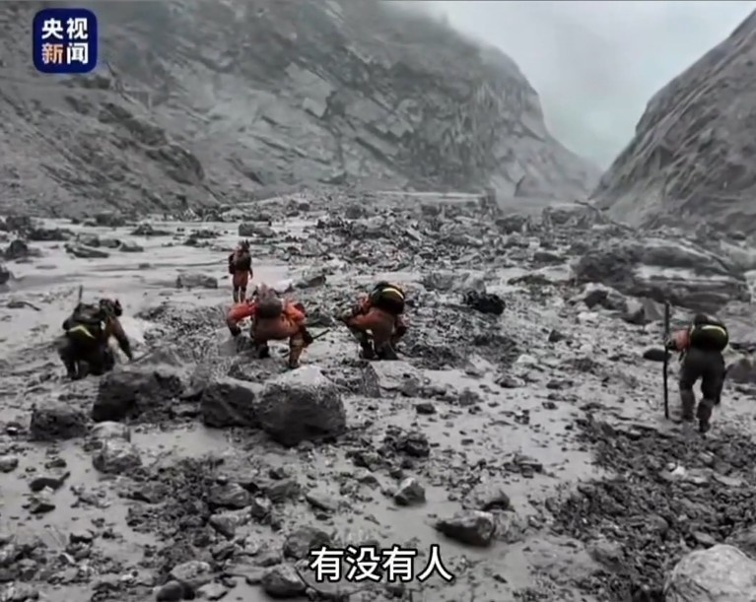
CCTV footage: In the disaster-stricken area of Jilong, rescue workers are calling out loudly to the flat ground, 'Is anyone there?' This isn't a reflection of their intelligence, but rather an indication that the director's intelligence is 'Too Low'. (Video screenshot)
The official media of the Communist Party emphasizes 'system and grand narrative.'
However, once the Xinhua reporters returned to the Jilong port within Chinese territory, the tone of their reports changed dramatically.
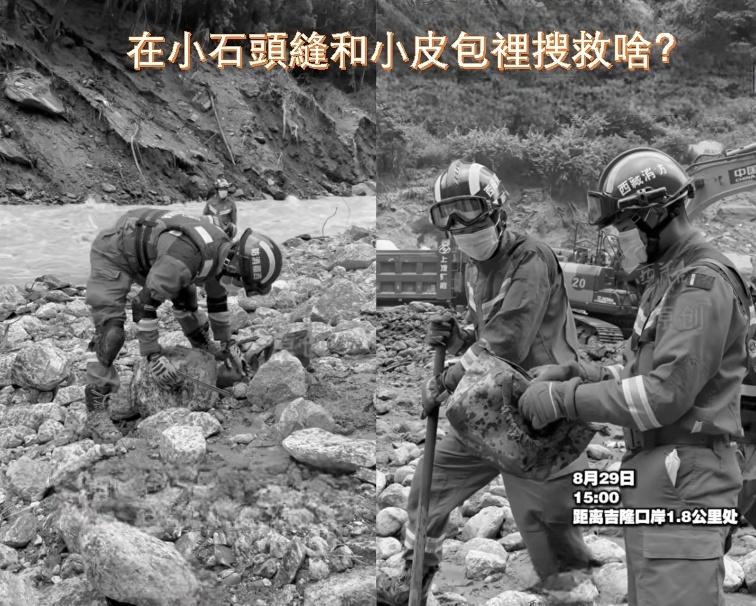
Readers can no longer find accounts from survivors in the official reports, nor the sorrow of families of the missing, and even less inquiry into the causes of the disaster. Instead, the reports are filled with cold, impersonal terminology: rescue forces, engineering machinery, drones, funding amounts; they emphasize the involvement of the Chinese Communist Party's military, armed police, fire services, and China Aneng (full name: China Aneng Construction Group Co., Ltd., a central enterprise formed by the overall transfer of the armed police hydropower troops), as well as official actions such as central funding allocations and the initiation of emergency responses.
The news headlines are all glorifying the Communist Party, with titles like 'Multiple Parties Rush to Provide Emergency Aid', 'Land, Sea, and Air All Advance Simultaneously', 'The Party Flag Flies High on the Frontline of Rescue', and 'Allocated 120 Million Yuan to Support Disaster Relief'. In the official narrative, the disaster scene has become a platform to showcase the system's advantages, while the suffering of ordinary people serves merely as a backdrop, with the emphasis always on 'how quickly the official response is and how much the leaders care'.
Netizens Can't Stand It
This stark contrast has even led netizens to express their frustration.
On August 30, netizen 'Lao Miao Ya Kou Hao' posted on social media platform X, questioning why Chinese journalists seemed to suddenly 'recover' their interviewing skills upon arriving in Nepal. For instance, China News Service reporter Cui Nan drove into the disaster area, interviewed compatriots who had been trapped in a cowshed for a night and were covered in mud at a temporary rescue center, documenting their harrowing experiences, and even thoughtfully paused the interview to take them back to the capital. They knew to seek out survivors, took photos for missing person notices, and asked those survivors, 'What did you experience?' They also focused their cameras on the anxious families waiting for news.
However, once they crossed the border into Tibet's Jilong, the reporting approach of the same group of journalists instantly shifted to: 'What has the rescue system accomplished? What have the officials done? How much aid has been distributed?'
The same landslide, viewed from either side of the border, presents two distinct narratives of disaster. 'Lao Miao Ya Kou Hao' couldn't help but wonder: why is this the case?
One response from a netizen states: In Nepal, journalists confront the real world and report on the fates of individuals; in contrast, in China, all significant disasters are under strict public opinion control by the authorities. News has shifted from being about uncovering the truth to focusing on preventing 'loss of control' and serving the 'political landscape.' Regardless of how grandly the news is presented, it cannot mask the deep-seated indifference of the Chinese Communist regime.
△







News magazine bootstrap themes!
I like this themes, fast loading and look profesional
Thank you Carlos!
You're welcome!
Please support me with give positive rating!
Yes Sure!