
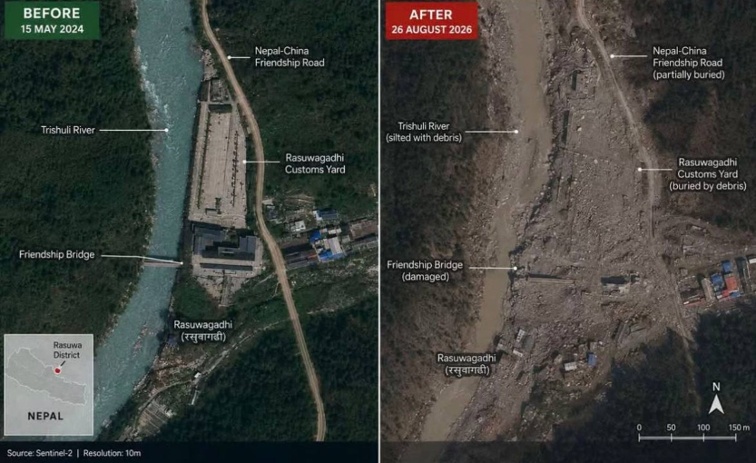
Villages along the Nepal–Tibet border were devastated by severe mountain floods, with the entire Gyirong port flattened. (Screenshot from X platform)
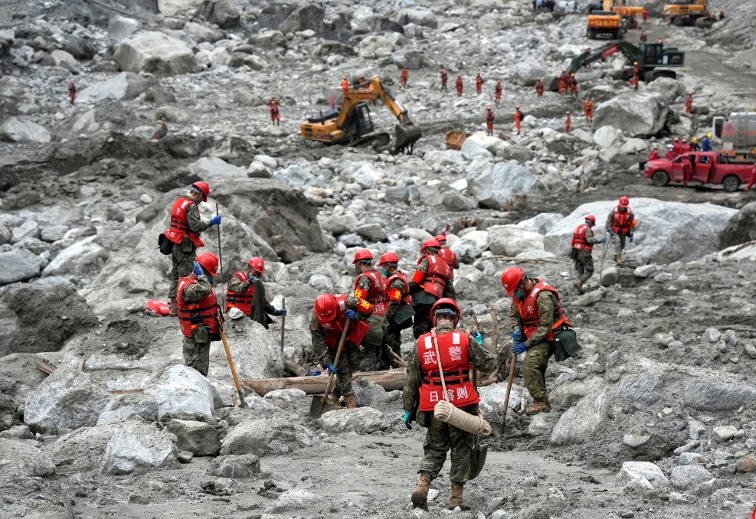
[People News] On August 26, 2026, a massive ice collapse and landslide struck the Himalayas at the border between China and Nepal, occurring almost without warning. A torrent of ice, rock, and sediment rushed down at nearly 50 meters per second. The Hesuo Bridge was destroyed, and the joint inspection building at Jilong Port was instantly engulfed. Dozens of tourist buses and freight trucks were swept away by the powerful mudflow.
The characters 'Ji' and 'Long' were washed away, a sign that is clearly unfavorable to the Party.
The landslide did not stop there. It blocked the river channel, creating a landslide lake (note). The flood then surged southward along the river valley, entering Nepal and inundating several villages downstream.
Is the 'Tibet Everest' advertisement merely a coincidence?
This news is heartbreaking and brings to mind the final scene from the 2025 Shen Yun performance. The piece, titled 'The Savior,' was set in Shanghai, China, where a massive flood swept through the city, with towering waves destroying much of Shanghai. At the critical moment, deities descended to the human realm, preventing this catastrophe and averting even greater loss of life.
A particularly striking detail in the performance was the stage backdrop, which depicted the cityscape of Shanghai. However, a prominent advertisement appeared in the scene, boldly displaying the words 'Tibet Everest.' Is this a prophecy? The disaster currently unfolding in the Jilong Valley is located in the Himalayas, which serves as a crucial gateway to 'Tibet Everest.'
Institutional challenges cannot withstand divine will.
On the day of the incident, there were no warning signs; the weather in the area was clear and sunny, with no unusual rainfall. The ice collapse occurred and engulfed Jilong Port in just six or seven minutes. This sudden event was beyond human prediction—when faced with such a major disaster, both individuals and systems seem incredibly small and fragile.
The large building at Jilong Port is situated on a critical path for river flooding; if there is an abnormal influx of water upstream, it could be washed away, resulting in loss of life. This gives this seemingly ordinary structure significant meaning, as its abbreviation stems from the phrase 'the Party leads everything,' and it serves as one of the model projects demonstrating the 'infrastructure capabilities' of the Chinese Communist Party (CCP).
The CCP's long-standing narrative asserts that as long as the Party exists, there are no challenges that cannot be overcome; as long as the system is superior, it can conquer all.
However, this Party, which prides itself on its 'superior' communist authoritarian system, saw this model building uprooted by a sudden disaster in just a few minutes, reduced to rubble along with 27 other nearby structures.
Why refuse international assistance?
Following the disaster, some media outlets echoed the CCP's propaganda, attributing this tragedy to a natural disaster caused by 'global warming,' describing it as an 'irresistible' chain reaction from a high-altitude ice collapse. While the term 'irresistible' may hold some truth, what is truly irresistible? It is not a matter of chance, but rather the inevitable forces of nature, the unavoidable will of fate.
Given that it is a high-altitude ice collapse, why was there such extensive construction in the area?
Since disaster has struck, why refuse all forms of international aid? Why prohibit foreign rescue teams and independent media from accessing the site?
The Chinese Communist Party (CCP) has consistently employed the blockade of news and false propaganda as its tactics. However, the reasons behind this are not difficult for people to understand in light of the natural disasters resulting from this man-made calamity:
The disaster of the "Belt and Road": The "Belt and Road" initiative serves as the CCP's strategy to recruit "allies" and form "alliances" globally, exploiting the goodwill of ordinary Chinese citizens and taking advantage of these "allies"—under the overarching premise of "Heaven's punishment on the CCP," those who choose to ally with the CCP can only imagine the dire consequences.
The sensitive Tibetan border: The disaster struck in the highly sensitive Tibetan border region, involving military installations, cross-border water conservancy projects, and strategic nodes of the "Belt and Road" initiative.
The channel where the Party supersedes the people: Gyirong Port is also a vital military-civilian dual-use route for the CCP's Tibet Military District to deploy troops and equipment towards South Asia, making its strategic position extremely sensitive.
On a superficial level, over the years, the CCP has been advancing cross-border hydropower stations, high-voltage transmission lines, and port infrastructure in this area, which is already situated in a core fracture zone of tectonic plate collision and has an extremely fragile geological structure. Years of blasting and deep excavation have gradually disrupted the balance of the mountain structure that high-altitude glaciers originally depended on for support.
On a deeper level, the CCP does not represent China. The destruction of this channel, where the Party is greater than the people, can be interpreted as divine will. The CCP's persecution of Falun Gong has sealed its fate. The arrogance displayed over the past thirty years will ultimately prove to be fleeting. Ice collapses, and snow avalanches carry significant implications for the CCP's future. How far off is the day of the Party's collapse?
This disaster serves to validate that the CCP's narrative of "man conquering nature" and "superior system" is fundamentally flawed.
The inevitable cost of defying heaven and earth.
The Chinese have long emphasized the harmony between humanity and nature. The relationship between humans and the universe is characterized not by conquest, but by reverence. To thrive in this world, one must adhere to moral principles, which are essential for a lasting existence.
The Chinese Communist Party (CCP) rejects belief in deities, instead placing its faith in Marx, this 'ghost from the West,' which promotes the idea of 'communing with heaven, earth, and humanity.' While the people of Tibet honor mountain gods, the CCP recklessly engages in blasting mountains, detonating explosives, and extensive excavation.
Just as the flooding of reservoirs across China devastates farmland, villages, and cities, the CCP not only brings repeated disasters but also precipitates a moral collapse within Chinese society. In simple terms, the inevitable consequence of the CCP's disdain for nature is the loss of lives among its followers.
Lessons from Nepal
In this calamity, Nepal has suffered immensely. According to ongoing reports from the Nepalese government, the death toll far exceeds a thousand, which is dozens of times greater than the figures reported by the CCP (the CCP's statistics are consistently absurd and misleading).
For years, the Nepalese government has actively collaborated with the CCP, signing agreements, approving land use, and inviting Chinese investment to build roads, hydropower stations, and cross-border power grids. Consequently, it has faced repeated criticism for becoming dependent on the CCP for debt. This 'debt dependency' has resulted in the construction of hydropower stations, transmission lines, and coastal infrastructure, thereby pushing more villages and lives into peril.
Some argue that Nepal is not the only nation closely tied to the rogue regime of the CCP. Indeed, a closer examination of countries that actively align with the CCP reveals a pattern of disasters or divine warnings they have faced.
The Fortunate Ones Amidst Crisis
According to a report by the BBC, that morning, Principal Lajin De La·Dapidi received four urgent phone calls in just a few minutes, each warning him of an impending major flood. One parent even rushed to the school specifically to pick up his daughter early, and these unexpected alerts made him realize the urgency of the situation.
Without any hesitation, he immediately ordered the emergency evacuation of all 900 students and staff, instructing the children to run to higher ground. He also stopped the school bus that was about to leave to pick up students, directing it to turn around and move away from the danger zone. Just ten minutes later, the teaching building and dormitory were almost instantly overwhelmed by the rushing floodwaters and debris.
There was no bureaucratic delay, no 'teachers run first'; only the principal and parents showing deep respect and care for life. Heaven rewards good deeds and provides a way out for kind-hearted people; throughout history, there are countless examples of such events.
Conclusion
In the face of disasters like pandemics, floods, tsunamis, earthquakes, and mudslides, it is essential for people to take timely and appropriate measures to mitigate risks. However, when disaster strikes, how can one escape? The fundamental way to avoid risks is to stay away from the CCP, a force that corrupts human hearts and opposes the divine.
[Note] A dammed lake refers to a lake formed when landslides (rockfalls) or lava block a river, causing water to accumulate to a certain level.
(Minghui Window)
△





News magazine bootstrap themes!
I like this themes, fast loading and look profesional
Thank you Carlos!
You're welcome!
Please support me with give positive rating!
Yes Sure!