
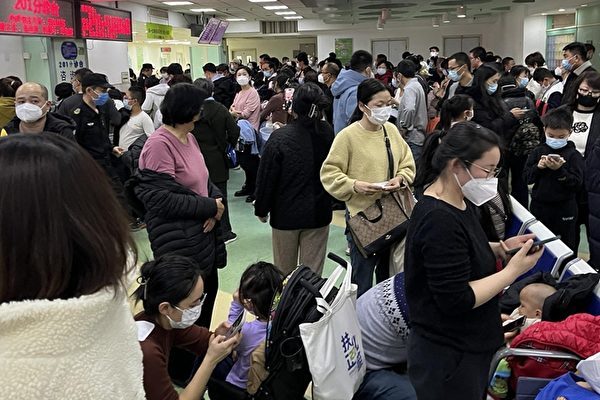
On November 21, 2023, Beijing Children's Hospital was overwhelmed with patients. (Video screenshot)
[People News] The 14th National People's Congress Standing Committee of the Communist Party of China voted on August 28 to pass the 'Medical Security Law of the People's Republic of China', which is set to take effect on January 1, 2027. This law, comprising 7 chapters and 56 articles, establishes 'participation in basic medical insurance' as a legal obligation for citizens for the first time. However, it fails to mention the minimum government subsidy, the maximum personal contribution, or the minimum reimbursement rate, leading to a strong backlash from public opinion and legal scholars across China. Netizens have angrily denounced it as the latest malicious law that 'only extracts money without providing security.'
Netizens: Mandatory Insurance Participation is a Pretext for Legal Theft
According to Articles 4, 10, and 11 of the law, citizens have the right and obligation to participate in basic medical insurance as mandated by law. Citizens who do not participate in employee medical insurance and do not have access to other forms of national medical security should' enroll in the basic medical insurance for urban and rural residents. The law also stipulates that the standards for personal contributions and government subsidies for urban and rural residents' medical insurance will be determined by the medical insurance and finance departments of each province, autonomous region, and municipality directly under the central government.
The public reaction online in China to this law, which imposes 'participation in medical insurance' as a mandatory obligation while remaining silent on the minimum protection standards, has been one of outrage and fervor. Netizens' comments are devoid of bureaucratic jargon, each one striking directly at the core issues, with many memorable phrases.
'Rights can be waived, but obligations must be fulfilled? Then who will guarantee my right to health and my right to life? Only discussing obligations without mentioning rights is not law; it is merely a notice for collecting head taxes.'
When it comes to taxation, it is framed as an obligation, but during reimbursement, it’s said, 'it depends on the financial situation.' This is simply about collecting money without delivering any services; where in the world can we find such a tyrannical clause?
Even the choice of whether to buy insurance is enforced; why not just directly deduct it from my bank account? What’s the point of going through the hassle of legislation? This is nothing more than a legally sanctioned form of robbery.
For migrant workers and those in flexible employment, every penny is hard-earned money that represents their sweat and toil. If you don’t help us with employment issues or address wage arrears, you only focus on the last bit of life-saving money in the pockets of ordinary citizens.
Previously referred to as 'social welfare,' it has now evolved into 'social security,' and now it’s been laid bare—this is essentially the 'survival permit fee' that you must pay to live in this country.
A netizen on social platform X, 'Lao Ma Ya Kou,' candidly remarked: 'What constitutes an 'evil law'? The newly enacted 'Medical Security Law' is the latest embodiment of such laws. It mandates 'you must participate in insurance,' yet fails to guarantee 'how I will provide you with insurance.' Furthermore, it preys on the poor: the poorer you are, the less you can afford; and the less you can afford, the less protection you receive.'
In the future, there may even be no right to 'not pay.'
The law also states that individuals in extreme hardship, members of families receiving minimum living security, and those eligible to prevent falling back into poverty must participate in the resident medical insurance, with their personal payment portion 'subsidized according to regulations.' However, the specific subsidy ratio, minimum standards, and criteria for determining eligibility are not detailed in the law.
Netizens have responded with a wave of criticism, exposing the official hypocrisy, stating:
The bill fails to specify a personal payment cap, implying that in the future, the government can decide how much to increase prices at will. Residents' health insurance premiums rise annually, and with this new legislation mandating such increases, even the right to opt out has been stripped away.
The absence of a 'personal payment cap' and 'minimum government subsidy' in the text suggests that future price hikes will be determined solely by the government, and reimbursement rates will depend on their discretion. Isn't this akin to handing the public a blank check to cover the costs?
Health insurance premiums for residents have escalated from just a few dozen yuan to several hundred, resulting in thousands of yuan in costs for families. With this new legislation enforcing mandatory participation, future annual price hikes will leave individuals without even the option to refuse payment!
The lack of a minimum reimbursement rate means that even a mere 1% reimbursement could be considered as fulfilling their obligation to provide coverage, correct? Every word avoids mentioning money, yet every statement revolves around it.
In response to this legislation that defines obligations without establishing a protection baseline, Wang Tong (pseudonym), a law professor from Hunan, remarked in an interview with The Epoch Times: 'This clearly forces the public to enroll in insurance; it is a tactic by the Communist Party to extract money from the populace. With 'should' repeated on both sides, there are no consistent numerical standards. By using 'per capita income' as a facade to grant local authorities discretionary power, it will only create an artificial welfare divide where 'wealthy provinces enjoy better protection while poorer provinces bear heavier burdens', ultimately leaving the most vulnerable groups unable to cope.'
This situation forces the impoverished into a dire predicament of 'the poorer you are, the less protection you receive.'
Article 12 of the bill states that the government will establish a long-term mechanism for insurance participation and enhance the 'incentive and constraint measures.' This will be integrated with the current residents' medical insurance policy, which will introduce a 'waiting period for insurance interruption' starting in 2025. Individuals who interrupt their insurance will face a fixed waiting period of three months upon re-enrollment, with an additional month added for each year of interruption, during which medical expenses cannot be reimbursed retroactively.
Mr. Fang, a rights activist from Sichuan, expressed to The Epoch Times: 'This set of regulations is most harmful to the unemployed and low-income groups. They are pressuring you to find work, but where can you find a decent job these days? This creates a vicious cycle of 'the poorer you are, the less security you have.'
Chinese netizens have also voiced their anger regarding the current state of hospitals and the medical insurance system: 'Only after entering the hospital do you realize that the truly effective medications are all excluded from the medical insurance catalog, and the reimbursement threshold is shockingly high. Ordinary people don’t even know how they will pay next month’s rent; I’m nearly starving, and yet you still force me to buy insurance that is useless for minor ailments and fails to protect against serious illnesses?'
'Not paying for medical insurance is deemed illegal, but when you do pay and go to the hospital, you encounter numerous out-of-pocket medications and services, with a frighteningly high reimbursement threshold. Ultimately, you find yourself having to sell your possessions. Is this really medical insurance, or is it merely a means to support hospitals and officials in enjoying a comfortable lifestyle and achieving their performance targets?'
'What can be reimbursed are mostly irrelevant medications. By forcing us to purchase this type of insurance, are you truly protecting us, or are you just safeguarding the funding pool of the medical insurance bureau?'
Administrative coercion leaves an invisible big stick.
Article 20 of the Medical Security Law clearly states that tax authorities "shall collect basic medical insurance fees in accordance with regulations." While the chapter on legal responsibilities does not specify fines for ordinary citizens who refuse to enroll in insurance, Article 44 explicitly proposes the establishment of a "credit management system" that includes insured individuals.
Netizens are quite aware of the situation; they are not relieved by the absence of specified fines but instead criticize this tactic as a form of wordplay, referring to it as a "soft knife cutting flesh" and "covert violence." They argue: "The lack of specific fine amounts is actually the most frightening aspect! In China, being 'included in credit management' is far more severe than fines. Today, you may be barred from taking the high-speed train, your child may be denied schooling, and tomorrow you could be unable to obtain a business license. This is using an invisible big stick to force compliance!"
"The involvement of tax authorities in fee collection equates 'not paying for medical insurance' with 'tax evasion.' What right does a system that cannot even ensure the basic survival of its citizens have to label them as 'untrustworthy'?"
"Article 20 directly states that collection is to be done by 'tax authorities'; isn't this a complete abandonment of pretense? What constitutes social welfare? This is clearly a 'health tax' and 'survival permit fee' aimed specifically at the common people!"
"The chapter on legal responsibilities is filled with checks on fraud, hospitals, and institutions, yet it fails to mention the 'minimum subsidy limit for citizens' or the 'minimum reimbursement ratio,' and it does not dare to specify fine amounts. This reflects a sense of guilt! They want to forcibly extract resources through taxes and credit checks while fearing that clearly stating fines will lead to civil unrest."
The reluctance to impose fines stems from the understanding that the poor simply cannot afford to pay. However, there is a desire to maintain the funding pool of the medical insurance fund, which has led to the creation of this 'bully clause' that emphasizes obligations without providing a clear bottom line and conceals penalties.
Previously, insurance premiums were collected through persuasion by village officials, but now tax authorities are involved, effectively linking 'not paying for medical insurance' directly to 'tax evasion'. With the state machinery mobilized to collect funds, do ordinary citizens still have any choice?
In this context, Guangdong legal scholar Zhou Hanmin (pseudonym) cautioned: 'The section on legal responsibilities does not explicitly mention fines, but the legal characterization of 'should participate' has left significant leeway for administrative enforcement. The Communist Party of China may likely adopt methods reminiscent of past 'family planning' policies, using local regulations or administrative documents to introduce measures such as recovering insurance premiums, tax coercion, credit penalties, or restrictions on public services for forced collection.'
The helplessness and anger of the grassroots
The widespread anger among netizens is quite clear: the opposition is not against the guarantees themselves, but against 'using the law as a stick to force ordinary people to pay, while shifting and concealing the government's responsibilities for providing those guarantees.' This type of legislation, which only defines obligations without establishing a bottom line, is perceived by the public as blatant institutional exploitation.
'Now, the unemployed are unemployed, and those with reduced salaries are struggling; many people don't even know how they will pay next month's rent. You want to talk to me about mandatory insurance? I'm on the verge of starvation, and you still want to fine me for not purchasing end-of-life care insurance?'
"With the unemployment rate so high, countless individuals are uncertain about where their rent for next month will come from. You want to discuss mandatory insurance with me? I'm on the brink of starvation, and if I don't purchase health insurance, I'll be labeled as 'untrustworthy'? What right does a system that fails to ensure basic survival have to define whether ordinary people are 'untrustworthy'?"
"Previously, health insurance was described as 'the Party's care and warmth', but now it's being enforced through the tax bureau and credit systems to compel you to buy it. This kind of 'forced care' is something that ordinary people simply cannot bear!"
This law, which the authorities have marketed as 'legal protection' under the 'Medical Security Law', has starkly revealed the brutal reality of a system that, amid fiscal decline, seeks to systematically extract resources from and control the lower strata of society across China, as perceived by the public and scholars. △





News magazine bootstrap themes!
I like this themes, fast loading and look profesional
Thank you Carlos!
You're welcome!
Please support me with give positive rating!
Yes Sure!