

Dark clouds hang over Tiananmen Square in Beijing. (Lintao Zhang/Getty Images)
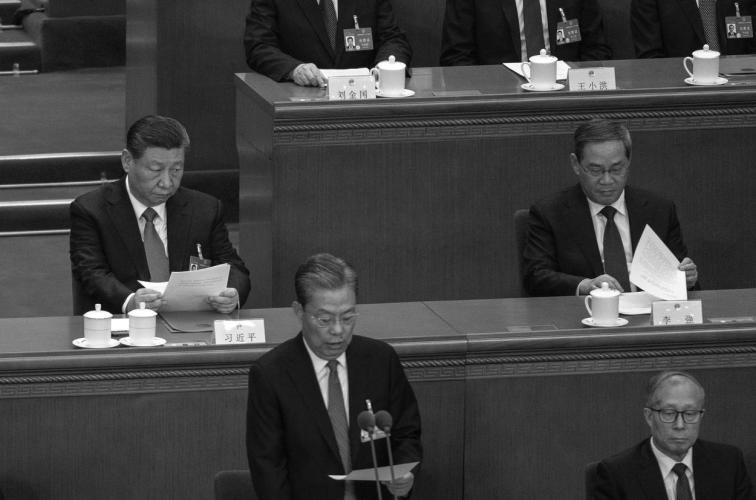
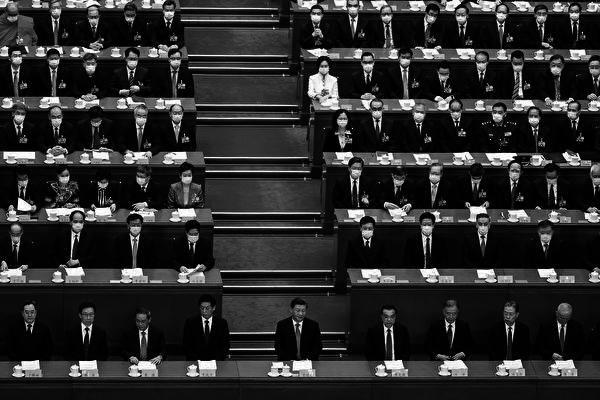
[People News] The Fifth Plenary Session of the 20th Central Committee of the Communist Party of China commenced today (26th) in Beijing. The meeting is set to review the 'Decision of the Central Committee of the Communist Party of China on Persistently Advancing Comprehensive Strict Governance of the Party on Several Major Issues.' In light of ongoing upheaval in high-level personnel changes, the manner in which the meeting addresses the interplay between anti-corruption efforts, political loyalty, and the performance of officials will be a crucial indicator for assessing Xi Jinping's next phase of governance.
As reported by Radio Free Asia, during a prior discussion on the preparations for the plenary session, the Political Bureau of the Central Committee emphasised the need to strengthen centralised and unified leadership, enhance long-term governance capabilities, and invigorate the enthusiasm of the entire Party. Senior commentator Ma Ju (Ma Jubin), based in the United States, remarked in an interview with Radio Free Asia on Monday (26th) that Xi Jinping's focus on internal Party governance centres on demanding absolute loyalty from the bureaucratic system to himself. However, while power can compel officials to publicly express loyalty, it is challenging to ensure their genuine internal agreement. Consequently, the ruler's demands for loyalty and suspicions of disloyalty may exacerbate the situation.
He stated: 'Thus, Xi Jinping's current governance within the Party essentially has one objective, regardless of how he articulates it—whether it pertains to loyalty to the Party, loyalty to socialism, and so forth—the core remains unchanged: it is absolute loyalty to Xi. Xi Jinping's current predicament mirrors that of past dictators, as he struggles to figure out how to secure absolute loyalty from everyone.'
Over the past year, 22 members of the Central Committee of the Communist Party of China and 6 alternate members have been dismissed or removed from their positions as representatives of the National People's Congress due to anti-corruption efforts. Furthermore, several military and party officials have not made public appearances for an extended period. Among those Central Committee members who have lost or may lose their positions, 14 are from the military. Notable figures include Zhang Youxia, the former Vice Chairman of the Central Military Commission, Liu Zhenli, the former Chief of the Joint Staff, Zhong Shaojun, the former Director of the General Office, and Ju Gansheng, the former Commander of the Strategic Support Force, all of whom have been stripped of their qualifications as representatives of the National People's Congress.
Media reports estimate, based on publicly available information, that around 45 individuals may be expelled from the Central Committee during this Fifth Plenary Session.
The expansion of anti-corruption efforts has led officials to adopt a more risk-averse approach.
In an interview with our station, senior commentator Cai Shenkun remarked that Xi Jinping's anti-corruption campaign over the past decade initially targeted the political forces left by previous leaders. However, following the 20th National Congress, the crackdown has also included officials promoted by Xi himself. He pointed out that as the influence of former political rivals has waned, the ongoing high-pressure anti-corruption campaign suggests that the purges are becoming increasingly politically selective.
"Thus, if the intensity of the anti-corruption campaign remains so high after the 20th National Congress, it indicates a political discernment. They are no longer primarily assessing your achievements or abilities, but rather your absolute loyalty to the party. If you fail to demonstrate that absolute loyalty, you could be eliminated at any moment, either through corruption or anti-corruption measures."
The recent removal of important officials from the upper ranks of the Communist Party of China under the guise of 'anti-corruption' raises the question: has this led to increased inaction among the remaining officials? Cai Shenkun remarked that this situation has become quite apparent: 'It is very clear now. I have discussed this topic repeatedly with friends back home today. Current officials are largely inactive and adopting a 'lying flat' approach. Xi Jinping no longer evaluates your political achievements; instead, he prioritises loyalty. During the Jiang and Hu administrations, most officials were technical bureaucrats, primarily from engineering and science backgrounds. However, there is now a significant reliance on liberal arts graduates, who tend to focus on abstract issues.'
According to data released by the Central Commission for Discipline Inspection, in 2025, 181 central management cadres were placed under investigation, nearly doubling from 92 in 2024. Additionally, 41,000 county-level officials and 137,000 township-level officials were also investigated that same year.
Since Xi Jinping took office as General Secretary of the Communist Party in November 2012, he has initiated a large-scale anti-corruption campaign under the slogan 'tigers and flies.' 'Tigers' generally refer to officials at the vice-ministerial level and above, while 'flies' denote corrupt officials at the grassroots level.
Why does the concentration of power exacerbate feelings of panic?
In an interview with our station, German-Chinese scholar David noted that even in a landscape with virtually no competitors, Xi Jinping feels the need to continuously purge officials to reinforce his authority. The focus of this plenary session on party discipline and anti-corruption suggests that as he seeks a fourth term, there is still a strong sense of insecurity regarding his power.
He stated, "There is a need for an unprecedented level of internal cleansing within the party, particularly a high-level purge reminiscent of 'cleansing the court officials.' This trend of purging is alarmingly similar to the purges during Stalin's later years, highlighting Xi Jinping's dilemma as he approaches his fourth term: while power is becoming increasingly centralised, corruption within the party, especially at the upper echelons, is worsening, and political loyalty among the elite is increasingly under scrutiny."
In January 2015, Xi Jinping underscored the significance of political discipline and rules; later that October, the Communist Party of China included the phrase 'recklessly discussing the central government's major policies' in its disciplinary regulations, further constricting the space for internal party discourse. Following this, terms like 'violating political discipline and rules' and 'recklessly discussing the central government' became common in announcements regarding the punishments of officials who fell from grace.
The cycle of personal centralisation leading to purges
David, a scholar of the history of the Communist Party of China, noted that Xi Jinping has thus fallen into a historical pattern faced by emperors in China when dealing with internal and external challenges: losing trust in ministers and deflecting responsibility through arbitrary purges of high-ranking officials. He criticised that since Xi Jinping assumed power, he has gradually undermined the collective leadership system of the Communist Party, effectively subverting the republican system established since the Xinhai Revolution, which has plunged the country into a highly unstable power structure, while failing to recognise the connection between this instability and his own centralisation of power.
David stated that Xi Jinping is experiencing a profound sense of insecurity regarding his power, with fewer means at his disposal, ultimately leading him to resort to surveillance and control methods reminiscent of the Eastern and Western Depots of the Ming Dynasty. This situation underlies Xi Jinping's increasing number of re-elections, his ongoing purges, and his growing panic, which casts a shadow over the Jingxi Hotel—a symbol of a dictator's isolation. The instability of the system resulting from the personal centralisation of power, coupled with the reliance on purges to uphold authority, is likely the fundamental cause of the escalating corruption within the Chinese Communist Party. △






News magazine bootstrap themes!
I like this themes, fast loading and look profesional
Thank you Carlos!
You're welcome!
Please support me with give positive rating!
Yes Sure!