

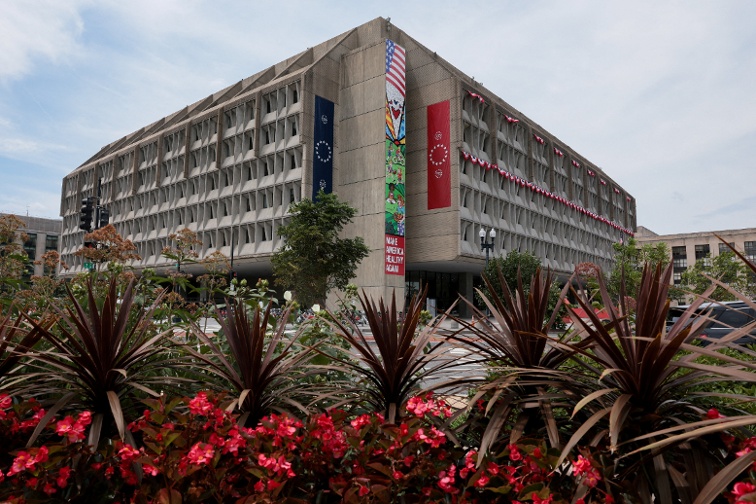
The hospital, which should be dedicated to saving lives, has transformed into a den of exploitation under the pervasive corruption of the Chinese Communist Party. The image depicts the inpatient department of Hebei Medical University Second Hospital. (Video screenshot)
[People News] On September 13, the National Medical Insurance Bureau of the Chinese Communist Party revealed a significant commercial bribery case involving Hebei Medical University Second Hospital (Hebei Yida Er Hospital), one of the top-tier hospitals in Hebei Province.
Over the span of 11 years, there were 46 instances of bribery, with the largest single bribe amounting to 16.58 million yuan, leading to a staggering total of 184 million yuan involved! More than 30 pharmaceutical companies surrounded this hospital to facilitate profit transfers.
Following the news, it quickly became a trending topic on Weibo. Official media even described it as "30 pharmaceutical companies hunting one hospital." However, netizens quickly countered: this is not hunting; it is clearly a "collective division of spoils" between the hospital and the pharmaceutical companies, colluding and rushing towards each other!
What harsh realities about the Chinese medical system and the struggles of ordinary people does this 184 million yuan of illicit money expose? Today, we will delve into a thorough analysis.
A stent costs 5,000 yuan! The entire burden falls on the common people.
The details in this report are shockingly cruel.
Media reports indicate that as early as 2025, this hospital was implicated in a scandal involving "5,000 yuan in kickbacks for each artificial heart stent." The latest disclosures reveal that life-saving medical supplies, including artificial lenses, drug-eluting stents, and balloon dilation catheters, were involved in a staggering total of 174 million yuan! For instance, a medical device company named "Hebei Xiangen" reportedly bribed the hospital staff with 20.64 million yuan to push these consumables into the hospital at inflated prices.
It’s worth considering: where does the money come from when pharmaceutical companies are willing to spend tens of millions on bribes? There’s no such thing as a free lunch!
Stents and catheters that should only cost a few hundred yuan are marked up to tens of thousands by pharmaceutical companies. A significant portion of this markup—30% to even 50%—is funneled back as kickbacks to the hospital's director, department heads, and doctors. Ultimately, this inflated cost is passed on to ordinary patients who are lying in hospital beds waiting for life-saving treatment, as well as to the national medical insurance fund that the citizens of China contribute to!
Netizens have made a poignant observation: "This 184 million is not just a cold figure; it represents the life-saving money of the common people! Every box of overpriced medication that is forced upon us, every stent that is misused, ultimately adds to our bills!"
Some netizens remarked, "This is alarming. Over 11 years, 30 pharmaceutical companies engaged in bribery 46 times, totaling 184 million yuan, with the highest single bribe reaching 16.58 million. It’s as if 30 pharmaceutical companies surrounded a single hospital, resembling a hunt on the African savannah."
Some netizens have raised doubts about the term 'encirclement hunting', arguing that there is a mutual exchange of interests between the parties involved in the bribery. 'If hospital leaders do not reach out or provide entry tickets, how can pharmaceutical companies encircle and hunt? To package corruption as passive victimhood is simply laughable.'
Other netizens pointed out that the inflated drug prices ultimately fall on the patients: 'The wool must come from the sheep, so what will such pharmaceutical companies and hospitals provide for patients? Only disaster.' '1.84 billion is not just a number; who pays this money? The patients. Every overpriced consumable, every box of overpriced medicine that is forced upon us, ultimately ends up on our bills. Pharmaceutical companies spend tens of millions on bribery, only to turn around and recoup double from medical insurance and patients. This is not business; it is profit-sharing.'
Systemic Corruption: The White Tower Under Power Monopoly
In August 2023, Li Yongjun, the vice president of Hebei Medical University Second Hospital, was dismissed. He had long overseen core operations such as medical services, equipment, and procurement. Li Yongjun's investigation was a key part of this major case, and the 184 million yuan reported by the National Medical Insurance Bureau represents the final tally confirmed in this 11-year-long 'collusion case'.
Many netizens shared their own medical experiences, criticizing doctors for installing stents in patients who do not need them and prescribing expensive nutritional drugs to receive kickbacks, effectively turning places meant for saving lives into ATMs. They questioned why such major cases continue to result in arrests, yet corruption keeps sprouting back like leeks.
This is not merely the moral decay of individual doctors, but rather the systemic rot caused by the highly monopolized power under the Chinese Communist Party's regime!
In the current system, the ability of a drug or consumable to enter a hospital is not fundamentally determined by its effectiveness or reasonable pricing, but rather by a small group of hospital leaders, pharmacy committees, and department heads who wield administrative power. In an environment devoid of independent judicial oversight and investigative media reporting, and where power is completely unchecked, the market mechanism is effectively stifled, transforming hospitals into private casinos where collusion between officials and businesses is overt and profit-sharing is blatant.
Netizens have voiced their dissatisfaction with the government's approach of merely 'naming and exposing' issues, urging judicial authorities to impose severe penalties. They remarked: The medical insurance bureau has named 11 companies, but what happens next? A single stent comes with a kickback of 5,000 yuan; doctors take one for every stent they prescribe, and their conscience has long been silenced by money. While it may be easy to apprehend a few hospital directors, unless the bribing companies are driven to bankruptcy and the recipients of bribes face heavy sentences, the 'termites' in white coats will never be fully eradicated.
Some netizens have pointed out that the authorities' grand 'naming and anti-corruption campaign is essentially a response to the recent drying up of local finances and the national medical insurance fund facing a significant deficit. The system relies on combating medical corruption to 'recover black money and fill the gaps.' This type of 'fragmented anti-corruption' that only targets a few typical cases without reforming the power structure is fundamentally a superficial solution that fails to address the root causes.
Who are the behind-the-scenes forces driving the 'three mountains' that burden the Chinese people?
This significant case has once again highlighted the pain points for ordinary people regarding the high costs and difficulties associated with medical care. Many netizens have expressed their concerns, stating: 'The common people are afraid to get sick and hesitant to go to the hospital; a serious illness can lead to a family's bankruptcy, and it turns out that all the money has been taken by this group of people,' and 'Housing, education, and medical care are three major burdens; among them, the medical burden is the most lethal because it directly threatens your life and drains your resources.'
The 184 million yuan black money scandal at Hebei Medical University Second Hospital is just a reflection of the hardships faced by ordinary Chinese citizens.
Indeed, life is incredibly tough for the average person in China today.
They are burdened with some of the least secure housing in the world: investing generations of savings into purchasing homes, only to see their investments vanish when faced with unfinished buildings, yet they are still coerced by banks and the system to continue making monthly mortgage payments. According to estimates from Lu Ting's team, Chief Economist at Nomura Securities China, by the end of 2023, there are approximately 20 million units of unfinished and delayed pre-sold homes in China. If we consider a family of three or four, the number of people directly affected by unfinished buildings or severely delayed housing deliveries could reach between 60 million and 80 million; when including both parents who have depleted their savings to assist in purchasing a home (six wallets), the number of impacted individuals easily surpasses 100 million.
Moreover, parents invest hundreds of thousands to ensure their children complete four years of university, only to see them face unemployment immediately after graduation. Each year, more than ten million university graduates find that most of them have become 'cheap labor' or are outright unemployed, with a large number becoming gig workers, competing with other delivery riders for orders in all weather conditions. After a month, many struggle to make ends meet, and the hope that education would elevate their lives is utterly dashed.
The Chinese populace consumes some of the dirtiest food globally and breathes the most polluted air filled with smog. When illness strikes, they not only confront high out-of-pocket costs for medications and healthcare but also the dangers of counterfeit drugs and inferior medical supplies. A serious illness can lead to the financial ruin of a middle-class family in an instant.
Housing, education, and healthcare—these three 'mountains' that burden the Chinese people are so heavy because they arise from the very system that fosters these challenges: the Chinese Communist Party's regime, which prioritizes power monopolization over the welfare of its citizens.
When power is wielded to siphon off the savings of the populace through real estate, to stifle social mobility through education, and to extract the last of the people's life-saving funds through healthcare, the entire social safety net has long been dismantled.
When a government transforms hospitals, which should be sanctuaries of healing, into instruments for systemic exploitation, and when over a billion people are gasping for breath under the weight of these three mountains, the foundational trust in a system sustained by plunder and corruption has already crumbled completely.
Some rational netizens have noted that the recent surge in anti-corruption efforts within the medical sector is fundamentally linked to the strain on the national medical insurance fund and the depletion of local finances. The authorities have stepped in to 'catch mice and plug holes,' stating that 'the aim of apprehending corrupt officials is to recover the embezzled funds for redistribution. If the system remains unchanged, in a few years, the weeds will grow back again.'
(First published by the People News)△





News magazine bootstrap themes!
I like this themes, fast loading and look profesional
Thank you Carlos!
You're welcome!
Please support me with give positive rating!
Yes Sure!