
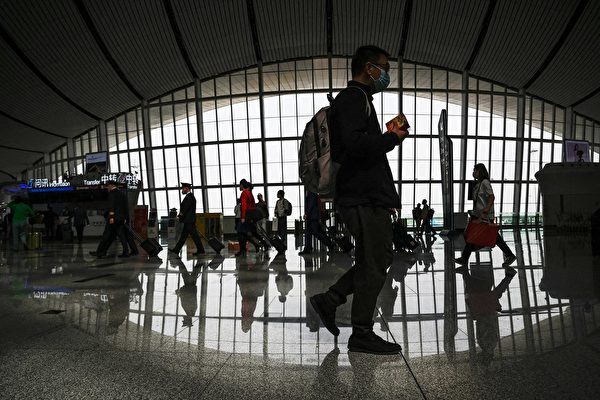
Passengers at Beijing Daxing International Airport on April 28, 2023. (Jade Gao/AFP via Getty Images)
[People News] On September 15, the upcoming 'Regulations on Exit and Entry Management' from the State Council has ignited extensive discussions both at home and abroad regarding the tightening of exit regulations and the increasing difficulty for ordinary citizens to travel abroad. Just five days before the regulations take effect, officials from the Ministry of Justice, the Ministry of Public Security, and the National Immigration Administration responded to reporters' inquiries, along with statements from the Cyberspace Administration, clearly denying that the supposed 'tightening of exit regulations' and 'closure of the country' are misinterpretations.
The official explanation indicates that the new regulations are aimed at high-risk activities such as illegal exits, cross-border gambling fraud, and unauthorized technology transfers, while normal activities like tourism, visiting family, studying abroad, and business will remain unaffected. The Ministry of Public Security, a key department responsible for exit and entry management under the Communist Party of China, is perceived by the public as attempting to sanitize the CCP's oppressive governance. However, an analysis of the new regulations, official statements, recent real-life cases at border entry points, and the systematic logic of a series of coherent policies during Xi Jinping's administration reveals that the official denial itself highlights a disconnect between the policymakers' true intentions and their public statements, further illustrating the CCP authorities' clumsy manipulation of the situation, akin to 'not having silver here.'
The State Council Order No. 841 comprises 19 articles, primarily aimed at enhancing the authenticity review of reasons for entry and exit. It specifies that immigration management agencies have the authority to inquire about circumstances and request documents, materials, and electronic data. In cases of false materials or statements, they may refuse to issue documents or permit exit. The order also clarifies the conditions under which exit is prohibited, including obtaining documents through deception, imposing restrictions within a certain timeframe after illegal exit, and actions abroad that threaten national security interests or violate export controls that could jeopardize industrial and technological security. Additionally, it allows for warnings and discouragements regarding high-risk destinations and regulates the filing of intermediaries.
Officials have repeatedly stressed that this is not intended to restrict normal exit but to prevent risks and maintain order.
However, the issue lies in the inherent ambiguities and unclear boundaries within these official statements, which create a noticeable disconnect with the actual implications. The new regulations grant the authority to verify 'electronic data', impose requirements for authenticity reviews, and expand the circumstances under which exit is prohibited. This objectively bestows extraordinary discretionary power upon border inspection and approval agencies, effectively leading to a disguised expansion of their authority.
Particularly in the context of generalized concepts such as export control, technological security, and national security, the definitions of 'potential harm' and 'abnormal travel' remain ambiguous. While officials deny a 'comprehensive tightening,' they sidestep the fact that the new regulations inherently increase enforcement at the institutional level and signal a tightening of policies. This contradictory approach of 'seeking to strengthen control while denying any tightening' reflects the Communist Party of China's consistent political logic, which involves regressive isolationist practices while firmly denying and evading responsibility in its narrative. In a contemporary world where openness and civilization are widely seen as pathways to development, openly acknowledging a tightening of national borders is neither commendable nor a sign of strength and prosperity; instead, it is likely to be interpreted as a passive contraction in response to economic pressures and a notable leftward political shift.
Around September 13, a document labeled 'Confidential ☆ 5-Year Special' began circulating on platforms like X. Titled 'Public Entry and Exit (2026) No. 831 Notice on Further Standardizing and Strengthening the Collection and Verification of Entry and Exit Personnel Information,' this document was issued by the Exit and Entry Administration of the People's Republic of China. It mandates that all entry and exit personnel information 'should be fully collected and recorded.' The document is highly detailed, covering various aspects: personal information and social identity, including political affiliation, job title, educational history, health records, biometric data, and military service; outbound travel plans and guarantees, which include details about hotels, travel companions, approval authorities, cash, electronic device serial numbers, and insurance; family and overseas connections, detailing information about spouses, parents, and children, as well as overseas relatives and their identities, along with past exit stay records; online accounts and digital activities, encompassing platforms such as WeChat, QQ, Telegram, WhatsApp, Weibo, Douyin, Xiaohongshu, Facebook, Instagram, X LinkedIn, YouTube, as well as browsers, email accounts, cloud storage, AI platforms, VPNs, and frequently accessed overseas websites; financial assets, including real estate, vehicles, stocks, funds, digital assets, equity, bank accounts, loans, and debts; and confidentiality and compliance records, which cover confidentiality levels, leaks, criminal records, administrative penalties, and restrictions on high consumption.
This document is currently unverified through official channels. Neither the official website of the National Immigration Administration nor the Chinese government website lists any corresponding document numbers or notifications with the same title. Its overly simplistic writing style does not conform to the bureaucratic narrative typical of official CCP documents, raising doubts about its authenticity and suggesting it may have been fabricated or altered by internet users. However, its rapid spread and resonance with the public can be attributed not just to its content, but to the underlying logic it conveys. It offers a comprehensive portrayal and information verification of outbound individuals, which aligns closely with public observations of the CCP's current policy trends. Even if the document itself is not an authentic red-headed document, the control model it describes—akin to 'checking the ancestry of eighteen generations'—reflects a reasonable prediction of public sentiment regarding future directions. This suggests a shift from limited verification to more comprehensive information collection, from individual case reviews to systematic risk identification and prevention, and from verbal openness to a substantial tightening of external circulation links.
Such speculation is not without basis. Recently, numerous real cases of strict checks on outbound Chinese citizens have been shared on social media and within overseas Chinese communities. On flights from Guangzhou, Shanghai, and other locations to the United States, passengers have reported that nearly 1 in 13, or even higher proportions, were stopped for further checks. Additionally, some travelers heading to Schengen countries were forcibly required to purchase return tickets due to not having them. Inquiries regarding the reasonableness of travel itineraries, sources of funds, and overseas contacts have significantly increased at ports such as Shanghai Pudong Airport.
Even those who were once beneficiaries of the system are not exempt. An account on platform X, 'Shen Tong', disclosed: 'The chief physician at Shanghai Shuguang Hospital, who is also the chairman of an international committee and a high-level talent, obtained a U.S. green card through the outstanding talent pathway. While he was packing his bags in Shanghai, national security officials approached him to inquire about the questions he was asked during his immigration interview with the Americans, and whether he had disclosed any national medical secrets. The chief physician, who has treated State Council members and has been accustomed to being in demand for decades, reacted arrogantly and dismissed the national security officials. He thought to himself, why should I fear legal immigration? Border control!'
Although these cases are not statistically representative, they clearly indicate that even before the new regulations are implemented, enforcement measures have already begun to intensify on a case-by-case basis. Border inspections are no longer limited to 'checking documents'; they increasingly involve identity verification and motive assessments, as well as 'checking attitudes' and 'observing performance'. The authority of the enforcement personnel is beyond what one might imagine.
When these phenomena are examined within the context of the policy framework of the Xi Jinping era, the underlying logic becomes much clearer. There is a noticeable tightening of controls over capital outflows, stricter foreign exchange approval processes, increased scrutiny of personal foreign exchange purchase limits and their intended uses, and enhanced monitoring of cross-border capital flows. Additionally, the government is accelerating its overseas taxation efforts, which now include comprehensive regulation and taxation of offshore assets, trusts, and insurance benefits. The approval process for the exit of government officials, state-owned enterprise employees, and individuals in sensitive positions has always been stringent, and in recent years, it has tightened further, becoming the norm. Export controls and technology security reviews are now directly linked to national security and political red lines concerning the movement of sensitive technology personnel. When these measures are brought to light, it becomes evident that this represents a significant upgrade in strategy; previously, the approach was scattered and inconsistent, but it has now evolved into an integrated and systematic framework. This reflects different facets of the same policy package aimed at preventing the outflow of capital, talent, technology, and sensitive personnel, effectively locking down access, restricting liquidity, safeguarding the Communist Party's regime, and mitigating the risk of a potential economic collapse.
Xi Jinping's policy of closing the country is not a sudden event like the fall of the Berlin Wall, but rather a gradual process reminiscent of boiling a frog in warm water. It begins with discouraging travel to high-risk destinations, progresses to scrutinizing unusual travel itineraries, expands electronic data permissions, and may ultimately lead to more extensive information collection and pre-approval processes. Each of these steps can be framed as 'preventing risks', 'protecting citizens', 'maintaining order', and 'governing according to the law', effectively denying any notion of a 'comprehensive tightening'. By the time ordinary citizens genuinely perceive that the barriers to traveling abroad have significantly increased, the situation will have already changed, the system will have solidified, and the opportunity for reversal will have diminished. This approach, which presents one narrative while concealing another, is characteristic of the Chinese Communist Party's typical underhanded tactics on sensitive issues, where there is a stark contrast between what is said and what is done. Official documents may appear grandiose, but they manipulate complex layers of procedures to achieve the actual effect of 'closing the country', while simultaneously projecting an image of 'open confidence'.
It is not unexpected that the system led by Wang Xiaohong of the Ministry of Public Security is stepping in to defend Xi Jinping. The origins of this policy stem from Xi Jinping's top-level design, encapsulated in the so-called overall national security concept, with the highest authorities defining the tightening measures. Various departments are tasked with implementing these policies and interpreting their powers, and if any backlash arises, these departments are responsible for 'clarifying misunderstandings', while the supreme leader maintains a detached, observer-like stance. This exemplifies a classic structure of political scapegoating. The more officials hastily deny the notion of 'closing the country', the more it reveals their awareness of what this label signifies in the context of contemporary global trends, which is at odds with openness, civilization, and the rule of law, and contradicts the trajectory of human development. It can also easily be interpreted by external observers as a strategic signal of economic decline and a political shift to the left.
Is this what Xi Jinping describes as a powerful display and the rise of the East while the West declines? Far from it; this reflects a genuine manifestation of a regime's anxiety overshadowing all else, a doomsday mindset deeply entrenched in security fears, and a self-destructive ecological crisis.
(Originally published by the People News) △




News magazine bootstrap themes!
I like this themes, fast loading and look profesional
Thank you Carlos!
You're welcome!
Please support me with give positive rating!
Yes Sure!